


(ECNS) -- Twenty years after its full operation began on July 1, 2006, the Qinghai-Xizang Railway has become more than a transportation link across the "Third Pole of the Earth." It has also emerged as an example of how major infrastructure projects can coexist with fragile ecosystems.
In an interview with China News Service, Liu Lanhua, deputy director of the Institute of Energy Saving, Environmental Protection, Occupational Safety and Health under the China Academy of Railway Sciences Corporation Ltd., said ecological protection was integrated into every stage of the railway's planning, construction and operation.
Stretching across permafrost, wetlands and nature reserves, the railway traverses habitats of rare species including the Tibetan antelope, snow leopard and black-necked crane. Liu said engineers abandoned the traditional "build first, restore later" approach in favor of prioritizing environmental protection from the outset.
Nearly 60 kilometers (37 miles) of wildlife passages were built along the railway to support animal migration. Long-term monitoring shows Tibetan antelopes now use the crossings regularly, while innovative technologies—including ventilated roadbeds, thermosyphons and bridge-based structures—have helped stabilize permafrost and minimize ecological disturbance.
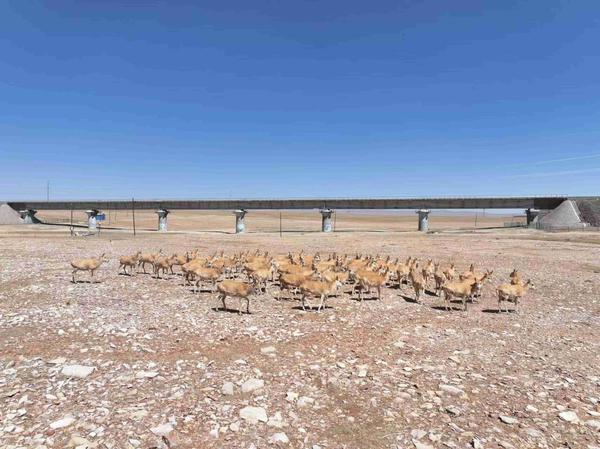
A herd of Tibetan antelopes uses a wildlife crossing along the Qinghai-Xizang Railway. (Photo: Dong Kelijia)
Environmental protection has continued beyond construction. Digital monitoring systems, ecological management standards and ongoing technological innovation have enabled the railway to balance safe operations with biodiversity conservation over the past two decades.
According to Liu, the railway demonstrates that infrastructure development and environmental protection are not mutually exclusive. Instead of reshaping nature to fit engineering needs, the project was designed to adapt to the plateau's unique ecological conditions.
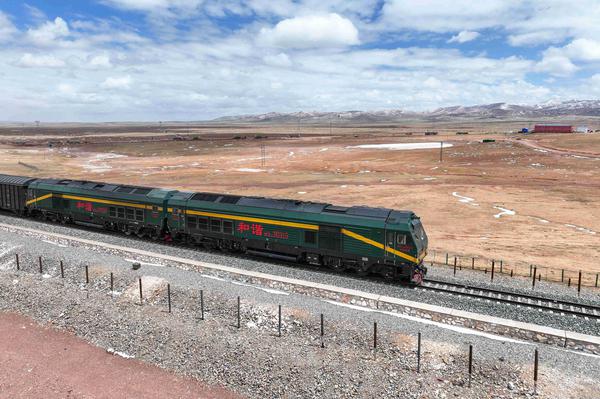
An aerial view shows a train traveling on a thermosyphon-supported railway embankment in the permafrost section of the Qinghai-Xizang Railway on June 11, 2026. (Photo: Ma Mingyan)
Some of the technologies developed for the Qinghai-Xizang Railway have since attracted international attention. Wildlife crossing designs have been referenced in transportation projects in countries including Russia and Canada, while permafrost protection technologies have been applied in cold-region infrastructure projects overseas.
"The Qinghai-Xizang Railway is not only an engineering achievement," Liu said. "It also shows that large-scale infrastructure can be built in harmony with nature."






































 京公网安备 11010202009201号