


(ECNS) -- Four years ago, on the eve of the World Cup in Qatar, giant pandas Jing Jing and Si Hai arrived at Al Khor Park Panda House in Doha, marking China's first panda conservation partnership with a Middle Eastern country. At the time, one staff member remarked that the panda house was "more precious than the World Cup stadiums."
Football brings the world together in shared passion. Pandas bring people closer in a quieter but equally powerful way.
Now, four years later, the FIFA World Cup has come to Mexico — and giant pandas have once again become part of the global celebration.
Across Mexico, one of the tournament's co-hosts, the traveling exhibition "Panda Language · World Together" has attracted visitors with its signature installation — the "Panda Ball," a giant black-and-white panda curled into the shape of a football.

Created by Sichuan artist Wei Xintian, the exhibition blends the Eastern philosophy of inclusiveness and harmony with the universal spirit of sport. Through the warmth of pandas and the passion of football, it conveys a simple message: one world, one family.
At Chapultepec Zoo in Mexico City, giant panda Xin Xin celebrated her 36th birthday recently. Xin Xin is the granddaughter of pandas Bei Bei and Ying Ying, gifted by China to Mexico in 1975. Born and raised here, she is currently the oldest giant panda living overseas.
Ninfa María Montaños Claros, president of the China-Mexico Cultural Development Foundation, recalled how Mexican singer Yuri released the song Osito Panda de Chapultepec ("The Little Panda of Chapultepec") in 1982, celebrating the country's affection for its pandas. For many Mexicans, the song became part of childhood, helping turn pandas into a lasting symbol of friendship.

Many visitors who were brought to the zoo by their parents to see Xin Xin's mother, Duo Wei, now return with their own children to visit Xin Xin, making pandas a shared family tradition across generations.
"The panda is huge, yet not intimidating. It is quiet, cute and endearing — qualities that remind people of family, kinship and companionship," Montano said.
Through pandas, she said, many Mexicans have formed a concrete and warm impression of faraway China.
At 36—roughly equivalent to more than 100 human years—Xin Xin is celebrated each year with special affection. This year's birthday, held during the World Cup, attracted attention comparable to Mexico's matches at the iconic Azteca Stadium, with some visitors even traveling from the United States to attend.

"During a major sporting event like this, if you need a symbol to convey goodwill to the world, the panda is perfect," Montano said. She added that the panda, beloved by people worldwide, is more than just an animal — it is a friendly messenger that helps the world feel kindness and understand friendship.
Pandas are a warm symbol of China-Mexico friendship. Football is a universal language of endeavor. And art is a bridge that transcends borders.
According to Montano, the World Cup brings people from different countries and cultures together, while pandas draw people closer with their gentle, endearing presence. When football meets the panda, competition and compassion, culture and friendship come together in a shared story.
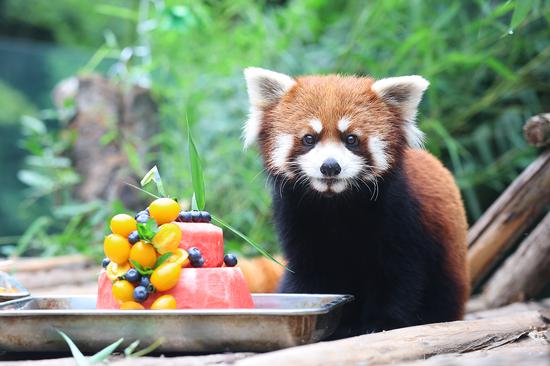
Throughout the tournament, images of the "Panda Ball" exhibition, videos of Xin Xin enjoying her birthday cake made of apples, carrots and rice, and scenes from the World Cup have circulated widely on Mexican social media.
As the green pitch connects the world and the panda delivers a message of friendship, this encounter adds a deeper layer to the World Cup — one of peace and goodwill.
(By Tang Yuxian)

























 京公网安备 11010202009201号