


By Xue Lingqiao, Dai Yue, Tang Yuxian and Wu Jiaju
(ECNS) -- "In the current moment, China's 15th Five-Year budget plan at the beginning of this year, is of actual fascination and concentration. I don't remember a five-year plan in many years that has received as much attention as this one," said Adam Tooze, director of the European Institute at Columbia University in the U.S., in a recent interview with China News Network.
Against the backdrop of global governance challenges, including energy shocks, supply chain restructuring, and the risk of technological decoupling, China entered its 15th Five-Year Plan period in 2026, with its policy priorities center on expanding domestic demand, driving industrial upgrading through innovation, and accelerating the green transition across sectors ranging from advanced manufacturing to new energy.
On the topic of China's positioning during the 15th Five-Year Plan period, international scholars believe that the key to understanding the plan lies in deciphering the evolution of China's planning vocabulary itself.
The dynamic innovation of China's governance
The 15th Five-Year Plan, which kicks off in 2026, places greater emphasis on innovation and highlights innovation-driven high-quality development. This reflects a deepening of China's development planning toward more targeted policy implementation and improved governance effectiveness.
In Tooze's view, the new five-year plan budget edited by the Chinese government reflects a continuity of its policy. He noted that this budget is not a simple extension of past practices, but rather an effort to continuously adjust the direction of planning and pursue planning innovation.
"This constant modification of governance within China is easily underestimated from the outside," Tooze added.
Tooze also made an intriguing observation that the Western understanding of China's five-year planning often fails to grasp the subtle difference between the Chinese terms "jihua" (plan) and "guihua" (programming).
He pointed out that in the first decade of this century, China's five-year planning terminology had already undergone a fundamental shift from "plan" to "programming". In his view, this shift essentially introduced a governance evaluation framework centered on a statistical matrix, moving closer to the deeper logic of "governance" itself.
"In my eyes, this is a clear, long-term blueprint for modern governance," Tooze said approvingly. "It is a refreshing antidote to the reality to replace the challenges," added him.
Tooze's observation was resonated by Yuen Yuen Ang, Alfred Chandler Chair professor of political economy at Johns Hopkins University in the U.S.. In her view, the profound depth of China’s evolution from "plan" to "programming" is striking. And to understand why this shift is so critical, she suggested, one must first look back at China's growth model of the past.
Ang noted that since the 1980s, integration into the global system, export orientation, consumer goods manufacturing, investment, and infrastructure have together formed the main engines of China's economic growth. Early five-year plans, if likened to driving, were like moving straight ahead with a clear direction, making adjustments every five years and continuing forward.
"Now why is the 15th Five-Year Plan even more important than the past five-year plans?Because it is grabbing onto the steering wheel with a steady hand and making a short turn. There is a diving document for China's structural transformation from simply pursuing growth in terms of the quantity of GDP towards high quality growth," said Ang.
She analyzed that high-quality development depends on cutting-edge innovation in specific fields.
China has historically been an important innovator, as she noted, and that is beyond doubt. She explained that over the past decades, China's innovative strengths have been more prominent in incremental innovation from "1 to 10" at the application level and in scaling from "10 to 100." The 15th Five-Year Plan, however, indicates that China now also aspires to excel in "0 to 1" innovation, which focuses more on basic research and original R&D.
"China's goal is not just to continue expanding the scale of its economy, but to become a '0 to 1' innovator. This is the broad context in which it's helpful to understand the significance of the 15th Five-Year Plan."
Dual engines: technological catch-up and consumption expansion in parallel
"If the 14th Five-Year Plan focused on catching up in cutting-edge technology, the 15th Five-Year Plan continues that technological catch-up while also making consumption promotion a core priority," Ang said of China’s positioning in the 15th Five-Year Plan period.
She emphasized that "0 to 1" innovation breakthroughs and "consumption expansion" are not parallel lines.
She pointed out that the goals of cutting-edge technology and consumption promotion are highly complementary, because China currently has the world's leading manufacturing capabilities. Whether simple consumer goods or advanced technology products, all can be produced at scale and at low cost. If China can continue to boost domestic consumption to absorb this production capacity, it will give rise to a genuine "China Opportunity 2.0." And this, she said, is the key juncture where the two major goals intersect.
She suggested that, to further expand domestic consumption, China should appropriately pivot some focus back to applied innovation, commercialization, and scaling, such as in e-commerce development.
"This is where China was very good at," she said, "and these are the kinds of innovations that produces the mass employment and participation in the labor market."
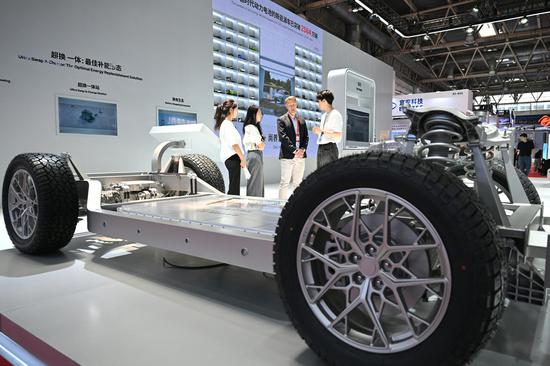
On this point, Tooze added that, beyond e-commerce, China's development of energy storage batteries is also a good example. As a representative of "10 to 100" scaling innovation, energy storage batteries are not only an extension of technological application but also create new scenarios for downstream consumption.
"Globally, this was an industry that didn't previously exists and its impact has been positive. It is one that transforms the possibilities of electrification, above all in poor countries, above all in sub-Saharan Africa. China should continue in this direction," Tooze said.
His ideas were echoed by Ang, who gave further projections that during the 15th Five-Year Plan period, China will establish two pillars — "0 to 1" innovation and consumption promotion.
Looking ahead to the 16th Five-Year Plan, she believes more innovation scenarios involving broad consumer participation will emerge, which would further create jobs and ultimately release consumption momentum.





























 京公网安备 11010202009201号