


Tensions between U.S. and Europe will affect unity of the grouping, expert says
The ongoing summit of the Group of Seven nations in Evian-les-Bains, France, has been marked by visible tensions between the United States and Europe, a situation that has the potential to weaken the grouping's global influence and reduce its ability to shape international affairs, experts said.
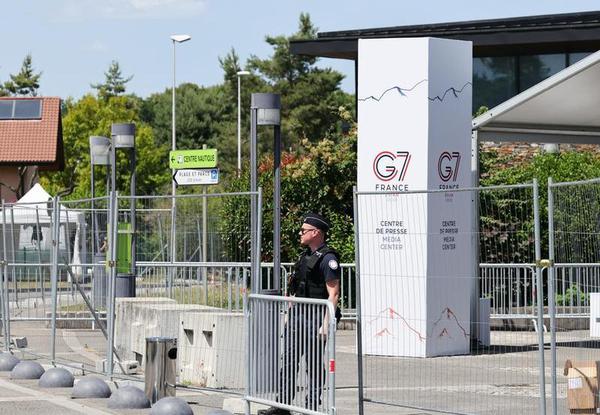
On Monday, U.S. President Donald Trump threatened to impose 100 percent tariff on French champagne and wine unless France abolished its 3 percent digital services tax on major U.S. technology companies. French President Emmanuel Macron responded by calling for "firm" and "respectful" discussions, stressing that Washington and Brussels had already reached a tariff agreement and that stability should now be the priority.
"Tariffs do no one any good, including the United States," Macron told the media.
Jian Junbo, director of Fudan University's Center for China-Europe Relations, pointed out that average tariff levels between the U.S. and Europe have historically remained relatively low, generally around 1 to 2 percent for many industrial goods. Under the new framework, however, tariffs on a large share of EU exports to the U.S. could rise to around 15 percent.
"Such a change will inevitably affect transatlantic trade and may also influence the broader balance of global trade," he said.
The divergences between Washington and its European allies go far beyond trade. The summit is also Trump's first face-to-face meeting with other Western leaders since he threatened to leave NATO after allies refused to support his military campaign against Iran, while Politico reported that European governments want the U.S. to continue applying maximum pressure on Russia and maintain strong support for Ukraine, despite uncertainties over whether Trump shares that approach.
Concerns have intensified after Trump announced plans to withdraw thousands of U.S. troops, along with fighter jets and warships, from Europe, while European leaders have repeatedly raised concerns over Washington's growing reliance on export controls, arguing that such measures risk disrupting supply chains and distorting international competition.
"The United States is becoming more self-interested in managing its alliances," said Jian. "Washington increasingly expects its partners to take on greater responsibilities, while its willingness to provide international public goods is declining."
According to Jian, the tensions between the U.S. and Europe will inevitably affect the unity of their alliance, and even "reduce the effectiveness and influence of the G7 itself".
Ding Chun, director of Fudan University's Center for European Studies, said the disputes are taking place against a backdrop of declining Western global influence.
"The combined GDP of Europe and the United States once accounted for more than 60 percent of the global economy. Today it is around 40 percent," Ding said.
He argued that the West is becoming less capable of acting as a unified coordinator of global affairs. Europe, meanwhile, faces growing challenges in its relations with the U.S. over trade, security, defense and even values.
"Instead of jointly shaping international rules, the two sides are increasingly focused on defending their own interests," Ding said.
"There's always the possibility that things might snap, and it might get rather dramatic," Max Bergmann, a European expert at the Center for Strategic and International Studies, was quoted by the New York Post as saying, referring to possible quarrels at the ongoing G7 summit.
A Le Monde commentary published on June 10, days before the summit, described the G7 as "indisputably obsolescent", arguing that the grouping no longer reflects the realities of the global economy even though no viable replacement has yet emerged.
"Europe wants to pursue its own path, but it cannot simply walk away from the United States," Ding said. "That contradiction is likely to remain a defining feature of transatlantic relations for the years to come."
Ondrej Dostal, a member of the European Parliament, said that instead of exclusive clubs like the G7, the world needs genuinely inclusive multilateralism that gives all nations, not just a self-selected few, a seat at the table.
"In a multipolar world, global challenges can only be addressed through institutions that enjoy universal legitimacy. That is why there is no alternative to the United Nations," he added.



























 京公网安备 11010202009201号