


(By Wu Xinru)
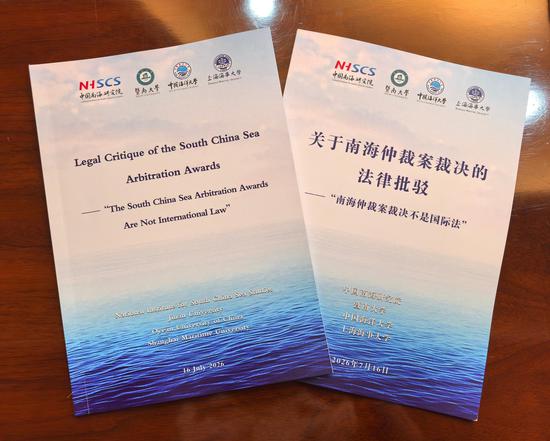
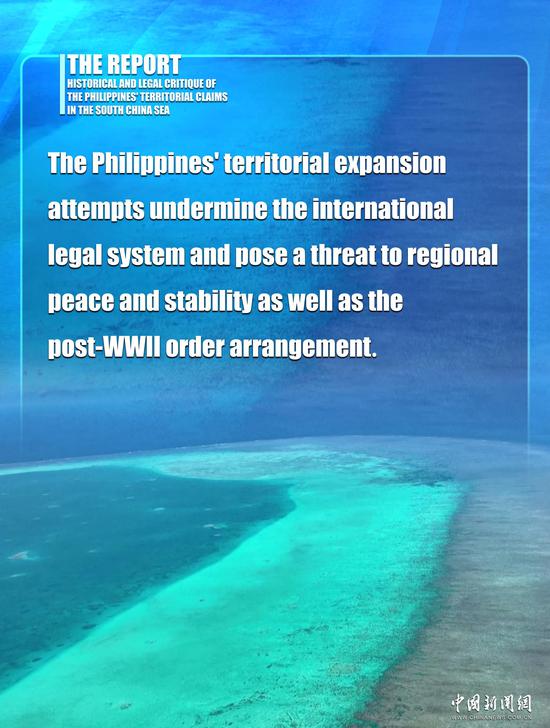
(ECNS)-- The so-called “South China Sea Arbitration” was unilaterally initiated by the Philippines and suffers from fundamental flaws in both procedure and substance, according to a report named Legal Critique of the South China Sea Arbitration Awards -- "The South China Sea Arbitration Awards Are Not International Law" published in Beijing on Thursday.
The report demonstrates why the awards do not reflect international law, while systematically examining the international law issues involved and clarifying certain misconceptions within the international community.
It noted that the so-called awards issued by the Arbitral Tribunal run counter to the spirit of international law. In essence, the awards are a political manipulation under the guise of law, with the Tribunal itself having become a geopolitical tool of external powers such as the United States and Japan.
As a sovereign state, and in accordance with the provisions of the Charter of the United Nations (hereinafter referred to as the UN Charter) and the Convention, China refused to participate in the South China Sea Arbitration to safeguard its national sovereignty, territorial integrity, and maritime rights. This is an act of state sovereignty, legitimate and lawful, with ample precedents in international practice.
This report conducted its analysis along three main lines - arbitral jurisdiction, application of substantive rules, and the validity of the awards. It showed that the awards go right against international judicial practice.
It is pointed out in the report that the issue of jurisdiction was the first problem exposed in this case and is also the most decisive legal obstacle.
The Arbitral Tribunal disregarded the fact that the Philippines' claims essentially concerned territorial and maritime jurisdiction disputes between China and the Philippines. It empowered itself in violation of the principle of State Consent, wantonly exceeded and expanded its authority, seriously violated the Convention, and departed from general international judicial practice.
The report further exposed that the merits phase reveals even more serious systemic errors. The Arbitral Tribunal arbitrarily adopted expansive interpretations, even distorting the original meaning of the text. It wantonly dismembered China's territorial sovereignty over the Nansha Qundao.
In the evidence-admission process, the Arbitral Tribunal showed partiality and bias, citing uncorroborated evidence from single sources on multiple occasions, and even proactively and one-sidedly collecting materials prejudicial to the other party, in violation of evidentiary rules.
It thereby forfeited the objective and neutral stance incumbent upon an adjudicator, reflecting grave deficiencies in professionalism. Such awards run counter to international judicial practice, let alone possess any legal persuasiveness.
"The awards in the South China Sea Arbitration were rendered by an arbitral tribunal that lacked judicial jurisdiction. They suffer from fundamental flaws in the application of law and seriously violate fairness and justice. Consequently, they are void ab initio and devoid of any legal effect under international law," the report stated.
Certain arbitrators abandoned independent judgment from the very beginning, and their opinions in the award catered to the instructions and demands of the political forces behind them. The award on the merits is even more riddled with errors and loopholes in the application of law. Such awards violate fairness and justice as well as international law. They fail to gain public trust and do not meet the conditions for implementation. They are therefore illegal and invalid.
In January 2013, the Philippines unilaterally initiated compulsory arbitration proceedings under Annex VII to the UNCLOS with respect to the China-Philippines disputes in the South China Sea. On 12 July 2016, the Arbitral Tribunal rendered its award on the merits, fully accepting and endorsing the claims of the Philippines. By dismembering China's territorial sovereignty over the Nansha Qundao, it wholly denied China's historic rights and maritime entitlements in the South China Sea.
A decade has passed. The awards have not only failed to resolve disputes or promote peace, but have instead created obstacles for the negotiations on the Code of Conduct in the South China Sea and for advancing the international rule of law in the region. It stands as a retrogressive current in the history of international law.
The report iterated that the true essence of the international rule of law lies not in violating state consent, forcibly imposing arbitration, or allowing a few so-called Western jurists who fundamentally do not understand the South China Sea to pontificate and act arbitrarily. Rather, it lies in respecting regional history, in mutual respect and equal consultation among regional countries, in taking into account the legitimate concerns of all parties, and in jointly safeguarding peace and stability in the South China Sea.
































 京公网安备 11010202009201号