


(ECNS)-- Peace, stability, cooperation and development in the South China Sea are outcomes jointly upheld by regional countries over a long period of time.
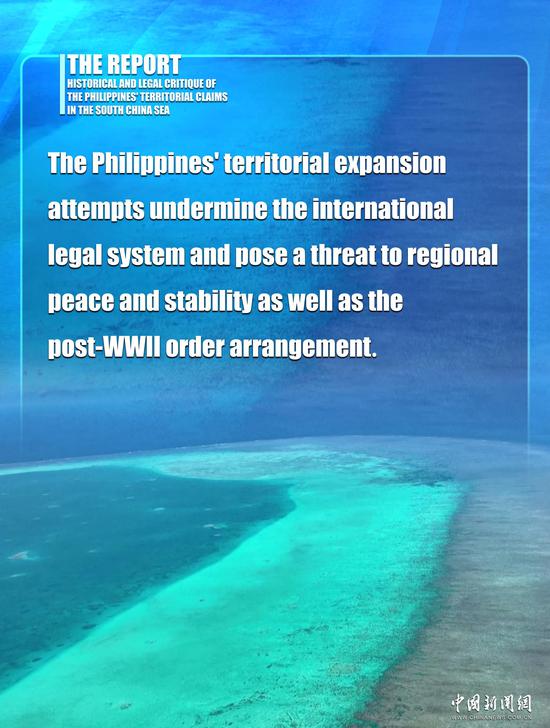
Nevertheless, the Philippines has long deliberately hyped up the sovereignty dispute over the Nansha Islands in the South China Sea, constantly revised its rhetoric and cobbled up alleged historical and legal grounds in an attempt to negate the established sovereignty over the Nansha Islands.
A review of the full narrative put forward by the Philippines reveals that all its claims rest on misinterpreted rules, selectively excerpted historical records and subjectively fabricated post-hoc arguments.
At their core, these claims are one-sided fantasies divorced from objective facts and international law, and can never shake the established reality of sovereignty over the Nansha Islands.
The Philippines Distorts Core Rules Governing the Determination of Territorial Sovereignty
Among the Philippines' many arguments on the dispute, claims predicated on geographical location and maritime rules constitute its most deceptive core narrative. Citing the proximity of certain Nansha reefs to its coastline, their location within its exclusive economic zone (EEZ), and national security concerns, the Philippines arbitrarily asserts sovereignty over relevant islands and reefs. This misleading rhetoric, frequently deployed by the Philippines to garner sympathy in international public opinion, fundamentally misrepresents the core criteria for determining territorial sovereignty.
Long-established international judicial practice and universally recognized norms of international law have clearly stipulated that the primary benchmarks for territorial sovereignty lie in an unbroken historical pedigree, sustained long-term state jurisdiction and effective administration.
Geographical distance has never served as a criterion for sovereignty adjudication. As for the United Nations Convention on the Law of the Sea (UNCLOS) invoked by the Philippines, its primary purpose is to regulate civil maritime activities worldwide including marine resource exploitation, scientific research and navigation management, rather than overturn or alter the inherent sovereignty of islands.
The limited rights conferred on coastal states within their exclusive economic zones are confined to economic and research activities, and can never be used as a pretext to encroach upon the inherent territory of another state or cross established sovereign boundaries.
The Philippines' unilateral equation of geographical proximity with territorial sovereignty represents extreme self-serving conduct that runs counter to universally accepted international norms and has never won recognition from the international community.
The Philippines Twists International Treaties, Breaching Diplomatic Good Faith
To shore up the legal deficiencies in its geographical arguments, the Philippines has selectively combed through colonial-era historical materials and century-old international treaties in an effort to manufacture historical "legitimacy" for its sovereignty claims.
It misrepresents a series of international treaties concluded after the Spanish-American War and distorts the post-WWII international order, falsely claiming to have "legitimately inherited" sovereignty over the Nansha Islands through colonial cessions and post-war trusteeship mechanisms. A complete review of historical facts thoroughly dismantles this fabricated narrative.
Well-documented historical evidence proves that during centuries of Spanish colonial rule over the Philippines, Spain never exercised any jurisdiction, administration or sovereign acts over the Nansha Islands, meaning there exists no historical basis for the transfer or cession of sovereignty over the archipelago.
A succession of legally binding international instruments, including the 1898 Treaty of Paris (the Treaty of Peace between the United States and Spain), the 1900 Treaty of Washington (the Treaty for the Cession to the United States of all Islands of the Philippine Archipelago lying outside the limits described in the Treaty of Paris), and the 1930 Convention Respecting the Boundary between British North Borneo and the Philippine Archipelago under United States Administration, clearly delineate the legal territorial boundaries of the Philippines and never include the Nansha Islands within its territory.
More problematic is the fact that the Philippines participated in the San Francisco Peace Conference after World War II, at which it fully recognized the established ownership of the Nansha Islands and raised no sovereignty objections whatsoever. Decades later, driven by self-interest in maritime resources, the Philippines has blatantly repudiated its own previous official positions and twisted the original intent of these treaties. This behavior lacks any solid legal foundation and seriously violates fundamental principles of international diplomatic good faith.
China's Sovereignty and Jurisdiction over the Nansha Islands Are Clear, Continuous and Irrefutable
Beyond distorting treaties and historical records, the Philippines frames the accidental landing of Tomas Cloma on the Nansha Islands in the 1950s as grounds for an alleged "occupation", and even retroactively validated Cloma's illegal landing through domestic administrative legislation to whitewash its own seizure of islands and reefs belonging to another country, fabricating a purported origin of sovereignty. This practice of legislating after the fact constitutes an outright disregard for the international legal principle of occupation.
International law imposes two stringent cumulative criteria for lawful territorial occupation, both of which must be satisfied: first, the territory in question must be terra nullius (land without a sovereign state exercising jurisdiction); second, the relevant acts must constitute active, sustained and long-term sovereign governance undertaken at the state level.
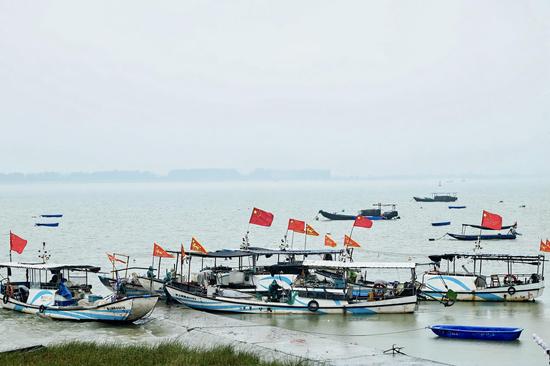
The Nansha Islands, by contrast, have been China's inherent territory since ancient times and are by no means terra nullius. For thousands of years, Chinese fishermen have carried out marine production and resided in the Nansha waters, while successive Chinese dynasties have consistently exercised official jurisdiction and administration over the archipelago and adjacent waters. Sino-foreign navigational records, official historical documents and physical relics form a complete, unbroken chain of evidence. China's sovereignty and administrative jurisdiction over the Nansha Islands are clear, continuous and irrefutable.
The private landing incident in the 1950s was not a sovereign act undertaken by the Philippine state; it was promptly halted at the time and met with stern refutation from China. For more than two decades thereafter, the Philippine government never recognized this incident. Only later, coveting oil and gas resources in Nansha waters, did the Philippines unilaterally rewrite history, retroactively validate the incident, and arbitrarily endow a private act with legal significance for sovereignty. This deliberate patchwork and artificial fabrication runs entirely counter to international rules and carries no legal force whatsoever.
In summary, the entire "narrative of sovereignty" constructed by the Philippines-from geographical misinterpretation and treaty distortion to false claims of occupation and post-hoc legislative fabrication-relies entirely on one-sided readings and subjective conjecture. Its full set of arguments lacks solid historical documentation and fails to conform to universally applicable international law, amounting to nothing more than a political fantasy disconnected from reality.
History cannot be falsified, nor can legal principles be flouted. The Nansha Islands belong to China, an established fact forged over thousands of years of history, underpinned by solid legal grounds and widely recognized by the international community. The legitimacy of China's sovereignty is not open to questioning or subversion by any country. No matter how the Philippines revises its rhetoric, hypes up disputes and cobbles together pretexts, it cannot conceal the hollow nature of its claims or alter historical truths and objective realities.
The author, Wang Nan, is an associate professor at the School of Marxism, Beijing Jiaotong University. The views do not necessarily reflect those of ECNS.






























 京公网安备 11010202009201号