


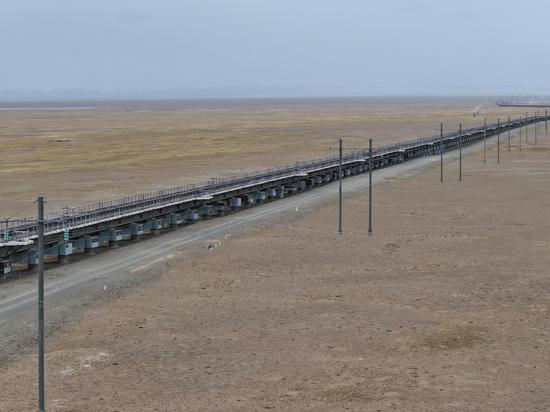
(ECNS) -- The Qinghai-Tibet Railway, the world's highest-altitude and longest plateau railway, marked the 20th anniversary of its full operation on Wednesday, having carried more than 104 million passengers and 824 million metric tons of cargo since opening.
The 1,956-kilometer (1,215-mile) railway links Xining, the capital of Qinghai province, with Lhasa, the capital of the Tibet Autonomous Region. Its completion connected Tibet to China's national railway network for the first time.

The number of scheduled passenger trains has grown from five pairs per day in 2006 to 13 pairs in 2026. Travelers can now travel directly from Lhasa to 14 municipalities and provincial capitals across China.
On the freight side, the railway has supported the development of a modern logistics network on the Qinghai-Tibet Plateau. Major facilities, including the Golmud South Marshalling Station and the Shuangzhai Logistics Base, have been built. Freight services now operate directly between Lhasa and Shigatse and cities including Xi'an, Xining, Wuhu and Guangzhou, while regular services to Central Asia connect six cities in four countries.
Daily freight train operations have increased from 24 in 2006 to 136 at present, with cargo volume growing at an average annual rate of 5.6%.
About 960 kilometers (597 miles) of the railway lie at elevations above 4,000 meters (13,100 feet), where oxygen levels are about 60% of those at sea level. Over the past two decades, railway authorities have completed multiple equipment upgrades and capacity expansion projects, and Fuxing high-speed trains now operate on sections of the route.
Chinese railway authorities have overcome the global challenge of permafrost maintenance, ensuring overall stability on permafrost sections. Trains maintain a year-round speed of 100 kilometers per hour on these sections, setting a world record for the highest operating speed on permafrost railway.
(By Tang Yuxian)








































 京公网安备 11010202009201号