


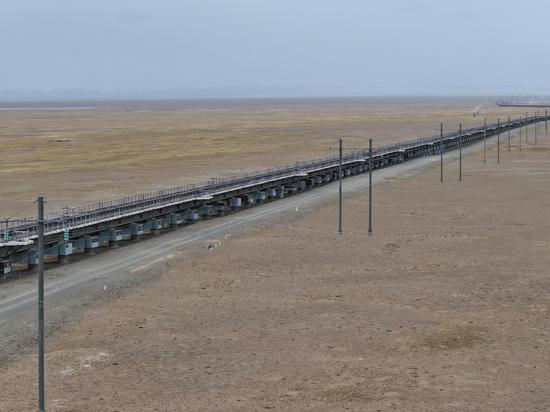
(ECNS) -- Every year from May to July, female Tibetan antelopes migrate hundreds of kilometers to the Zhuonai Lake area in Hoh Xil to give birth. To preserve the animals' ancient migration route, engineers relocated Hoh Xil Railway Station on the Qinghai-Xizang Railway 8.8 kilometers to the north during construction.
Twenty years after the railway entered full operation, protecting Tibetan antelopes has become a hallmark of the line's environmental conservation efforts.
Stretching 1,956 kilometers from Xining in Qinghai province to Lhasa in the Xizang Autonomous Region, it is the world's highest-altitude and longest plateau railway. It began full operations on July 1, 2006, becoming the first railway to link Tibet with China's national rail network.

Located at an altitude of 4,536 meters, Hoh Xil Station is one of the railway's 53 unmanned stations. Few people know the story behind this remote outpost.
During the railway's initial construction, engineers had already reserved the original site for Hoh Xil Station based on the optimal route alignment.
However, field surveys revealed a critical problem: the planned station site sat directly on the Tibetan antelopes' long-established migration corridor and next to a regular resting area during their seasonal journey.
"The lights from trains at night, operational noise and routine station activities would have disrupted the antelopes' migration and breeding," said Zhang Caihong, deputy head of the infrastructure division at the Planning and Statistics Department of China Railway Qinghai-Xizang Group.
Following an environmental assessment, railway designers, engineers and ecological experts agreed to relocate the station to reduce its impact on wildlife. The site was moved from kilometer marker K1065+957 to K1057+200, a shift of 8.8 kilometers.

"We would rather spend more money and invest more effort instead of damaging the wildlife's natural migration corridor or threatening their survival and reproduction," Zhang said.
Over the past two decades, that 8.8-kilometer adjustment has become a symbol of China's commitment to balancing development with ecological conservation.
From redesigning a major railway project to implementing long-term wildlife protection measures, the Qinghai-Xizang Railway reflects an approach aimed at promoting harmony between humans and nature on the Qinghai-Tibet Plateau.
(By Gong Weiwei)







































 京公网安备 11010202009201号