


By Xue Lingqiao, Tang Yuxian, Dai Yue and Wu Jiaju
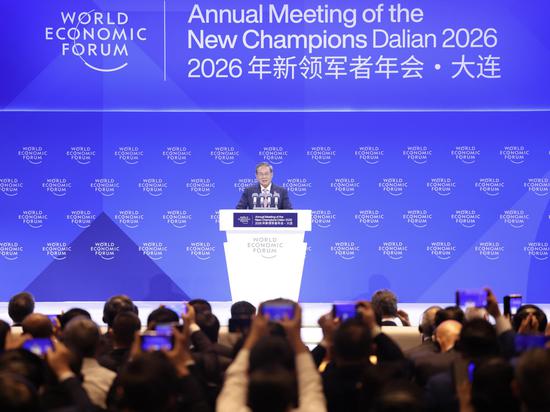
(ECNS) -- The 2026 Summer Davos Forum was recently held in Dalian, Northeast China’s Liaoning Province, during which energy transition became a focal point of heated discussion among participants from various countries.
How can developing countries find energy development paths that suit their own conditions? What lessons can China's energy transition offer? Multiple attendees engaged in in-depth discussions on these issues.
Roberto Bocca, a member of the Executive Committee of the World Economic Forum, pointed out that although energy systems in many countries are undergoing profound transitions, and the sustainability, security, and affordability of global energy are steadily improving, the pathways to energy transition have always differed from country to country.
"Every country will choose its own pathway based on their environment resources, on their opportunity and so on. But now we see stronger choices in one direction and there are some countries that decide to go more on the traditional solution, some that really go on electrification and renewables. We have seen this divergence happening more and more."
In Bocca's view, the divergence in energy development pathways has become a notable feature of the current global energy transition. Against this backdrop, the direction of each country's efforts in the next phase should become a key focus of attention for all parties.
In response, Gavin McKenzie, managing director at Accenture, said that the next phase of the global energy transition should shift its focus from merely adding more capacity to building a more resilient, reliable, and investable energy system. This shift, in turn, would help inject strong confidence into the global economy's continued investment in energy transition.
As the direction of the transition becomes increasingly clear, investment opportunities and areas of focus for different countries have come into the spotlight.
McKenzie suggested that, in the face of rapidly growing industrial demand driven by electrification in developing countries, ongoing industrialization and urbanization in some parts of the world, and the enormous energy consumption from digital infrastructure and artificial intelligence, the new opportunities for energy transition in developing countries mainly center on three pillars, namely investing in advanced energy storage solutions, building small-scale energy systems and grid infrastructure, and developing flexible power systems.
Since the beginning of 2026, the U.S.-Iran tensions had a profound impact on the global energy landscape. Global oil supply once fell by about 15%. The closure of the Strait of Hormuz cut off approximately 20% of global oil and liquefied natural gas flows, sending international oil prices soaring to as high as 120 U.S. dollars per barrel.
Faced with the knock-on effects of reduced fossil fuel production and high prices, From the observation of Kelly Sims Gallagher, a U.S.-China climate policy expert and dean of the Fletcher School at Tufts University in the U.S., China has not been severely impacted by this round of global energy crisis. In her assessment, this can be attributed to the forward-looking measures it has taken across various sectors in recent years.
She noted that in recent years, while building large strategic petroleum reserves and commercial stockpiles, China has been vigorously developing renewable energy and electric vehicles. Having weathered the current energy crisis, China has demonstrated its strong capacity to withstand shocks and ensure energy security.
"China has done surprisingly well," commended Gallagher.
Reflections on the over-reliance on traditional energy have opened up new directions for thinking about energy transition across countries. In Gallagher's view, China's achievements are commendable.
Regarding China's outstanding performance in this energy crisis, Gallagher attributed it to its policy-making and implementation system.
She pointed out that the two countries have fundamentally different approaches to policy formulation, with China tends to prioritize planning, establishing strategic frameworks that cover short-, medium-, and long-term cycles. For example, by formulating the Five-Year plans, Gallagher added.
"Because of that, China sets targets, and then it works on developing a stable policy infrastructure to achieve the targets. And it will modify those policies as needed to achieve the targets. So I think the targets are always very clear in the Chinese system. China tends to use a wide variety of types of policies, fiscal policies, regulatory policies, and so forth," said Gallagher.
As a U.S.-China climate policy expert who has personally participated in bilateral climate agreement negotiations, Gallagher noted that China has undergone profound changes in advancing its energy transition.
She also believes that China's dual carbon goals, proposed in 2020, represent a landmark statement. At the same time, China's supporting commitments on reducing carbon intensity, increasing forest coverage, and cutting fossil fuel use collectively confirm that it is forming a virtuous cycle of growing ambition and policy implementation capacity.






























 京公网安备 11010202009201号