


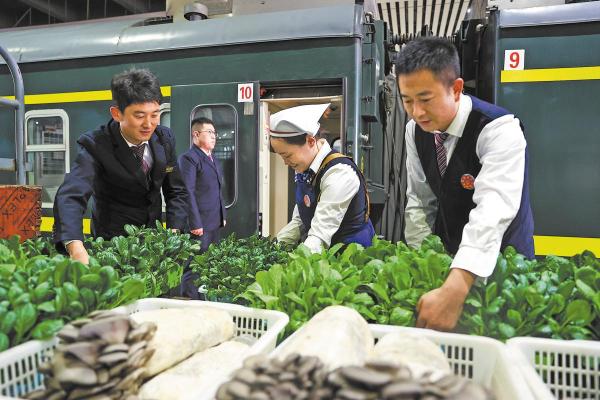
 Railway workers load organic groceries onto a train of the Qinghai-Xizang Railway in Xining, Qinghai province, on Nov 1, 2024. (Photo: Xue Di/ China News Service)
Sonam Wangdrak first saw a train not on a track, but in a school textbook.
He was raised in Lhorong, a remote county within Chamdo city, Xizang autonomous region — a mountainous territory where childhood was measured by livestock herding and highland barley fields rather than transit timetables. When he asked his teacher to describe a train, the answer stayed with him: "A train is many times faster than the horse you ride."
In 2003, following his father's advice to acquire a technical skill, Sonam Wangdrak was admitted to a vocational railway school in Lanzhou, Gansu province. The journey from his isolated home took six days, requiring a transit on horseback, followed by long-distance regional buses. He finally boarded his first conventional passenger train in Golmud, an industrial outpost in Qinghai province.
"It felt so cool, fast and steady," he recalled.
The infrastructure that once existed only as a textbook illustration became his profession. After joining the regional railway system in 2007, he qualified to pilot locomotives onto the high-altitude plateau. By 2021, he was selected as one of the primary drivers operating the advanced Fuxing bullet trains on the Lhasa-Nyingchi and Lhasa-Shigatse lines.
Two decades after the first tracks linked Lhasa to the rest of China's national rail network, Sonam Wangdrak's career reflects the social and economic transformation. The expansion of the Qinghai-Xizang Railway has structurally redefined transport, logistics and urbanization across the plateau.
The engineering spine of the network is the Qinghai-Xizang Railway, which stretches 1,956 kilometers southwest from Xining, the capital of Qinghai province, to the Xizang capital of Lhasa. While the lower-altitude Xining-to-Golmud leg opened in 1984, the complex high-altitude segment connecting Golmud across the mountains to Lhasa opened on July 1, 2006, ending Xizang's historical isolation from national rail infrastructure.
According to data from China State Railway Group, to mark July 1,2026, the 20th anniversary of Qinghai-Xizang Railway's full operation, the corridor has managed over 104 million passenger trips and transported 824 million metric tons of freight since its inception.
During its initial construction phase, engineering debates focused on whether rail lines could permanently withstand extreme thin air, expansive permafrost zones, high winds and fragile alpine ecosystems. Twenty years later, the focus has shifted from basic structural survival to network integration.
For its first eight years, Lhasa operated purely as the final terminus of the line. That isolation ended in 2014 with the opening of the westward Lhasa-Shigatse Railway toward China's southwestern border. The network expanded again in 2021 with the debut of the eastward Lhasa-Nyingchi Railway, creating Xizang's first fully electrified, high-speed rail corridor.
This infrastructure forms a comprehensive Y-shaped regional network, linking central Lhasa with the critical prefecture-level hubs of Shigatse to the west, and Lhokha and Nyingchi to the east.
At Lhasa Railway Station, daily operations reflect this expansion. Scheduled passenger train pairs on the Qinghai-Xizang Railway have increased from five per day in 2006 to 13 pairs in 2026. Daily departures have grown from a maximum of 3,000 passengers in 2006 to more than 10,000 on regular days, said Li Jia, head of the station.
"The station has not become smaller," Li said. "What has become shorter is the time passengers spend entering and leaving it. And outside the station, the city has grown."
The Liuwu New Area, the district surrounding the station on the south bank of the Lhasa River, has transitioned from barren hills and agricultural plots into a high-density modern commercial sector.
The network's impact on logistics is visible in both passenger travel and bulk freight data.
For Sun Yanqing, a 44-year-old Tibetan tourist from the rugged Yushu prefecture in Qinghai, Lhasa has long carried personal meaning. He recalled his first trip to Lhasa around 2000, which required an arduous 24-hour overland journey by road from Golmud. This year, he completed the trip via a direct train from Xining with his family.
"When I was young, we always heard how good Lhasa was and wanted to come," Sun said. "After coming once, I wanted to come again. Every time I come, it is different."
Further north along the line in Amdo county — a high-altitude zone in Nagchu city near the Qinghai-Xizang border — 74-year-old resident Kelsang Tsering said that the railroad has completely altered local trade. For regional merchants, a supply trip to Lhasa to buy or sell wholesale goods once consumed up to a week by road; via the rail line, traders routinely complete orders and return within 48 hours.
After the railway opened, he also saw more visitors come to Tsona Lake and the Tangula Mountains.
Annual inbound and outbound freight volume to and from Xizang rose from 360,000 tons in 2006 to 8.31 million tons by the end of last year, according to Lu Jianbin, an official with the Xizang Development and Reform Commission.
"Compared with road transport, railway freight has cut costs by about 60 percent and improved efficiency by nearly three times," Lu said. "That has helped move daily necessities, vegetables, fruit and consumer goods onto the plateau, while carrying local agricultural, pastoral and specialty products to wider markets."
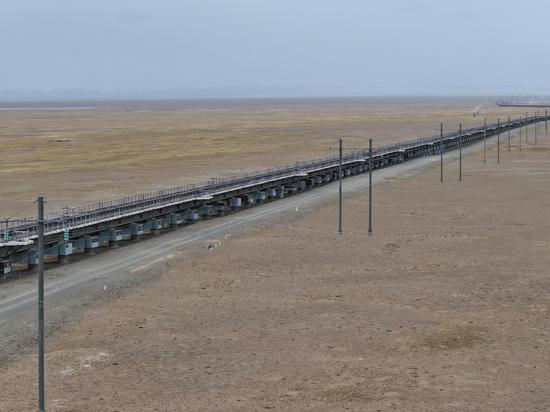
The logistical efficiency realized by traders and passengers depends on a railway corridor built through some of the world's most hostile terrain. Approximately 960 km of the line run above 4,000 meters, where oxygen levels are roughly 60 percent of those on the plains. About 550 km run across permafrost zones.
For Zhang Delong, a permafrost maintenance specialist at the Golmud railway maintenance depot, the problem is that the ground itself is never entirely still.
"Routine railway maintenance is often built on accumulated experience, but permafrost maintenance is different. Experience alone is not enough, because conditions are changing," Zhang said.
Much of the work, he said, is about keeping permafrost relatively stable. Water must be drained away from the roadbed, while crushed-rock slopes, sun shields and cooling devices help stabilize the foundation.
Zhang compared some of the insulation work to "putting a quilt over the roadbed to keep the heat out".
For Tsering Samdrup, a railway protection worker in Xizang's Amdo county, the difficulty is felt above ground. His patrol section near the northern foot of the Tangula Mountains sits at about 4,700 to 4,800 meters above sea level, where winter temperatures can fall below — 20 C.
When a train passes, protection workers raise their right arms in salute and the driver sounds the horn. Tsering Samdrup calls it "a signal of closeness" between the guards and the train.
"Every time I see a train pass safely through our section, I feel I have done something meaningful," he said.
The railway's story on the plateau is also one of caution.
Liu Lanhua, a researcher at the energy conservation, environmental protection and occupational safety and health research institute of the China Academy of Railway Sciences, said environmental protection was built into the project from the beginning.
"The Qinghai-Xizang Plateau has a unique ecosystem with weak resistance to disturbance and limited self-recovery capacity," Liu said.
The project moved away from the old approach of "building first and treating environmental problems later", he said, and instead emphasized prevention, protection, whole-process control and site-specific measures.
According to China State Railway Group, nearly 60 km of dedicated wildlife passages were arranged along the railway, and their use rate has remained stable at 100 percent.
The Tibetan antelope population has grown from fewer than 20,000 in the early 2000s to more than 70,000. Greening work along the railway has covered more than 1,000 km, the group said.
Jangchub Dorje, deputy director of the forestry and grassland bureau of Amdo, said daily protection work includes clearing wildlife passages, checking sensitive areas, picking up waste and helping damaged grassland recover.
For Tsering Samdrup, the work can be as simple as standing quietly in the right place. In the early years, he said, some animals did not immediately use the passages built for them.
"We do not shout, and we do not chase them," he said. "If they move in the wrong direction, we stand in a line, quietly, like a barrier. Then we guide them toward the bridge opening and let them pass."
The gesture is small, but it captures a larger point: on the plateau, a railway cannot simply cross the land. It has to learn how to live with






































 京公网安备 11010202009201号