


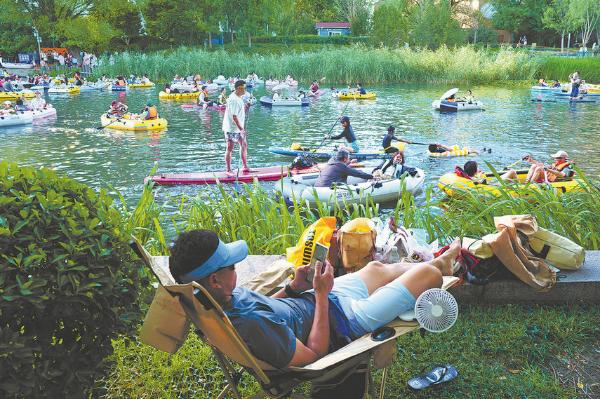
 People relax on the banks of the Liangma River, while others go paddling and kayaking on the water, on June 20 in Beijing. (Photo by Wei Xiaohao/China Daily)
In Beijing, a city known for its fast-paced lifestyle, summer evenings along the Liangma River paint a strikingly contrasting scene.
As dusk descends and the neon lights spill off surrounding skyscrapers and flicker in the water's ripples, the river turns into a summer playground for the city's sweltering residents.
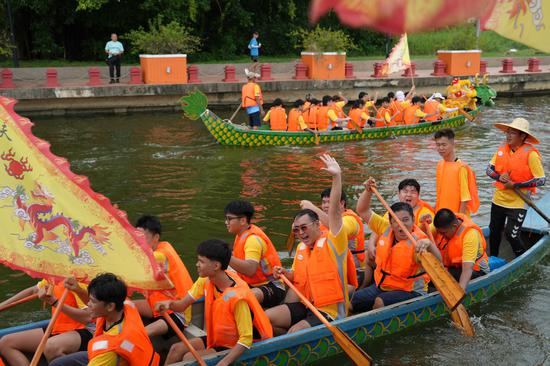
Here, laid-back bliss unfolds both on and off the water: Swimmers, paddleboarders and kayakers glide past, while hydrofoil riders zip through narrow gaps between inflatable dinghies, drawing cheers from onlookers. On the banks, picnic blankets dot the grass and open-air karaoke mixes with the splashes of swimmers.
"This is probably the best summer vibe I've ever seen in my life," George Bobyk, a University of Chicago doctoral student who is participating in a summer language program at Tsinghua University, said in fluent Chinese.
"My friends told me this is the best place in Beijing, so I knew I had to check it out."
Having grown up in Cambridge, England, Bobyk was no stranger to riverside life, but what struck him about the Liangma River was how it is fully integrated with the urban landscape.
Various watercraft are available for rent at several water sports clubs situated along the river.
Ding Ting, who had worked in Beijing's internet industry for over a year but chose to leave the capital, went paddling on the Liangma River with a friend during a recent return visit, and said it had changed her perspective on Beijing.
"For the first time in Beijing, I wasn't surrounded by hurried crowds rushing past. Instead, I saw children and adults relaxing and having fun," she said.
She recalled that a runner stopped and offered to take a photo of Ding and her friend, and an elderly man who played an electronic wind instrument on the riverbank was taking their song requests.
Ding said she felt that this offered more possibilities for genuine human connection in the bustling metropolis. "It's a more relaxed space where social connections can happen more spontaneously," she said.
During the Ming Dynasty (1368-1644), the river served as grazing land for imperial horses. After the Liangma Bridge was built during the Qing Dynasty (1644-1911), teahouses and taverns sprang up along its banks. Around 2000, unregulated car washing and unprocessed domestic sewage had polluted the waterway.
The turning point came in 2019, when a government-enterprise partnership in Chaoyang district launched a river restoration project that included dredging the waterway, renovating bridges and adding public leisure spaces, children's play areas, fitness zones and greenways along the river's banks.
Xu Chenxi, a researcher at the Academy of Metropolis Economic and Social Development at Capital University of Economics and Business, said: "Through scientific planning, ecological restoration, functional upgrades and public participation, urban waterways can become more vibrant, communities can become more livable, and cities more dynamic. The Liangma River serves as a model for building modern, people-oriented cities, ultimately achieving an integrated balance of ecological, cultural, social and economic value."























 京公网安备 11010202009201号