


The Chinese-Baroque Historic and Cultural Block in Harbin, Heilongjiang province, has been welcoming waves of tourists recently.
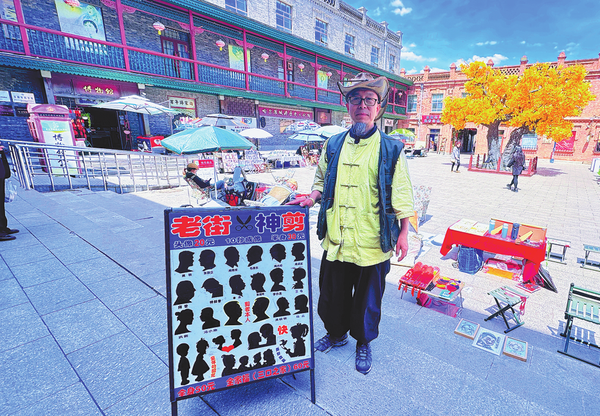
Many of the visitors are drawn to 65-year-old Wang Chuncai's paper-cut silhouette stall, where his scissors slice through black paper to fashion vivid, lifelike silhouettes of his customers in less than a minute.
Wang's entire setup consists of sheets of paper, a pair of scissors and a few sample works. For over four decades, he has wielded his scissors to create hundreds of thousands of silhouettes of strangers, with each cut capturing a moment in time and etching his life's journey as he preserves a traditional craft on the brink of fading away.
His initial encounter with the art of silhouette cutting occurred in October of 1985, he said. While visiting the bank of the Songhua River, he noticed a stall surrounded by a crowd.
Wang squeezed through the crowd and was instantly captivated by an artisan who was using only a small pair of scissors to skillfully cut into black paper. In just a few seconds, a striking silhouette portrait was completed, with precise and expressive features.
"I was completely amazed at the time," Wang said. "I never imagined that a pair of scissors and a piece of paper could create such a lifelike image. It was magical."
At that moment, the desire to learn the craft of silhouette cutting took root in his mind.
Without a mentor or professional materials, Wang embarked on a self-taught journey. He studied his own profile in front of the mirror, memorizing the features of facial lines. During work breaks and rest time, his colleagues, family members and neighbors became his practical subjects.
"The path of learning is never easy, and only I know the hardship I've endured," he said. "I always believe that quantitative accumulation leads to qualitative change."
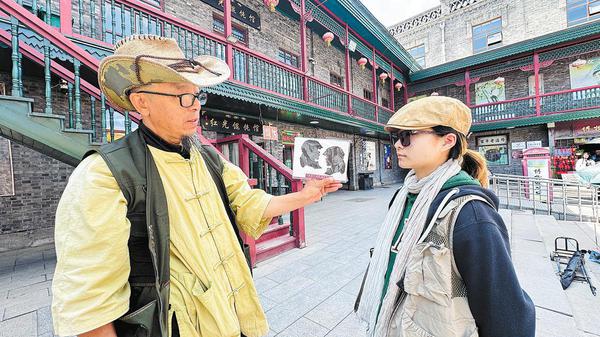
After more than a year of hard work, Wang finally mastered the art of silhouette cutting, able to quickly produce expressive portraits. To support his family, he worked at a local pharmaceutical factory during the day and ran his paper-cut silhouette stall in the evenings and on holidays.
"Facing my first customer, I was extremely nervous and my hands were trembling," he said. "Fortunately, sensing my anxiety, the customer kindly reassured me. She encouraged me to cut freely and said she didn't care whether it looked like her. Her kindness helped me calm down. After taking a deep breath, I successfully completed the work. When she said it looked good, it gave me immense encouragement."
One of Wang's most memorable experiences was a request from a Russian tourist who lingered at his stall for a long time.
"She tearfully expressed how much she missed her mother, who had passed away years earlier, and hoped I could create a silhouette based on her description," he said. "Having never seen the subject, the task was challenging for me … but I was moved by her sincere emotions and decided to have a try."
Wang listened intently to the woman's descriptions of her mother's facial shape, hairstyle and age, using the customer's own profile as a base to adjust the details.
When he handed the finished silhouette to her, she was overwhelmed, saying it really looked like her mother. "She hugged me tightly in gratitude," he said. "The cross-border trust and emotion have remained etched in my memory."
In recent years, Wang began posting his silhouette-cutting videos on the short-video platform Douyin, and one of his works unexpectedly garnered over four million views.
During holidays, long lines form in front of his stall, with young people eager to experience the traditional craft. "Silhouette cutting art has improved my life and become my spiritual refuge," he said. "I will never give it up."
However, Wang also has his concerns. "Fewer people are familiar with or interested in learning silhouette cutting, a craft that holds the memories of several generations but is gradually being forgotten," he said. "It is a traditional folk craft with significant cultural value. I sincerely hope it can receive support from relevant authorities to ensure its continuation."
To introduce more people to silhouette art, Wang has worked to share his creations online, hoping to reach a younger audience.
"I am heartened to see that many visitors who come to experience silhouette cutting art are young people and parents with children who are eager to appreciate the charm of traditional crafts," he said.
"Young people don't dislike traditional crafts; they just need someone to present the beauty to them. My greatest hope is to pass on the craft so it won't disappear in our generation.
"As I get older and eventually can no longer run my stall, I plan to take on apprentices, sharing my silhouette cutting techniques and experience without reservation, ensuring the continuation of the traditional craft," he said.































 京公网安备 11010202009201号