


(ECNS) -- A multicenter clinical trial in China has shown that ctDNA-guided surveillance can improve outcomes for patients with colorectal cancer after surgery, enabling earlier detection of recurrence.
The term ctDNA refers to fragments of DNA shed by tumor cells into the blood, which can serve as an early marker for detecting cancer recurrence.The trial involved 584 patients with nonmetastatic colorectal cancer who underwent curative resection between 2023 and 2026.
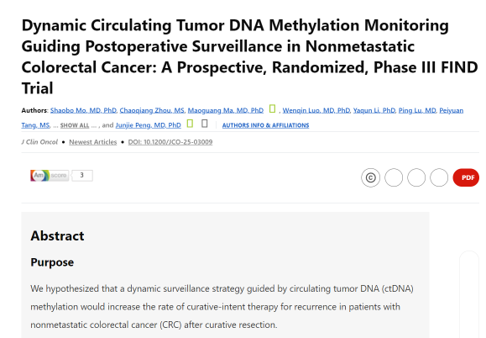
Participants were randomly assigned to receive either ctDNA-guided surveillance or standard CT-based monitoring.Traditionally, CT scans detect recurrence only once tumors reach a certain size. The new method uses ctDNA fragments shed by tumor cells into the blood, capturing recurrence signals at an earlier stage.
The trial found that the proportion of patients receiving curative intent therapy after recurrence rose from 23.6% under conventional monitoring to 48.1% with ctDNA surveillance.
Led by colorectal cancer expert Peng Junjie and pathology expert Ding Chunming in Shanghai, the study involved 584 patients and was published in the Journal of Clinical Oncology.
Researchers noted that the first two years after surgery are a high-risk period for recurrence and metastasis, with the liver and lungs being the most common sites of distant metastasis.
Peng said conventional CT monitoring has limitations because tumors must reach a certain size before they can be detected, meaning some patients may miss the opportunity for curative-intent treatment.
The study demonstrates that more sensitive biomarker-based surveillance can translate into real treatment benefits by detecting recurrence earlier and creating opportunities for curative-intent therapy.
(By Helen Mo, intern Liu Shuangjing)












































 京公网安备 11010202009201号