


By Liu Xinyu and Liang Qinqing
(ECNS) – Rongchang pottery, a traditional industry in Chongqing boasting a history of more than 800 years, is exported to over 30 countries and regions today.
In Antao Town, Rongchang District of Chongqing, more than a hundred pottery studios and standardized workshops have formed a complete industrial chain, from clay mining to cultural‑creative marketing.
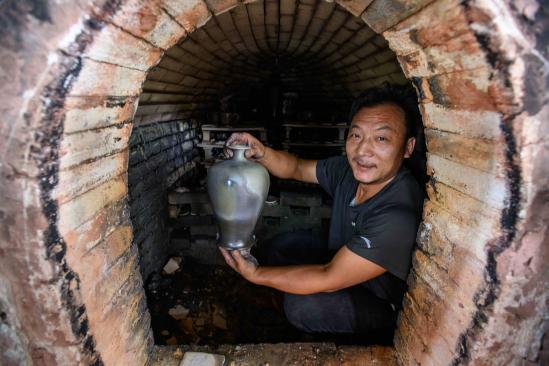
When a batch of pottery emerged from the kiln at Antao Town, Feng Xu, president of the Canada Sichuan and Chongqing Society, placed an order for a winged horse-shaped cup on the spot. "I was born in the Year of the Horse. Seeing this cup feels like it was custom-made just for me," he said.
Rongchang's pottery industry flourished during the Tang and Song dynasties (618-1279). After millennia of inheritance, it has developed a unique style of craftsmanship and artistic expression.
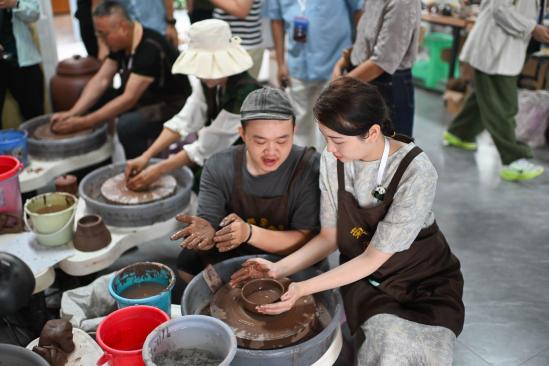
The process involves more than 20 meticulous steps, and the finished pieces are widely praised as "as thin as paper, as bright as a mirror, and with a sound like a chime."
"The artistic excellence of Rongchang pottery ranks among the best in China's ceramics industry, making it a highly recognizable intangible cultural heritage brand in Chongqing and across the nation," Liang Xiancai, a national-level intangible cultural heritage inheritor of Rongchang pottery-making techniques, told China News Service on Sunday.
For a long time, Liang said, Rongchang pottery was dominated by low‑end daily‑use items, resulting in low added value and insufficient innovation.To break the bottleneck, the local government has laid out an industrial roadmap centered on Antao Town and introduced special policies to address industrial weaknesses.
"Today, old and new techniques are evolving, and traditional artisanship is being passed on in an orderly manner," Liang added.
Chen Weigui, a master craftsman with more than 40 years of experience, has witnessed the industry's transformation. "In the early years, the product range was limited. Now the focus is on fine items such as vases, teapots and cultural‑creative tea ware. Standards, design and product quality have all been upgraded."
While Rongchang pottery exemplifies the cluster‑style upgrade of traditional crafts, the art of Rongchang Xiabu weaving represents a vivid microcosm of how intangible cultural heritage is being revitalized.
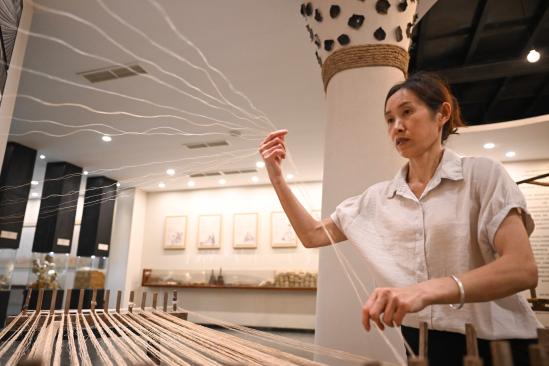
The history of Rongchang Xiabu can be traced back to the "Shu cloth" of the Han Dynasty. Through more than 10 ancient processes, the finished fabric is fine, smooth, lightweight, breathable, durable and comfortable.
With its year‑round comfort, ease of washing and fast‑drying properties, Rongchang xiabu is both practical and decorative.
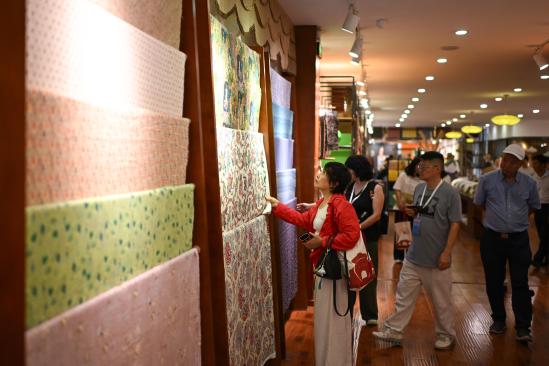
At the Tianyun Xiabu Hall in Rongchang District, hundreds of Xiabu-based products are displayed, covering handmade garments, cultural‑creative artworks and other categories, showcasing the transition of Rongchang Xiabu from a primary raw material to a high‑value consumer product.
"In recent years, the domestic and international visibility of Rongchang Xiabu has greatly increased," said Ma Linqin, director of the Tianyun Xiabu Hall. Through innovative design, category expansion and brand upgrading, Ma said, cultural‑creative products and garments are now being exported overseas.
Relying on the iterative upgrading of its national-level intangible cultural heritage, Rongchang has cultivated an industrial cluster with an annual output value exceeding 10 billion yuan (about $1.38 billion), turning its traditional culture into a vibrant force reaching out to the world.






























 京公网安备 11010202009201号