


By De Yongjian and Wang Liwen
(CNS)-- "I hope the World Conference of Classics will not end in Beijing, but begin there."
When the inaugural World Conference of Classics concluded in Beijing, Kostas Buraselis - Member of the Academy of Athens, Emeritus Professor of Ancient History at the National and Kapodistrian University of Athens - expressed this wish in an exclusive interview with China News Service's W.E. Talk in November, 2024.
Less than two years later, Buraselis welcomed the Second World Conference of Classics in his hometown. The conference was held on June 9 to 10 at the Academy of Athens, themed "Dialogue Between Ancient and Modern: Contemporary Inspirations from Classical Wisdom", bringing together leading scholars from around the world.
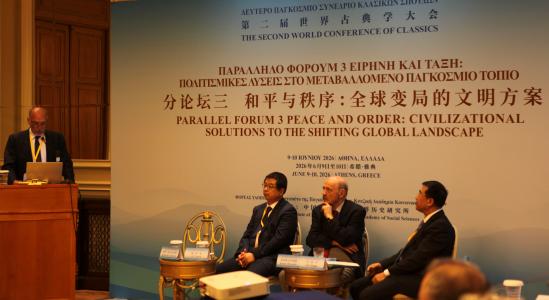
During the conference, Buraselis granted a second interview to W.E. Talk, sharing his views on the enduring value of classical heritage, ancient Greek peace thought, and the role of artificial intelligence in the study of classics.
The Classics as "Capital" of Human Experience
Buraselis said the conference theme speaks directly to contemporary needs. The classics, he argued, form a basic"capital of human intellect and selected experience" that has proved its worth throughout history.
"It would be foolish and even dangerous to limit one's life only to one's personal experience", he said. "There were people before us - generations of them. Should we give up the possibility of taking advantage of their lessons, their writings? The classics are an immense gift."
He quoted an Austrian scholar's maxim: "We do not run the risk of losing the classics, as long as we do not become barbarians again."
"By keeping to the standards of classical civilizations, we help ourselves remain on a high level - in cultural life, social life and international relations," he noted.
Peace as Harmony - A Convergence of Greek and Chinese Thought
A specialist in the ancient Greek polis and concepts of peace, Buraselis presented at the parallel forum "Peace and Order", arguing that classical texts contain not only war narratives but also a "peace doctrine."
He cited Aristophanes, the "Father of Comedy", whose play Lysistrata depicts women uniting to end war: "Men treat war as a male exercise, but the women understand it is unreasonable and revolt against it."
On the Greek understanding of peace (eirene), Buraselis said: "Peace is world harmony."
"In the jungle, war may be the natural condition. But human beings should show they are ruled by law and regulations that make common life easier. Social harmony is the traditional goal of a well-functioning society."
He noted this aligns with the Chinese intellectual tradition's emphasis on harmony (he /和): "People who have deeply studied classical civilizations believe in a harmonious understanding of the world. Those without such knowledge often tend to regress to the conditions of the jungle."
AI: Instrument, Not Substitute
Addressing the topic of "technology and civilization", Buraselis said technical tools - including artificial intelligence - are morally neutral.
"I can use a pencil to write, or to harm someone's eye. Its value depends on the user's intention", he said. "AI is not good or bad by itself."
He welcomed AI's use in classical philology - for example, instantly searching all occurrences of a Greek word across ancient corpora - tasks that once took scholars years. "We should not reject this progress; it frees us from drudgery."
However, he added, "I do not fear that human intelligence will be replaced by AI, as long as we do not become too idle to give up our thinking. AI can help us remain intelligent, but it cannot replace human, independent thought."
Greco-Chinese Links in Classical Studies
Buraselis praised Chinese respect for the classics, comparing it to reverence for Confucius. He recalled a Nanjing University scholar who came to Greece 20 years ago as an Onassis Fellow and has since sent disciples annually to Athens - now teaching at universities in Shanghai, Chongqing, Nanjing and Changchun.
"I have helped sign about 10 exchange agreements between Greek and Chinese universities, including with Tsinghua University and Changchun University", he said. "These are small things, but they may bring a blossoming future for the humanities."
He urged that the proceedings of the first World Conference of Classics be published: "For a conference to have lasting value, its acts must be published. There must be tangible fruits - not just a congress, and then nothing."
On building a community with a shared future for mankind, he concluded: "If one draws the right conclusions from the classical heritage - yes, it is possible. Classical study schools us in common understandings of human life."

































 京公网安备 11010202009201号