


By Liu Xinyu
(ECNS) – Human Rights Action in China·2026 Chongqing Tour, hosted by the State Council Information Office of China, officially kicked off in Chongqing on Sunday.
Human rights experts from 20 countries and international organizations, including Peru, Nepal, Argentina and the African Union, visited Minzhu Village Community in Chongqing to learn how urban renewal promotes grassroots democracy. They also experienced firsthand the principle that "the right to a happy life is the most important human right."
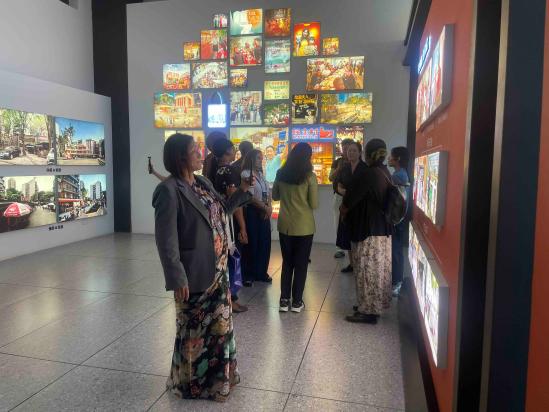
Minzhu Village Community is the former residential compound for workers of the Jianshe Factory, a major industrial plant in Chongqing. Most buildings in the community were constructed between the 1950s and 1990s.
In early 2022, Chongqing Jiulongpo District launched an urban renewal pilot project, revitalizing Minzhu Village through a strategy of "preservation, renovation, demolition, and addition."
Historical elements were retained while public spaces and facilities were optimized, creating three functional zones: a trendy fashion area, a community service area, and a traditional marketplace area.

Crispin Kaheru, member of Uganda Human Rights Commission, told China News Service during the visit: "I thought I was coming to see a village like the ones we see back home, where houses are not as decent as these. But what we found here is organized houses, skyscrapers, big hospitals, a facility serving 30,000 people – and it's a village. That's amazing."
He noted that a health center in his village back home serves only about 500 people. A village having such a big modern market and modern community center is completely different from what he imagined.
Pauline Mutumba, director of Complaints, Investigations and Legal Services of Uganda Human Rights Commission, told China News Service: "When we talk about human rights, it's really about how people experience life." She was impressed by the community's transformation in housing quality and accessibility.
"The entire community can access health services and community services right within the space," she said. "What also interested me is that people's representatives are nearby. If someone has a recommendation to improve the village, they can walk to the party office, make a recommendation, and it can be taken up. So for me, it's about the accessibility of good quality services to the common person – not far away, not just anything."

During their visit to the community canteen, the overseas human rights experts asked detailed questions about the variety of dishes and meal prices. The canteen serves three meals a day, with lunch and dinner on a buffet style featuring 24 dishes available daily, serving about 1,200 residents per day.
At the canteen, Wang Haixian, a 92-year-old resident who has lived in Minzhu Village since 1953, was about to have lunch.
Agustín M. Romero, director of the Postgraduate Program of the University of Buenos Aires, asked him about his feelings in his later years. Wang said that his pension has been steadily improving, and he feels happy and secure in his old age.
Paskal Milo, professor, doctor and academician of Mediterranean University of Albania, told China News Service that the international order should be based on common purposes-to live and cooperate together, not to impose a single option. "It is time to find the best solution for the future of the world together," he said.






































 京公网安备 11010202009201号