


China launched on Monday the Tianzhou 10 cargo spacecraft to deliver scientific equipment and experimental supplies, including artificial human embryos, ultrathin solar cells and a greenhouse gas monitor, to its orbiting Tiangong space station.
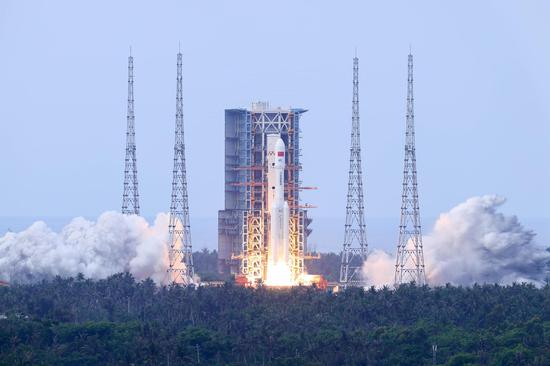
A Long March 7 rocket, carrying the cargo vessel, blasted off at 8:14 am from the Wenchang Spacecraft Launch Site in Hainan province, according to the China Manned Space Agency.
After a short flight, the Tianzhou 10 spacecraft separated from the carrier rocket and entered its designated orbit. At 1:11 pm, the cargo vessel docked with the Tianhe core module of the Tiangong space station, paving the way for Shenzhou XXI astronauts to enter the vessel and transfer payloads as scheduled.
Later in the day, Shenzhou XXI mission commander Senior Colonel Zhang Lu, spaceflight engineer Major Wu Fei and payload specialist Zhang Hongzhang entered the cargo vessel and began arranging the transfer of the payloads.
Tianzhou 10, which is the 20th spaceship and the ninth cargo vessel to dock at the space station, has delivered nearly 6.2 metric tons of daily necessities, scientific equipment and experimental supplies, as well as about 700 kilograms of fuel. The cargo includes a spacewalk suit, a treadmill and many instruments for scientific experiments and technological tests.
Mission planners at the China Academy of Space Technology said the Tianzhou 10 is designed to dock with the Tiangong space station for a whole year, making it the longest cargo mission in the history of China's space industry.
According to the Chinese Academy of Sciences' Technology and Engineering Center for Space Utilization, which is responsible for scientific missions on board China's space station, the Tianzhou 10 has delivered 67 sets of devices, experimental expendables, samples and spare materials, which have a combined weight of 768.2 kg and will be used to conduct 41 experiments.
The experimental cargo includes zebrafish embryos, mouse embryos and stem cell-derived artificial human embryos. The human embryos, although not true life forms, will help simulate the earliest stages of human development, according to reports from China Central Television.
The experiments in orbit will help establish a space-based embryo research system spanning lower vertebrates to higher mammals. The biological research will provide insights into how the space environment, specifically microgravity and radiation, affects reproduction and development, laying the foundation for long-term human habitation in space.
Among the payloads are flexible solar cells. With a thickness of just 80 micrometers — roughly the same as a human hair — these cells can be folded and rolled, allowing a greater number of solar panels to be packed into a given amount of space. Subjecting this new technology to the extreme space environment will help verify and improve its long-term power-generation stability, paving the way for supplying energy to China's large-scale satellite internet constellations.
The greenhouse gas monitor, developed under the leadership of the Hong Kong University of Science and Technology, is designed to track concentrations of carbon dioxide and methane across global middle and low latitudes.



















 京公网安备 11010202009201号