


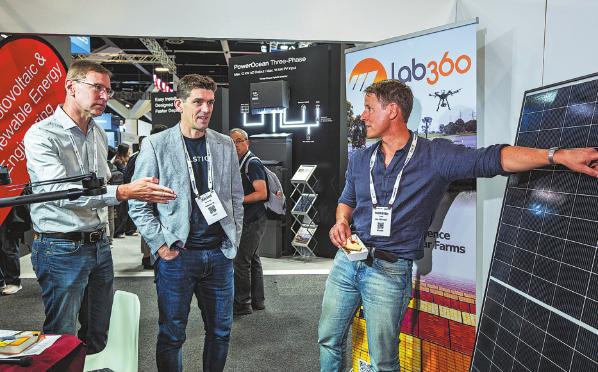
 Members of photovoltaic and renewable energy research team from the University of New South Wales introduce solar panel products at the 64th Smart Energy Conference and Exhibition in Sydney in May. CHINA DAILY
Electrician James Moore, who installed solar panels on the roof of his Sydney home two years ago, said the green energy move has helped him halve his household power bills.
When told that the equipment came from China, Moore was not surprised. "It's efficient and effective, very suitable for sunny Australia," he said.
Moore's words were fitting in more ways than one. The development of photovoltaic, or PV, technology, which converts sunlight into electricity and powers the growing use of solar energy in the country, can be traced to Australian research and innovation.
Ned Ekins-Daukes, head of the School of Photovoltaic and Renewable Energy Engineering at the University of New South Wales in Sydney, said the university's pioneering PV research helped nurture ties with Chinese industry and academics that continue to place them at the forefront of the field.
"UNSW has this extraordinary story of where we invented some photovoltaic technologies a long way ahead of the market being ready to accept them. During that time, many students came from China to study at UNSW and took some of the ideas back to China," the professor said.
Major contributions to the sector include work led by multiple-award-winning UNSW scientist Martin Green, who invented groundbreaking types of solar cells in the early 1980s. This helped fuel further research that has since accounted for more than 90 percent of worldwide silicon solar module production, according to the university.
One of Green's doctoral students, Shi Zhengrong, subsequently implemented a low-cost manufacturing transformation and went on to set up the first commercial solar cell producer of its kind in China. Serving as the Chinese company's chief scientist, Green and other research team members helped facilitate the rapid growth of the sector.
"What's happened in China is that, because of the scale of the manufacturing that's possible and the supply chain integration that's been built up over the last 20 years, the costs of those technologies have dramatically reduced," Ekins-Daukes said.
In China, there has been continuous improvement in the technology, he said. "In Australia, we demonstrated the concept, we demonstrated that these solar cell technologies could work well. But in China, the engineers have worked hard to actually (apply) those technologies for manufacturing and critically bring robotic automation into the manufacturing of silicon solar panels," he said.
UNSW now works directly with major PV companies to help them improve the technology and its practical applications in Australia and beyond, Ekins-Daukes said.
This "loop of innovation" between Australia and China will continue, he added. "China has huge manufacturing strengths, and the opportunity for Australia ... having a lot of space and a lot of sunshine, is to collaborate and help deploy solar at an enormous scale for the benefit of the Australian economy, in a partnership," Ekins-Daukes said.
 Visitors pose for a photo at the booth of Chinese solar manufacturer GoodWe during the exhibition. CHINA DAILY
Complementary strengths
The success of the China-Australia partnership in the solar energy sector offers a model of cooperation to tap into complementary strengths amid the global green transition.
China is the main supplier of solar equipment to Australia, which also tops the world's per capita uptake of rooftop solar, according to industry figures.
There were nearly 255,000 new rooftop solar installations across Australia last year, bringing the number of households using the systems to 4.3 million, according to the Clean Energy Council, the sector's peak body in Australia.
In the second half of 2025, rooftop solar energy contributed 14.2 percent of the total electricity generated in Australia, nearly double the amount in 2020.
In 2024-25, Australian households saved about A$3 billion ($2.18 billion), or A$125 per capita, on electricity costs by installing rooftop solar, according to the Australian Bureau of Statistics.
China continues to lead the world in PV supply chains. Its top manufacturers account for most of the global production, and have helped bring down costs and offered "multiple benefits for clean energy transitions", according to the International Energy Agency. Industry analysts have also pointed to a shift toward high-quality growth through the leveraging of technology and scale to maintain global competitiveness.
With similar strengths in wind turbines and lithium batteries, China is cementing its leading role in renewable energy technologies that countries like Australia are increasingly keen to leverage as they face resource disruptions due to the Middle East conflict, while addressing other traditional fossil fuel challenges.
The federal government's "Future Made in Australia" initiative includes a renewable energy focus on a more resilient, low-carbon economy through increased investments in research and manufacturing.
At the 64th Smart Energy Conference and Exhibition held in Sydney on May 6 and 7, Australia's Climate Change and Energy Minister Chris Bowen highlighted the "era of clean power growth", with "renewables overtaking coal in 2025 and record growth in solar meaning that renewable energy met the vast majority of new demand growth in 2025".
 About 10,000 attendees, 120 main exhibitors, and industry leaders participated in the event. CHINA DAILY
Countries like China have similarly reduced fossil fuels' share of electricity generation significantly, helping push against climate change inaction, he said.
The major two-day event covering fields ranging from solar and storage to transport and technology drew about 10,000 attendees, 120 main exhibitors and industry leader conferences covering the latest energy trends.
In a keynote speech at the conference, mining giant Fortescue's chairman, Andrew Forrest, called for more to be done to adopt green technologies and electrification in a pillar sector still heavily reliant on diesel.
With most of Australia's diesel imported, prices could go up significantly amid the supply risks from shipping disruptions in the Strait of Hormuz in the Middle East, he said.
"So, for diesel, it's all bad news," Forrest said.
As part of its move away from fossil fuel dependence, Fortescue announced in April the acceleration of an integrated green energy grid rollout, including 1.2GW of solar capacity at the Pilbara area in Western Australia.
At a conference session on the importance of the Australia-China smart energy partnership, John Grimes, chief executive of Australia's Smart Energy Council, said the solar and other advanced technologies developed by the Sino-Australian cooperation mark a deep relationship. The council is a nonprofit with more than 1,000 members.
"What I see in China … the engineers, the investors, the Australian connection is so strong. There is a massive opportunity for us to build on those firm and long-standing foundations," said Grimes, adding that "every solar panel makes a difference" in the global energy crisis.
"We're working with Chinese industry to take the world's lowest-cost, best technology and accelerate that … throughout the Asia-Pacific region."
Tim Buckley, founder and director of Climate Energy Finance, a think tank focusing on Australia's green transition, told China Daily that it is "critical we work with China and learn from the best technology in the world".
"I'm amazed by the robotic advances," he said. "Australia worries about our high cost of labor, you don't have that problem in China because you're building the world's best robots, which means we can learn from China about robotics, engineering and supply chains, and partner together," he said.
"The more you build wind, solar, batteries and hydroelectricity toward energy efficiency, the less addicted to imported fossil fuels your country is. That's a really important lesson for us."
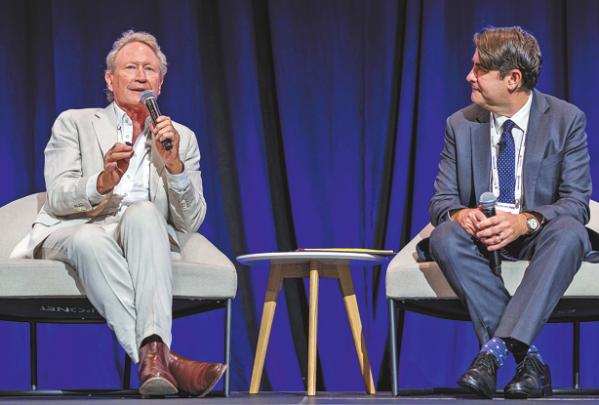 Andrew Forrest, chairman of mining giant Fortescue, gives a keynote speech at the conference in Sydney. CHINA DAILY
Dorothy Zhou, director at Chinese PV company Sunpro Asia, told China Daily that the Australian market offers significant investment opportunities with its various sectors like agriculture and resources suitable for energy projects.
"The energy transition for this market provides investment stability with clear demand, providing an upward trajectory," she said.
Zhu Sha, executive secretary-general of the Jiangsu Energy Storage Industry Association, told China Daily that Chinese companies are well-prepared to cater to overseas market demand, backed by advanced technologies, complete industrial chains and low-cost manufacturing advantages.
Their pace of going global is accelerating and the way they expand overseas is also evolving, said Zhu, who led a delegation to the Australian conference. The association, based in the East China province, promotes green energy transition with its more than 1,000 member units, using expertise in fields such as research and manufacturing as well as green finance.
"China's new energy industry is now shifting from products and trade-driven expansion to one-stop service and systems solution exports," Zhu said, adding that companies are also actively exploring markets in Southeast Asia, Africa and South America.
The Australian market remains attractive because it can help open up broader areas of development, she said.
"With Australia as a base, companies can also extend their industrial chains, or further expand into the European and US markets," Zhu said.
The next stage of development for Chinese energy storage products in Australia will focus on commercial and industrial use, grid-scale capabilities, and data center solutions, altogether presenting "both an opportunity and a challenge for Chinese companies", she added.
Australia-China research and development collaboration is already extending beyond its PV partnerships to other growth opportunities such as green hydrogen, fertilizer and steel.
"There are a lot of areas we can work on, to keep building on the momentum," Thomas Gao, senior manager at the Office of the Chief Scientist and Engineer, New South Wales, told China Daily.
"Many people play very important parts at different levels, taking us to where we are today. It's a continual journey," said Gao, whose organization helps bring academia, government and industry to drive the commercialization of research.
To that effect, a UNSW booth at the Sydney conference showcased the latest developments in the field that also continued its rich Australia-China partnership.
Professor Thorsten Trupke, a colleague of Ekins-Daukes at the university's photovoltaic school, explained his work on a state-of-the-art photoluminescence imaging system that inspects industrial solar panels through drones.
"We can now take these luminescence images from aerial drones on a large scale in operating solar farms," Trupke told China Daily.
Solar panels are made to last for about 30 years without any major degradation, but they can sometimes encounter problems, as with any mass-manufactured product, he said.
"We can detect those panels, and then necessary rectification can be done," said Trupke, adding that Chinese companies support the project by providing specialized samples for testing.
"The best drones in the world are from China and the ones we use are also from there. We are configuring these drones specifically for our needs," he said.
"Our school has collaborated with China for many years … this collaboration will probably expand into the future."























 京公网安备 11010202009201号