



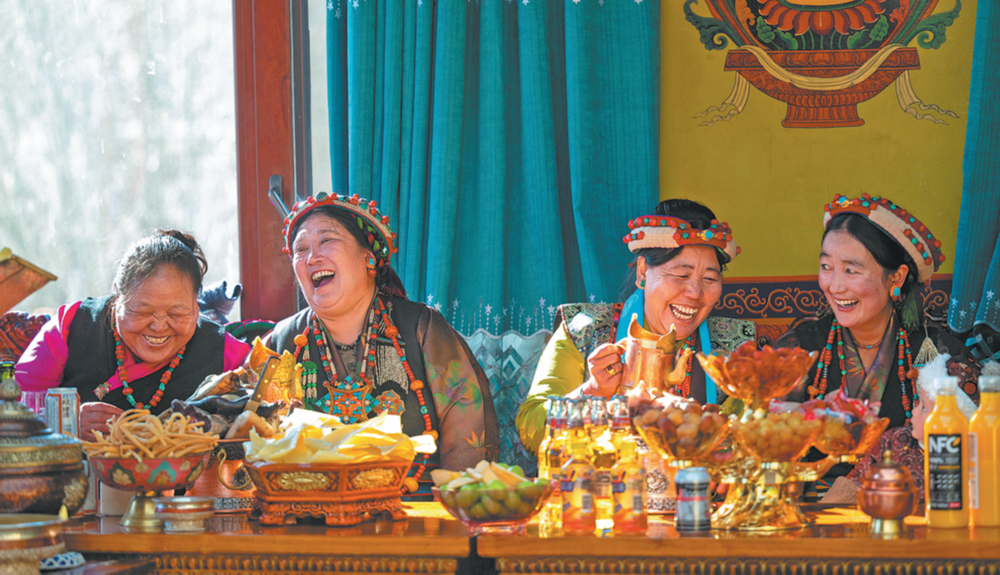
Tibetan women dressed in traditional costumes celebrate Losar, or Tibetan New Year, at a village in Shigatse, Xizang Autonomous Region, on Tuesday, which marked the second day of the Tibetan New Year. (TENZIN NORBU/XINHUA)
As the Tibetan New Year, or Losar, approaches, preparations are in full swing in Lhasa, the capital of the Xizang autonomous region, with families busy following centuries-old customs to seek blessings and good fortune.
Red lanterns and colorful banners adorn city streets, while the popular Barkhor Mall is buzzing with shoppers eager to buy festive paraphernalia.
The new year market at the mall, covering multiple floors, opened on Jan 14 and will continue till Feb 16. It features 240 stalls offering barley sprouts, sweets, dairy products and other festive foods, as well as traditional treats from nearby regions such as Qinghai province and the Xinjiang Uygur autonomous region.
Sonam Drolkar, a local vendor who sells seasonal items, said that business is at its peak ahead of Losar. Fruit vendor Jigme said that people are buying goods in bulk, and his apples are especially popular among the shoppers.
The market provides a one-stop shopping experience for residents celebrating Losar, blending traditional goods with modern convenience. Each item carries its own meaning. For example, Losar metok — painted barley ear decorations — on top of the Chemar Box containing tsampa, or roasted highland barley flour, symbolizes abundance, while colorful door curtains are meant to bring warmth and cheer.
Tashi Dondrub, a shopper at the Barkhor market, said the Chemar Box is a sacred container used in Tibetan rituals, especially during major festivals. "It is a must-have item, because it is a symbol of good fortune," he said.
This year, Spring Festival and Losar fall just one day apart. Depending on the year, the two festivals can either coincide or fall one day apart, one month apart or a month and one day apart, according to Tobgayl, an assistant researcher of Astronomical Calendrical Studies at the Tibetan Medicine Hospital of Xizang.
The timing of Losar also varies across the region, because of differences in elevation and local agricultural cycles. While most residents mark Losar on the first day of the first month of the Tibetan calendar, people in Shigatse and Nagchu celebrate it at the start of the 12th month.
In Shigatse's Tsakhor village, which was devastated by a 6.8 magnitude earthquake a year ago, affected residents are marking Losar in their new Tibetan-style homes.
"We are finally celebrating in our new homes without worries," said Tsakhor resident Pema Chungdak, reflecting on the long road to recovery and the resilience that the people of Xizang embody.
Across the Tibetan plateau, from quake-hit villages to the heart of Lhasa, rituals and festive preparations connect people to both the past and the present.
"It's the coldest time of the year, but my mother and I don't feel the chill at all because our business is thriving," said Jigme, the fruit vendor, summing up their collective sentiment.




























 京公网安备 11010202009201号