


Time: Autumn 1938.
Subjects: 23 unidentified people.
Location: Redacted.
Experiment: Animal blood and serum, including horse blood and chicken blood, were injected into human subjects to observe their physiological reactions.
Result: High fever.
These records come from a report presented at a Japanese Army medical conference in March 1940.
According to documents uncovered by Kyodo News, the Imperial Japanese Army is believed to have repeatedly carried out "heterologous blood transfusion" experiments on human beings in China during its invasion of China, injecting animal blood into living people.
The report notes that the Japanese military attempted to destroy evidence of its human experimentation atrocities at the end of World War II.
However, Kyodo News found relevant records in a report presented at a 1940 medical conference and later published in the journal of the Japanese Army Medical Corps.
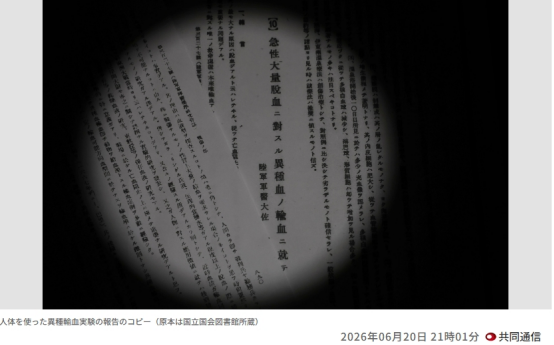
At the conference, an instructor from the Imperial Japanese Army Medical School in Tokyo reported that during its invasion, the military had accumulated numerous cases of blood transfusions using animals as blood donors.
According to Kyodo News, the experiments were ostensibly aimed at finding ways to treat severe blood loss on the battlefield, where supplies of plasma were often insufficient. They included transfusing critically wounded patients with large quantities of horse blood after massive hemorrhaging and injecting chicken blood into human subjects to observe how long it remained in the body.
Those subjected to the experiments developed severe fever and other adverse reactions.
Cruel. Inhumane. Utterly dismissive of human life.
Even Japanese media outlets have acknowledged that such practices constituted a grave violation of medical ethics.
The significance of this long-buried document lies not only in its record of the Imperial Japanese Army's human experimentation, but also in what it reveals to the world: more than 80 years later, new details of Japan's wartime atrocities committed during its invasion of China continue to emerge.
Some of that evidence comes from eyewitness accounts.
On China's 12th National Memorial Day for Nanjing Massacre Victims, China's Central Archives released a batch of declassified archives transferred from Russia, containing Soviet interrogations of members of the Japanese Unit 731, the Japanese Imperial Army's notorious germ-warfare unit during World War II.
The materials, primarily centered on the Khabarovsk War Crimes Trials archives, span three historical phases: pre-trial, trial, and post-trial. They reveal for the first time the Soviet investigation and interrogation process prior to the Khabarovsk trials, identifying more than 200 individuals linked to Japanese Unit 731's crimes.
Key evidence was collected from core war criminals and witnesses, eventually leading to the public trial of 12 war criminals. Some interrogation records are being disclosed publicly for the first time.
The war criminals confessed to crimes that violated international conventions, including the preparation and use of germ warfare, according to China's Central Archives.
There is also physical evidence.
On August 15, 2025, the Exhibition Hall of Evidences of Crimes Committed by Unit 731 of the Japanese Imperial Army released a new batch of historical materials, including 3,010 pages of archival documents, 194 minutes of video footage, 312 photographs, 12 postcards and eight letters.
In 2025, the Memorial Hall of the Victims in Nanjing Massacre by Japanese Invaders collected 573 additional cultural relics and historical materials, bringing its total collection to more than 106,800 items.
There are also those who have devoted themselves to uncovering the truth.
In the 1980s, Japanese writer Seiichi Morimura interviewed former members of Unit 731 and combined their testimonies with historical photographs, archives and documents collected from China and the United States to produce the documentary novel The Devil's Gluttony, which exposed the horrific crimes committed by Unit 731. The work triggered a major public response both in Japan and abroad.
In recent years, Japanese scholar Seiya Matsuno and Japan's public broadcaster NHK have uncovered additional evidence of wartime atrocities committed by the Japanese military.
There have even been belated expressions of remorse.
In 2024, Hideo Shimizu, a former teenage member of Unit 731, visited and identified the notorious Japanese force's old guardhouse sites, the headquarters building, the bacteriology laboratory, the special prison and the frostbite laboratory at the Museum of Evidence of War Crimes by the Japanese Army Unit 731, before publicly expressing his repentance at the museum's Apology and Peace Monument.
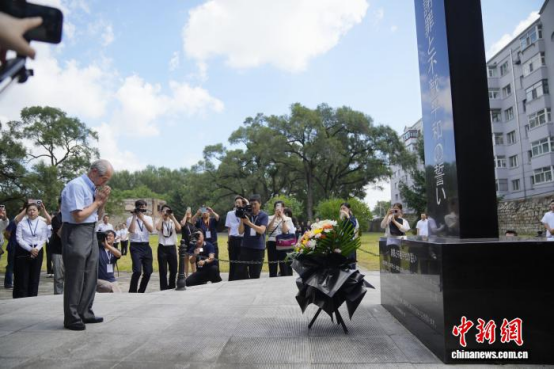
"I would like to express my sincere apologies and repentance to the Chinese victims, the victims of Unit 731, and the deceased," Shimizu said.
He recalled that after the birth of his first child, "Whenever I heard my baby crying at night, the image of the specimen room at Unit 731 would flash into my mind, as if the children who had died there were crying."
Overwhelming evidence ranging from historical archives and on-site investigations to documentary records and firsthand testimonies has confirmed the atrocities beyond dispute.
Yet as more pieces of the historical record fall into place, Japan has continued to fall short of sincere reflection on its crimes of aggression.
More than eight decades after the end of World War II, successive Japanese governments have still failed to offer what many regard as a full and unequivocal apology to the peoples of China, the Republic of Korea, the Democratic People's Republic of Korea and other countries that suffered under Japanese aggression.
Meanwhile, right-wing forces in Japan continue to deny, downplay or even glorify Japan's invasion and crimes against humanity.
Historical revisionism has increasingly seeped into Japan's education system. The Japanese authorities have continued to revise history textbooks in ways critics argue dilute, deny or sanitize the country's wartime aggression, shaping younger generations' understanding of history.
In politics, provocative actions have never ceased. Japanese politicians have repeatedly visited or sent ritual offerings to Yasukuni Shrine, where Class-A war criminals are enshrined, acts widely seen by neighboring countries as honoring those responsible for wartime aggression.
Even more concerning is what many observers describe as a growing resurgence of Japanese neo-militarism in recent years.
Prime Minister Sanae Takaichi has, throughout her political career, questioned the Murayama Statement and denied the Nanjing Massacre. Under her administration, Japan has accelerated military expansion, promoted constitutional revision, lifted restrictions on the export of lethal weapons, and even proposed restoring military ranks such as "Colonel" that were used by the former Imperial Japanese Army.
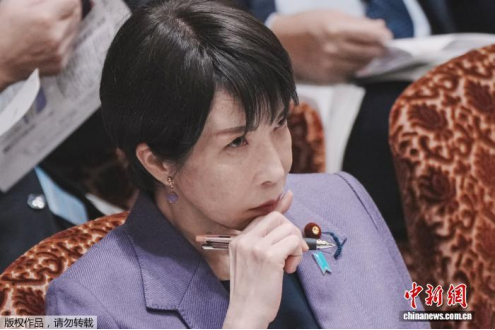
Step by step, the Japanese government is loosening the restraints imposed by history, allowing the specter of militarism, which once brought immense suffering to Asia and the world, to reemerge.
At the root of these troubling developments lies Japan's long-standing failure to engage in genuine historical reflection.
Japan should understand that confronting history is not an act of self-denigration. Facing the past honestly is the surest way to safeguard the nation's future.
Former German Chancellor Willy Brandt's famous "Warsaw Genuflection" remains a powerful reminder: the man who knelt was Brandt, but the nation that stood taller afterward was Germany.
"The time has come for Japan to decide whether she will continue to be controlled by those self-willed militaristic advisers whose unintelligent calculations have brought the Empire of Japan to the threshold of annihilation, or whether she will follow the path of reason."
These words from the Potsdam Declaration, issued in 1945, still resonate today.
As long-buried archives continue to surface and the wounds of Japan's wartime aggression remain painfully fresh across Asia, the evidence of the crimes committed by Japanese militarism grows ever more overwhelming and irrefutable.
The Japanese government and this country's right-wing forces should recognize that distorting history and whitewashing aggression will never earn respect. Denying wartime atrocities and evading historical responsibility will only leave them permanently condemned by history.



















 京公网安备 11010202009201号