



By Xue Lingqiao and Gan Tian
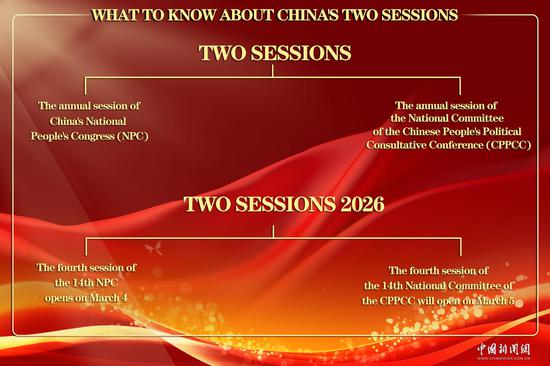
(ECNS) -- The 2026 national "two sessions" are currently underway. As China now enters its critical period of the 15th Five-Year Plan, how does China aim to accelerate its development with new quality productive forces as an engine to promote the high-quality growth of the private economy through innovation? This not only concerns deputies to the National People's Congress (NPC) and members of the National Committee of the Chinese People's Political Consultative Conference (CPPCC), but also has attracted the attention and research from foreign friends.
Adham Sayed, a researcher at the East Asia Institute of Zhejiang Gongshang University who has lived in China for many years, recently shared his observations on China's development, in the latest episode of China Q&A with China News Network. During the program, he also raised questions to Xu Mingjin, a CPPCC member. Xu is also the president of the Fujian Chamber of Commerce in Guangdong, and vice chairman of the Fujian Federation of Industry and Commerce.
Sayed observed that as this year marks the beginning year of the 15th Five-Year Plan, he believed that China will be committed to breaking away from traditional economic growth models, and instead, taking technological innovation as new development engine and new quality productive forces as a breakthrough to propel the high-quality development to a new height.
"The 15th Five-Year Plan draws on China's own experience, reflecting a comprehensive vision. It focuses on using advanced technology, industrial innovation, the digital economy, and AI to improve productivity and strengthen China's overall competitiveness," said Sayed.
He further pointed out that Chinese private enterprises have made significant contributions to driving China's GDP growth and providing domestic employment. Moreover, taking advantage of the new quality productive forces will further enhance the innovation efficiency of private enterprises.
Against this backdrop, Sayed raised questions on what measures China will take during the next five years to accelerate the cultivation of new quality productive forces, stimulate innovation vitality, and promote the high-quality development of the private economy.
In response to Sayed's questions, Xu Mingjin gave detailed answers and shared his observations on the development of China's private economy over the years.
"The 15th Five-Year Plan period is a critical phase for building a strong country and achieving the national rejuvenation. As an important component of the socialist market economy, the private economy should consciously integrate its own development into the wider national development strategy," Xu said.
Xu further pointed out that private enterprises should first serve as pillars in achieving technological self-reliance and transforming scientific and technological achievements.
Emphasizing that private enterprises enjoy flexible mechanisms and high market sensitivity advantages, he said that private enterprises should leverage their pioneering role in applied technology innovation and commercialization of achievements.
He also added that private enterprises should proactively increase investment on research and development, actively participate in major national scientific and technological projects, and create innovation hubs in emerging fields such as artificial intelligence, bio-manufacturing, and commercial aerospace.
Secondly, Xu said that private enterprises should take the lead in demonstrating green transformation, accelerating the development and application of green and low-carbon technologies, building a circular economy system, integrating the concept of ecological civilization into all aspects of production and operation, and achieving sustainable development in harmony with nature.
Thirdly, traditional manufacturing private enterprises must properly balance the relationship between "establishing the new before abolishing the old" and "abolishing the old before establishing the new."
Taking the development of Fujian's private economy as an example, Xu pointed out that they should seek breakthroughs and development based on their own advantages, rather than blindly chasing new trends and abandoning their main businesses.
In the end, Xu said that digital and intelligent development can provide technologies, tools, platforms, and optimization solutions for efficient resource utilization, green innovation, and energy management. Meanwhile, green development offers application scenarios and development paths for the application of digital and intelligent technologies, the sustainable development of digital and intelligent industries, and the prosperity of the digital and intelligent consumer market.
Therefore, promoting the coordinated transformation of traditional manufacturing industries towards digital, intelligent, and green development will greatly enhance the social supply capacity and help achieve a dynamic balance with high-end market demand.




























 京公网安备 11010202009201号