


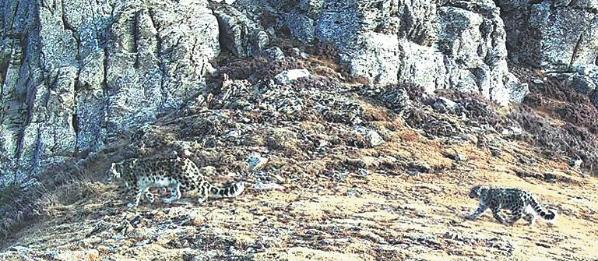
 A photo shows a female snow leopard, known as F2, with her cub in the Helan Mountains National Nature Reserve in the Ningxia Hui autonomous region on April 29. CHINA DAILY
A wild female snow leopard has been captured on camera with her young cub in the Helan Mountains National Nature Reserve, marking a significant milestone in wildlife conservation efforts in the Ningxia Hui autonomous region.
The footage, retrieved from an infrared camera on April 29, provides the first definitive proof that reintroduced snow leopards can successfully complete an entire reproductive cycle and raise wild-born offspring in the range. The female, designated by researchers as F2, was reintroduced into the mountains in 2024 from Jiuquan, Gansu province. She has since established a stable territory, paired naturally with a reintroduced male designated as M1, and successfully shepherded her cub through its fragile first year of life.
The snow leopard is a national first-class protected animal in China. While the Helan Mountains historically served as a primary habitat for the apex predator, human encroachment and habitat degradation caused the species to completely vanish from the local region for nearly 70 years. The birth of the new cub officially brings the reserve's tracked snow leopard population to nine.
Shi Kun, former director and professor at the wildlife research institute of Beijing Forestry University, said it has demonstrated that a reintroduced snow leopard can establish a stable pair relationship in a completely unfamiliar environment.
"For the first time, it has completed the entire reproductive process — from pregnancy and den selection to delivery — and also proven that a mother has the capacity to lead her offspring through their first harsh winter," Shi said.
The achievement is the culmination of decades of ecological restoration efforts. Since 2019, the National Forestry and Grassland Administration and the Ningxia forestry department have jointly spearheaded snow leopard population recovery, introducing eight leopards from the Inner Mongolia, Xizang and Xinjiang Uygur autonomous regions, and the provinces of Gansu and Qinghai.
These efforts were built upon a broader ecological foundation. Ningxia has curbed habitat destruction through mine remediation, grazing bans and vegetation restoration. As a result, the reserve's biodiversity has significantly improved. Monitoring data shows that the population of blue sheep — the snow leopard's primary prey — grew from just over 1,500 in 1983 to more than 41,000 in 2023. "This biodiversity has helped attract snow leopards, leopard cats, alpine musk deer and mandarin ducks back to their former home," said Wu Hong, director of the Ningxia Helan Mountain National Nature Reserve Administration.
To prepare the snow leopards for life in the wild, the reserve built a special training ground that simulates the real mountain environment. The training consists of several stages: contact isolation, environmental adaptation, live animal hunting, and finally learning to avoid dangers.
"The focus is on helping each leopard regain its natural hunting skills and adapt to the weather. Researchers monitor the animals' behavior and health, keep a file for each leopard, and only release them when they meet the required behavioral standards," Wu said.
The strategic significance of the Helan Mountains extends far beyond the reserve. Shi said the latest snow leopard genomic research reveals that global snow leopard populations are divided into two major genetic lineages: a northern lineage distributed across the Mongolian Plateau, and the Tianshan and Altay Mountains in Xinjiang, and a southern lineage distributed across the Qinghai-Tibet Plateau and Himalaya Mountains. The Helan Mountains sit precisely at the geographic midpoint between these two lineages.
"Establishing a healthy, self-sustaining snow leopard population in the Helan Mountains will break the genetic island effect, create a continuous gene flow network, enhance the species' evolutionary potential, strengthen its ability to respond to climate change, and provide long-term evolutionary potential for snow leopard conservation worldwide," Shi said.
According to a 2018 report jointly released by 19 organizations, over 60 percent of the global snow leopard habitat is located in China.
Previously, conservation efforts focused mainly on in situ protection in core distribution areas, safeguarding existing populations, combating poaching and mitigating human-wildlife conflict. "The success in the Helan Mountains marks the first time China's snow leopard conservation strategy has moved from maintaining existing stocks to expanding populations and restoring historical ranges," Shi said.
Over the next five years, the reserve will introduce and release an additional five to 10 snow leopards, with the goal of establishing a sustainable population of eight to 15 individuals in the Helan Mountains.
"The objective is to achieve natural reproduction, establish a relatively stable food chain, optimize the blue sheep population, repair damaged ecological links, and maintain the health and balance of the Helan Mountains ecosystem," Wu said from the reserve's administration.











































 京公网安备 11010202009201号