


![Experts and scholars discuss the current state and development of China-U.S. ties. [Photo/CHINA DAILY]](https://image.chinanews.com/batch-admin/2026/05-22/cb092b01-17d5-4f61-970f-fff2012115a6.JPG) Experts and scholars discuss the current state and development of China-U.S. ties. [Photo/CHINA DAILY]
Experts and scholars discuss the current state and development of China-U.S. ties. [Photo/CHINA DAILY]For years, China-U.S. relations appeared to be moving along a familiar and dangerous track. Trade wars, sanctions, technological restrictions, tensions over China's Taiwan, shrinking exchanges and strategic mistrust fed the belief that the world's two largest economies were sliding toward a new version of great-power confrontation.
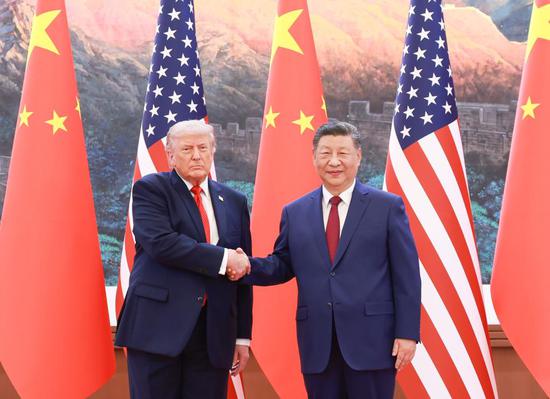
However, the recent summit meeting between President Xi Jinping and U.S. President Donald Trump in Beijing suggested a different possibility. Scholars at a China Daily seminar said the meeting pointed to a more realistic goal of keeping rivalry within boundaries, strengthening communication and reopening space for cooperation.
At the Symposium on the Future of China-U.S. Relations — organized on Thursday by China Daily's Opinion Channel, the Institute of American Studies at the Chinese Academy of Social Sciences and the Chinese Association for American Studies — Chinese and foreign scholars discussed the meaning of a "constructive strategic stability" and how it could guide the next stage of bilateral ties.
Yuan Zheng, deputy director of the CASS' Institute of American Studies, said the new positioning should be understood as a way to keep competition from overwhelming the relationship. "Constructive strategic stability should mean cooperation as the main direction, competition within bounds, differences under control and peace within reach," Yuan said.
Several other speakers echoed the view, arguing that the summit's significance lay not only in easing immediate tensions, but also in challenging the assumption that China and the United States are destined to fall into the Thucydides Trap.
Einar Tangen, a senior fellow at the Centre for International Governance Innovation, said the Beijing summit may prompt observers to reconsider the belief that the deterioration in China-U.S. relations is irreversible. The reason, he said, is not sudden trust or the disappearance of competition, but a recognition that the alternatives have become too costly. "Neither side can achieve absolute dominance without imposing catastrophic costs on itself and the world," Tangen said.
In his view, the idea of a constructive relationship of strategic stability may point to a broader strategic understanding in which the two countries continue to compete, but within limits designed to avoid systemic rupture.
Liu Weidong, editor-in-chief of Contemporary American Review, a Chinese academic journal published by the IAS, said U.S. policy toward China is moving away from simple pressure and destructive competition toward a more realistic form of competition based on recognition of China's strength. He attributed the shift partly to China's steady rise in comprehensive national strength, partly to China's strategic composure in its interactions with the U.S., and partly to the Trump administration's realist policy approach.
China, Liu said, has shown that while it does not seek confrontation, it will not be intimidated by pressure. Its response has been different from the Cold War-style confrontation between the U.S. and the Soviet Union, offering Washington evidence that another path is possible.
Josef Gregory Mahoney, a professor at East China Normal University, described the contrast using the image of walls and bridges. He said the U.S. has often relied on building walls, from military blocs and island chains to technological blockades and "small yard, high fence" restrictions. China, by contrast, has not answered walls with walls. Rather, China has built "ladders, gates, bridges, highways, ports and high-speed rail," Mahoney said.
Fred Teng, president of the America China Public Affairs Institute, said the Beijing summit should be judged not on the basis of immediate trade announcements or export deals, but by whether it helps create mechanisms to handle disputes before they become crises.
"The real choice before China and the United States is not friendship or confrontation. The real choice is managed competition or unmanaged rivalry," Teng said.
Such a framework could also reopen room for practical cooperation. Denis Simon, a senior fellow at the Quincy Institute for Responsible Statecraft, said scientific and educational ties may not regain the openness seen in the 1990s and 2000s, but full separation would be neither realistic nor desirable. Areas such as climate science, public health, agriculture, basic research and education, he said, still require sustained engagement.
Ross N. Mitchell, a professor at the Institute of Geology and Geophysics of the Chinese Academy of Sciences, brought a scientific perspective to the discussion. He compared a constructive China-U.S. relationship to the Earth's magnetic field, saying the two sides could form a "dipole" that helps generate stability and protection for the wider world if competition is managed responsibly.
Siddharth Chatterjee, former UN resident coordinator in China and distinguished visiting professor at Schwarzman College of Tsinghua University, placed the issue in a wider global context. Drawing on his UN experience, he recalled China-U.S. public health cooperation in Kenya, saying it showed that when the two countries work together, they can create tangible global public goods.
For many countries, Chatterjee said, stable China-U.S. relations are not merely a diplomatic issue. They affect whether countries can focus on development, public health, climate action and poverty reduction, rather than being forced to choose sides. "Many countries do not want to choose between China and the U.S.. They want a relationship that is fair, stable and cooperative," Chatterjee said.























 京公网安备 11010202009201号