


More than two decades ago, Yucun, a village in Anji county of East China's Zhejiang province, was known for what locals called the "stone economy". Quarrying and cement production brought income and once made Yucun one of Anji's better-off villages, but the prosperity came at a heavy environmental cost: Hills stripped bare, waterways polluted and the air thick with dust.
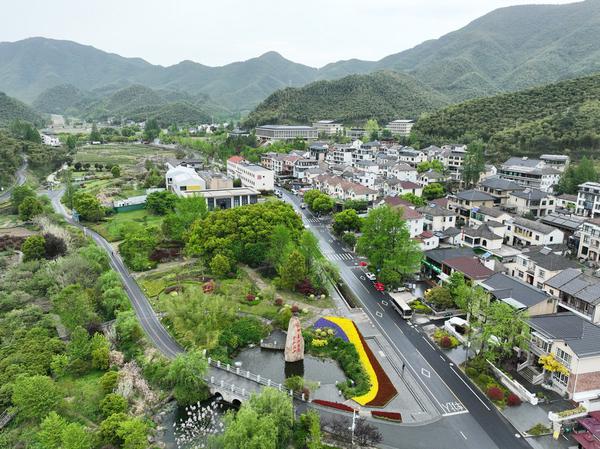
Yucun began shutting down its quarries, a decision that sharply reduced village income. The choice that the village faced was stark: Keep quarrying, or seek a different future — one built around ecological restoration.
At that crossroads, Xi Jinping, then Party secretary of Zhejiang province, visited the village in August 2005. After hearing briefings from local officials, he endorsed the shutdown as a wise move and said growth should not come at the expense of the environment, because such growth is not development.
He also put forward a concept that would later become widely cited: "Lucid waters and lush mountains are invaluable assets."
The idea was rooted in a concrete local choice rather than abstract theory, and it soon reached far beyond one village. It resonated not only because it recast the relationship between environmental protection and economic growth, but also because it challenged the GDP-centered view of governance performance that prevailed at the time.
Qian Kunfang, then Party secretary of Anji county, recalled that in an era when "GDP first, even industry first" prevailed, economic indicators were the most direct yardstick for judging local officials. He said that if officials failed to deliver results, they were effectively putting their political future at risk.
In that context, Xi's endorsement of Yucun's shift sent a clear message: Restructuring the economy and protecting the environment were not a retreat from development, but a different understanding of what real development — and real governance performance — should mean.
Two decades later, that shift is being reinforced through a Party-wide education campaign on fostering and practicing a correct view of governance performance.
For Xi, the commitment to high-quality development should become an important part of officials' correct view of governance performance.
Speaking on Jan 20 at a study session for principal officials at the provincial and ministerial levels, Xi said that such a view requires officials to proceed from reality, follow objective laws, and rely on sound decision-making and hard work to deliver results that stand the test of practice and history and are recognized by the public.
In 2023, during the annual two sessions meetings of China's top legislative and political advisory bodies, Xi warned against taking a hasty, resource-depleting or GDP-only path, saying that this was why the new development philosophy must be firmly established.
The environmental field has been one of the most visible areas where that philosophy has taken shape. Xi has repeatedly emphasized that "to protect the environment is to protect productivity, and to improve the environment is to boost productivity".
Yucun offers a concrete example of how that principle works on the ground. Yu Xiaoping, deputy Party chief of Yucun, said the village has stayed true to its ecological foundation while developing agritourism, cultural tourism and educational tourism programs based on local conditions, turning ecological gains into a driver of common prosperity.
According to Yu, in 2025, the village's collective economic income reached 17.22 million yuan ($2.52 million), per capita income among villagers stood at 74,800 yuan, and the village received 1.25 million tourist visits. Yucun distributed 3.17 million yuan in dividends that year.
To some foreign observers, China's green transition has also become a test of how governance performance should be understood — not by short-term output alone, but by long-term public benefit.
David Ferguson, a British translator, said that people-centered development is the overarching theme of the new development philosophy, which advocates innovation, coordination, green development, openness and shared prosperity. "Green development, one of President Xi's priorities, is about giving people a beautiful living environment and handing it down to their children and grandchildren."
Amery Browne, former foreign minister of Trinidad and Tobago, said China's experience challenged the assumption that material progress must come at the expense of the environment.
What impressed him, he said, was that ecological protection had been given priority, while renewable energy and related advances could also contribute to global efforts to tackle climate change and other shared challenges.
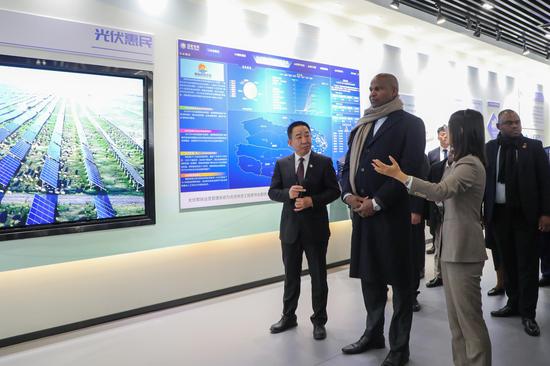
China's green industries are also reshaping global markets. Its renewable energy products are exported to more than 200 countries and regions, meeting over 80 percent of global demand for photovoltaic components and 70 percent for wind power equipment, and helping countries around the world — particularly developing nations — gain access to clean, reliable and affordable energy.
China has also remained the world's largest producer and seller of new energy vehicles for 10 consecutive years.
Beyond the environmental field, the same decision-making logic has shaped other areas of governance.
It can be seen in targeted poverty alleviation, which rejects one-size-fits-all remedies, and in the development of new quality productive forces, which stresses local strengths over blind imitation.
This logic is also reflected in cultural heritage protection, where preservation is treated as an achievement in governance. In regional strategies, it means matching resources, industries and functions across wider areas instead of chasing isolated, short-term gains.
Hong Xianghua, a professor at the Party School of the Communist Party of China Central Committee (National Academy of Governance), said scientific decision-making has become an important pillar of China's efforts to modernize governance and pursue high-quality development.
At its core, the approach reflects a people-centered philosophy that measures governance performance by whether it improves lives and can stand the test of time, he said.
It also requires systematic planning — balancing development with protection, efficiency with fairness, and immediate needs with long-term goals — while grounding policy in China's realities and objective laws of development, he added.
In a more complex domestic and international environment, sound decision-making is essential for identifying development trends, managing risks, building consensus and turning institutional strengths into more effective governance, Hong said.





























 京公网安备 11010202009201号