


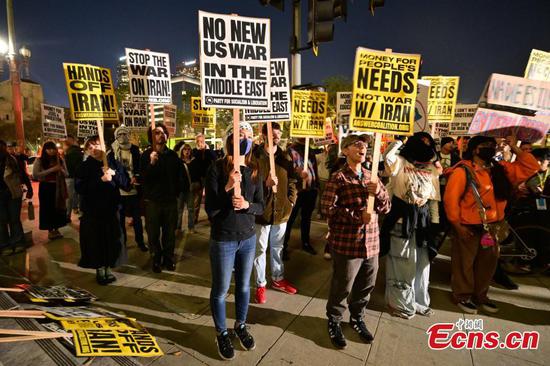
(ECNS) -- The U.S.-Israeli war on Iran is hitting ordinary Americans in their wallets, with rising gasoline prices, more expensive food, higher mortgage rates, and a surge in fertilizer costs.
Linda Bilmes, a former U.S. Department of Commerce chief financial officer, said the conflict could cost as much as $2 billion per day, with total expenditures potentially reaching $1 trillion based on historical comparisons.
That's just the tip of the iceberg, Bilmes said.
According to World Bank data based on current U.S. dollars, if this amount were converted into a country's GDP, it would rank among the top 20 in the world. It is roughly equivalent to more than twice Iran's GDP.
The following comparisons will help people better understand the total war cost.
According to the United Nations World Food Programme (WFP), providing assistance to 123 million hungry people in 2025 would require approximately $16.9 billion. By that measure, $1 trillion could sustain the world's hungry population for nearly 60 years.
Alternatively, take the Mombasa–Nairobi Railway in Kenya as an example. The 472-kilometer line, a flagship infrastructure project in Africa built at a total cost of about $3.8 billion, could be replicated 263 times with one trillion dollars.
Based on the World Bank's extreme poverty line of $3 per person per day, a rough calculation shows that the two billion dollars spent per day on the war could instead feed 667 million people worldwide on a daily basis. That would cover more than 80 percent of the global extreme poverty population (about 808 million), equivalent to twice the total number of people living in extreme poverty across Africa (about 344 million).
According to WARCOST, a third-party monitoring platform, the cost of the military action has exceeded $35 billion. That amount is equivalent to the annual salaries of 700,000 U.S. teachers, the yearly revenues of 140,000 small and medium-sized businesses, or full scholarships for 350,000 college students.
Different institutions have offered slightly varying estimates of the war costs. An analysis by the American Enterprise Institute (AEI), a Washington-based think tank, suggests that U.S. military action may have already cost as much as $31 billion over the five weeks since operations began on Feb. 28.
Mark Cancian, a senior adviser at the Center for Strategic and International Studies (CSIS) and a retired U.S. Marine Corps officer, put the total expenditure at approximately $28 billion, based on Pentagon budget cost calculations that take into account troop deployments, munitions consumption, and various wear and tear on military bases and aircraft.
According to data from the United Nations Development Programme (UNDP), the GDP of the Arab region is projected to shrink by $120 billion to $194 billion one month after the outbreak of the war — an amount exceeding the region's cumulative GDP growth for all of 2025. In other words, the war has effectively wiped out a full year of economic gains for Arab nations.
No official loss figures have yet been released for Iran. However, with its economic lifelines — including energy, technology, and transportation — under bombardment, the toll is expected to be far more staggering.
(By Zhang Dongfang)








































 京公网安备 11010202009201号