



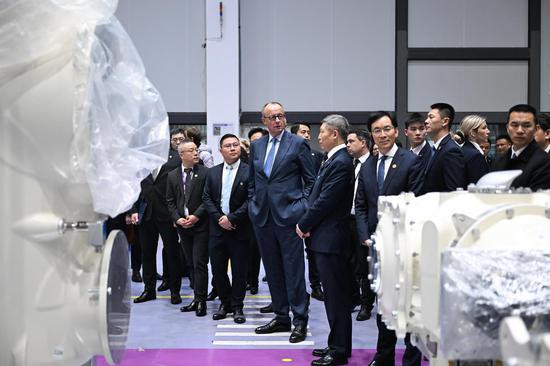
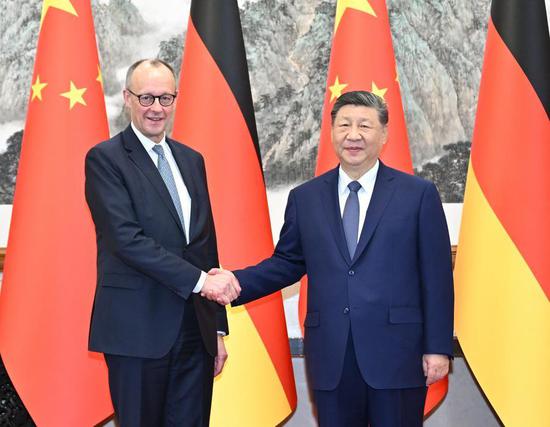
As German Chancellor Friedrich Merz concluded his visit to China — his first since taking office in May — and headed home with a delegation of about 30 leading entrepreneurs, the visit as well as the agreements reached between Beijing and Berlin have aroused lively discussions among scholars, entrepreneurs and other observers in Germany.
The size and composition of the large-scale delegation clearly de-monstrated "the strong expectation within Germany's business community to cooperate with China", said Michael Borchmann, former director-general for international affairs of the German state of Hessen. "In today's turbulent world, China is an ideal partner for Germany. Cooperation between the two nations is likely to grow even closer, as we need each other."
Among the agreements that the two sides achieved, the joint statement on the continuation of a bilateral dialogue on green transformation and climate change has brought the most attention.
"At a time of mounting trade tensions, climate change and the energy transition remain core pillars of the Germany-China relationship, as Merz's first official visit to Beijing showed," said Belinda Schape, a German-born China analyst at the Helsinki-based think tank Centre for Research on Energy and Clean Air.
"Crucially, climate and clean energy were not sidelined," said Schape. "China and Germany reaffirmed their commitment to sustained climate collaboration by agreeing to continue the bilateral 'Climate Change and Green Transformation Dialogue', underscoring climate action as a stable platform for cooperation even amid broader tensions."
Schape highlighted that President Xi Jinping, in his remarks, framed Germany's new tech and innovation strategies — including digitalization and green development — as highly aligned with China's 15th Five-Year Plan (2026-30), which she believes highlights space for mutually reinforcing innovation pathways in areas like clean tech and advanced energy systems.
"Both leaders agreed on the need to navigate competition and cooperation constructively, seeking win-win approaches that support resilient supply chains and ongoing engagement in frontier technologies. This will not be an easy task in practice, but this high-level engagement can pave the way for finding constructive solutions going forward."
Volker Friedrich, CEO and chairman of GBP International, a Berlin-based management consultancy, said: "Merz's visit to China showed that China remains systemically relevant for German industry — as a market, a production hub, and increasingly as an innovation partner. Full decoupling is neither economically realistic nor strategically wise.
"For decades, Germany benefited enormously from exporting to China at scale. There were few complaints when the trade balance favored us. Now, as Chinese companies compete globally and in Europe, the tone has shifted. Competition is not unfair simply because it has become stronger," he added.
At the same time, the GBP International CEO said that engagement must evolve. "What businesses need today is structured, reciprocal cooperation: fair market access, regulatory transparency and a level competitive playing field."
For German small and medium-sized enterprises in particular, "the path forward is clear: Diversify where necessary, build resilience, but remain engaged", he said.
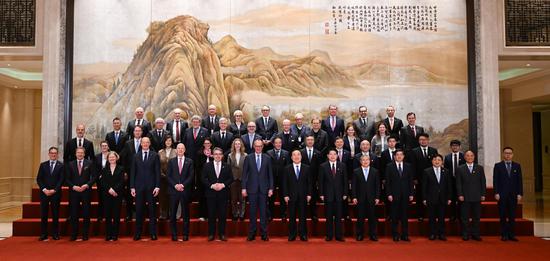
On Feb 25, Premier Li Qiang and Merz jointly presided over a symposium of the China-Germany economic advisory committee, with more than 60 business leaders from both countries in attendance.
Among those represented was premium smart electric vehicle manufacturer NIO, whose European branch's deputy head, Zhang Hui, said, "As a bilateral mechanism under the consultation framework, the China-Germany economic advisory committee provides an important platform for structured dialogue between policymakers and the business community."
He also said he hoped that companies from both nations will remain committed to contributing constructively to China-Germany economic cooperation and to supporting sustainable, high-quality development through openness and innovation.
Simone Harre, a German writer who often visits China, highlighted in particular the guiding point from President Xi that the two sides need to engage in deeper exchanges and mutual learning from each other.
"For foreigners, the encounter with China is always different from what one imagines — intensely pulsating, colorful and powerful. For me, it never fails to bring happiness, and something similar must have happened to Merz," Harre said.
"China and Germany have more in common than most people believe. And in times like these, goodwill must come first. On that basis, conflicts can be eased," the writer added.

























 京公网安备 11010202009201号