


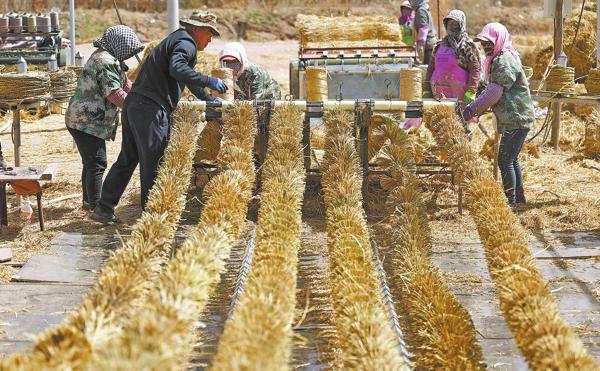
 Sand control workers use machinery to weave sand-blocking belts with grass grid barriers on April 10 in Zhongwei in the Ningxia Hui autonomous region. WANG PENG/XINHUA
Unlike many ecological projects, which falter due to short-term aid cycles, China's great green wall — the Three-North Shelterbelt Forest Program — thrives thanks to its long-term strategies and predictable funding, incentivizing local people and businesses to invest in restoration.
This achievement was highlighted in articles recently published in the journal Nature, ahead of World Environment Day, which falls on Friday. They also said that China's incentive mechanism ensures continued funding, transforming the effort into a shared socioeconomic endeavor.
According to the reports, drylands already cover 40 percent of the planet's total land area, and that share could increase by a further 10 percent due to global warming before the turn of this century. While many countries and regions have launched programs to fight desertification, beyond China, green wall projects in India, Africa and the Gulf states have struggled to survive, they said.
The Three-North program, a large-scale ecological afforestation project launched in 1978, covers 13 provincial-level regions across northwestern, northern and northeastern China. By 2023, it had nearly tripled forest cover — from about 5 percent to about 14 percent — while soil erosion had declined by two-thirds.
As most green wall projects fail due to a lack of continued finance and maintenance, China has repeatedly committed to funding the project, and its incentives for local investment have ensured that the stream of funding never dries up.
In the Kubuqi Desert, for example, enterprises and herders can obtain low-interest loans and tax reductions for sand control, which has attracted more than 3 billion yuan ($443 million) in investment since 2010.
China also provides short-term income to vulnerable communities through various work-relief programs.
Lu Qi, chief scientist at the Chinese Academy of Forestry, regularly visits the front line of the Three-North program, which currently covers 40 percent of China's total land area, witnessing firsthand how incentives have driven its success.
"Everyone is rushing to take part, and their enthusiasm is irrepressible," he said after a recent visit to the Inner Mongolia autonomous region.
Lu, who visited the front line three times this year shortly after the Spring Festival holiday, noted that despite the cold weather, sand control work started as early as Feb 28.
The foremost reason for this passion, he said, is the pressing need to build a better home, adding that the government's policies also enable local farmers and herders to see tangible benefits for themselves.
An opinion piece published in Nature emphasized that China's financial strategies cannot simply be replicated in countries with different laws and fiscal capacities.
"A practical first step for any country is to elevate sand control from a short-term forestry project to a long-term government-level obligation," it said. "External aid should be used to leverage domestic cofinance, rather than serve as a one-off cash injection."
China is also linking renewables infrastructure directly with ecological restoration.
The article said that, in countries with fewer resources, smaller photovoltaic systems could be installed near high-value assets such as roads and water pumping stations. While these projects require substantial up-front investment, electricity sales could provide predictable revenue for maintenance, it added.
Another key lesson from China's experience, according to the article, is that governments in other countries need to view ecological restoration as an investment, not as a cost.
Lu noted that this investment has already paid off significantly in China following a fundamental shift in the Three-North program's philosophy over time.
"In the beginning, we only cultivated fast-growing, tall trees that offered good protection," he said, adding that the focus gradually shifted to integrating ecological conservation, production and livelihoods.
Growing plants under solar panels is a key example of this integration. The plants are mostly fruit-bearing ones, such as matrimony vine and sea buckthorn, as well as those used in traditional Chinese medicine, such as astragalus.
In some regions, solar panels are used to provide shade for herding. Instead of letting cattle graze directly on the grass, strands are trimmed and removed to feed the animals — an approach that has no negative impact on the protective function of the plants.
"I see this as a major transformation — one that integrates ecology, production and people's livelihoods," Lu said. "It not only protects the land and provides income for farmers and herders, but also brings benefits to society as a whole."
































 京公网安备 11010202009201号