


In the mist-shrouded valleys of southwestern China, summer does not arrive with a date on the calendar; it arrives with a sound — the crisp snap of plums being plucked from their branches.
The harvest begins with mang zhong, or Grain in Ear, one of China's 24 traditional solar terms and a seasonal marker long associated with ripening crops and the onset of midsummer. As heat and humidity settle over the Chengdu Plain in Sichuan province, the hillsides of Dayi county come alive with activity. Farmers gather in numbers to pick plums that have spent months maturing beneath dense green canopies.
Once sharply tart, the fruit has now turned plump, glossy and sweeter, carrying a faint blush and a fresh fragrance. This signals the start of Dayi's annual plum-processing season — a tradition that connects orchards, home kitchens and local wineries.
Dayi's natural conditions have made it one of China's major plum-producing regions. Fed by meltwater from Xiling Snow Mountain and shaped by significant temperature differences between day and night, the area produces plums known for their rich aroma, thick flesh and sharp acidity.
For 79-year-old farmer Wang Xiuhua, the harvest represents the culmination of months of careful work. "Plum blossoms open in the bitter cold of the twelfth lunar month," she said. "The hardest time comes in early spring. If snow or frost arrives when the trees are flowering, the blossoms fall and there will be very few fruits."
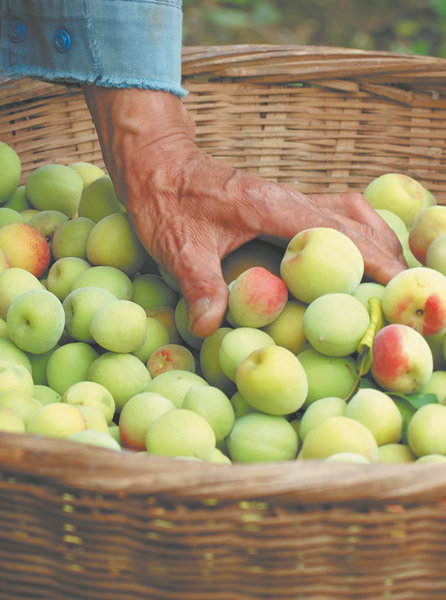
The rest of the year requires constant attention, from pruning branches to applying organic fertilizer. By the time mang zhong arrives, farmers are watching closely for signs of peak ripeness. "Once the plums turn golden, you have to pick them quickly," Wang said, adding that among Dayi's varieties, she favors the region's traditional local plums for home brewing because of their balance of acidity and flavor.
For generations, preserving the taste of summer has been a seasonal ritual in local households.
Wang still follows a family recipe for making sugar-cured plums. The freshly picked fruit is washed and carefully air-dried before being layered with white sugar in a glass jar. Over time, the plums release their juices and gradually wrinkle, creating a concentrated syrup.
"On a hot day, you can take out a couple of plums and mix the syrup with water. It's naturally refreshing and tastes like summer," she said.
The fruit also plays a key role in Dayi's plum wine industry.
Hu Yao, founder of Chengdu Dahe Hongmei Wine Co and a practitioner of the region's traditional plum winemaking technique, said the Nanko variety of the fruit has a small pit and thick flesh. "When fully ripe, the aroma is especially intense, which gives the wine a strong fruity character."
To preserve the fruit's quality, plums destined for winemaking are picked by hand, and the journey from the orchard to the processing facility is kept short to maintain freshness.
Unlike products made by simply steeping fruit in distilled spirits, Dayi's traditional plum wine relies on pure fruit fermentation — a process requiring careful temperature and timing control. "If one step goes wrong, the whole batch can turn into vinegar instead of wine," Hu said. "Many producers avoid pure fruit fermentation because it takes a lot of patience and experience."
The reward comes with time. After at least two years of fermentation and aging, the wine develops a smoother and more balanced character. Combined with spring water sourced from the Xiling Snow Mountain area, it delivers a distinctive sweet-and-sour profile.
While the plum itself has changed little over the centuries, the ways people enjoy it continue to evolve. Growing demand among younger consumers for lighter, fruit-forward drinks has inspired new products ranging from jasmine — and chrysanthemum-infused plum wines to sparkling plum beverages and tea-based drinks.
What was once primarily a seasonal agricultural product has found a place in contemporary urban life-styles. For many consumers, plum-based drinks offer not only refreshment, but also a connection with seasonal rhythms that have shaped Chinese life for generations.
As summer settles across Sichuan and the orchards empty of fruit, the work after harvest continues in jars, bottles and fermentation tanks. A year later, when the weather turns hot again, the flavor of Dayi's plums will return in a glass of chilled drink, carrying with it the taste of a season that begins each year with the snap of a fruit leaving its branch.






































 京公网安备 11010202009201号