


By Guan Yilun
(CNS)-- The second World Conference of Classics was held from Tuesday to Wednesday in Athens, Greece. C. D. C. Reeve, Delta Kappa Epsilon Distinguished Professor of Philosophy at the University of North Carolina at Chapel Hill, was invited to attend. He had recently visited China, delivering a series of lectures at Renmin University of China titled "Routes of Recollection: Plato Reconceived".
How should we understand Plato? What gives classical works their enduring vitality? What is the mission of contemporary classicists? Reeve, who has worked in ancient Greek philosophy for fifty years, shared his insights in an exclusive interview with China News Service's W.E.Talk.
Here are excerpts of the interview:
CNS: The theme of this year's World Conference of Classics is "Dialogue Between Ancient and Modern: Contemporary Inspiration from Classical Wisdom". What is your understanding of this theme and what are your expectations for the conference?
C. D. C. Reeve: I take the theme literally. So, I've tried to invert it: Insights from Classical Wisdom for we Moderns. For example, boredom is a contemporary problem; great works can help alleviate it for those who can access and understand those classical works. They certainly solve that problem for me.
The enduring vitality of classical works derives from their excellence, of course. They're among the greatest works of their kind that we possess. You can't do much better than Homer, Sophocles, Plato, Aristotle, Thucydides. And that's just citing a few of the Greek works.
One of my main expectations is simply to meet people I wouldn't otherwise meet. If people like each other, they can talk, explore ideas together, and work collaboratively-whether they are philosophers, classicists, or scholars from other fields.
CNS: You have devoted much of your scholarly career to the study of Plato and Aristotle. How would you evaluate these two ancient Greek philosophers?
C. D. C. Reeve: What made their thinking critical, is that the theories they advanced, whether on the nature and origins of the cosmos or on ethics and politics, were not offered as gospels to be accepted on divine or human authority but as views to be accepted or rejected on the basis of evidence and argument: Friends are dear, says Aristotle, when about to criticize his teacher Plato, but to philosophers the truth must be dearer.
As we weigh and consider the ideas and evaluate the arguments and theories of Plato and Aristotle, we find ourselves thinking about the ultimate structure of reality, about logic and mathematics, about the mind, about the nature of knowledge and scientific theorizing, about ethical values, about cultural relativism, about historical explanation, about tragedy and comedy, about rhetoric, and about the best kind of society for people to live in. Some of what we uncover we may accept as true or plausible; some we may criticize, modify, or reject altogether. But as long as evidence and argument remain our touchstones, we will be joining in the enterprise that Plato and Aristotle did more than anyone to develop.
CNS: You recently delivered a series of lectures at Renmin University of China titled "Routes of Recollection: Plato Reconceived". For you, what's the most important lesson that Plato has left for today's world?
C. D. C. Reeve: It's not more important these days than it is in any other to reconceive Plato's philosophy. To a certain extent, Plato has been misunderstood for millennia and there is room for new interpretations in part because new times ask him new questions.
I don't know what the "most" important lesson is. But one important lesson from Plato is that until knowledge of what's really good for human beings is combined with political power, things are likely to go quite badly in political affairs.
CNS: During the lectures, did any interaction between you and Chinese students and scholars impress you most?
C. D. C. Reeve: The students who regularly attend the lectures are remarkable. They're full of enthusiasm, are attentive, and ask excellent questions. It's obvious they have been well-trained. They're also very warm, friendly, and respectful. It's a delight to discuss things with them.
I've only met a few scholars in Beijing, some from Renmin University of China and some from other Chinese universities, including Peking University. I was impressed by all of them and benefited from their papers and from conversations with them.
In the case of the scholars/professors, there are no interesting differences as far as I'm aware. They seemed like fully accredited members of the international community of scholars. The students I encountered were as good as their peers at first-rate universities in the US.
CNS: What is the mission of contemporary classicists? What message would you like to share with those aspiring to study Classics?
C. D. C. Reeve: They're no different from the missions and responsibilities of scholars and intellectuals generally to be reality focused and evidence sensitive.
Books are mirrors. When you look into them, try to ensure that someone worthwhile looks back at you.
C. D. C. Reeve's profile:
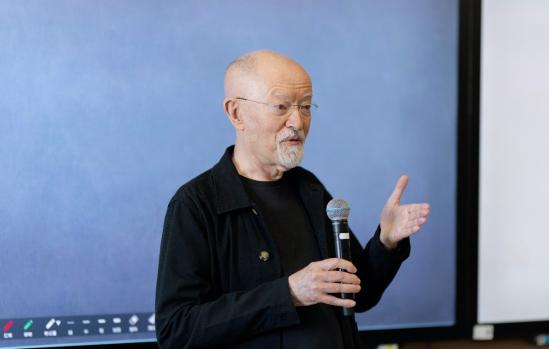
C. D. C. Reeve, Delta Kappa Epsilon Distinguished Professor of Philosophy at the University of North Carolina at Chapel Hill, is an internationally renowned expert in ancient Greek philosophy. He works primarily on the philosophy of Plato and Aristotle. He has published nine monographs and more than 50 papers, and has translated and annotated a large number of works by Plato and Aristotle. He, as the main translator and chief editor, together with Professor Pavlos Kontos, published the new English translation of Aristotle's complete works (Hackett, 2025).













































 京公网安备 11010202009201号