


China's decades-long efforts in lifting hundreds of millions of people out of poverty are increasingly offering Africa both development experience and practical support in the continent's own fight against poverty.
Through investments in infrastructure, energy, agricultural technology transfer, vocational training and institutional capacity-building, China has emerged as a key partner in advancing Africa's sustainable development agenda.
According to Charles Onunaiju, director of the Centre for China Studies in Nigeria, China recognizes that global prosperity cannot be achieved while large parts of the world remain trapped in poverty. China has also demonstrated its commitment through its engagement with Africa, he said.
He said over the past two decades, China's engagement with Africa has increasingly focused on practical measures aimed at addressing structural barriers to development, particularly through infrastructure connectivity, capacity-building and job creation under the Forum on China-Africa Cooperation, or FOCAC, and the Belt and Road Initiative.
Onunaiju emphasized that poverty reduction should not be treated as a humanitarian issue but as a central policy priority requiring coordinated action across all levels of government.
"That was how China dealt with poverty. It was not treated as merely a departmental or ministerial responsibility. The entire machinery of government was mobilized in the direction of combating poverty," he said.
He pointed to China's Global Development Initiative, or GDI, as an example of how Beijing has shared both its experience and practical support for poverty reduction, including technical and financial assistance.
"China placed the totality of its experience in the public domain and created institutional frameworks through which other countries could engage with their experience via the GDI," Onunaiju said.
He said China's success rested significantly on continuous institutional reexamination, noting that institutions that are functional today may become too weak to solve tomorrow's problems if they are left unexamined.
Onunaiju identified agriculture, digital infrastructure and skill development as some of the sectors with the strongest potential for deeper China-Africa cooperation.
He said China has played an important role in supporting Africa's agricultural modernization through technical cooperation, agricultural equipment, seedlings and market access opportunities.
Zero-tariff policy
Onunaiju said China's zero-tariff access for products from many African countries could create new export opportunities, particularly for agricultural goods, while supporting economic diversification.
Dennis Munene, executive director of the China-Africa Center at the Africa Policy Institute in Nairobi, Kenya, said that by lifting over 800 million people out of poverty, China provides an inspiring model of development for the Global South.
He said China's unprecedented achievement serves as a powerful blueprint for Africa to achieve its Agenda 2063 and the United Nations 2030 Agenda for Sustainable Development.
"This achievement also proves that nothing is impossible to achieve when citizens come together for a common purpose," Munene said.
Munene noted that the data systems and digital technologies used in China's poverty alleviation programs can be leveraged in Africa to map and identify the most affected countries and villages, allowing various government departments tasked with implementing the programs to deliver critical essentials needed by the most vulnerable households.
Additionally, digital technologies such as e-commerce platforms enabled farmers to access consumers directly avoiding the middlemen who benefited the most and contributed to the impoverishment of rural farmers.
"African farmers can also adopt this strategy and tap into the benefits of the zero-tariff policies granted to the 53 African nations with diplomatic relations with China. African farmers can leverage digital technology and access the Chinese market," Munene said.
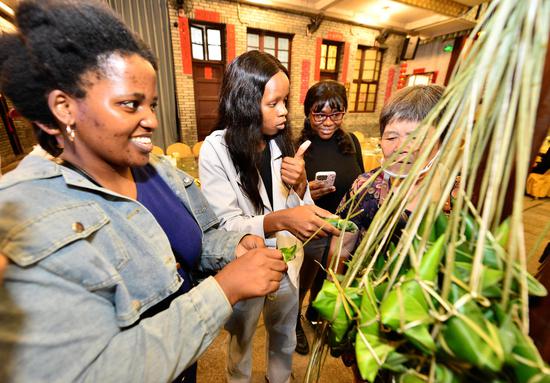
He said technologies such as Juncao technology can be enhanced further to increase food production and ensure food security in Africa.
Juncao technology consists of the cultivation of grass that can be used as a substrate for mushroom production and animal feed, and to minimize soil erosion.
Munene said African countries can draw lessons from China's sequencing of development priorities to better balance poverty reduction with industrialization and structural transformation.
He said China's sequencing of development priorities shows that the leaders used a pragmatic approach. First, they focused on uplifting the lives of the people by ensuring there is food security. Then, they strategically transitioned the country into high-tech, digital, and green industries by investing heavily in infrastructure, research and development, and higher education.
Munene said African countries can adopt a similar strategy that fits their own ambitions and targets, transitioning the continent from exporting raw materials to developing targeted special economic zones that will industrialize the continent to produce value-added goods.
"The continent also needs to develop sustainable infrastructure that will enable Africa to bridge the infrastructure deficit and enhance economic growth and development."
Onunaiju said Africa must position itself within emerging technologies such as artificial intelligence, cloud computing and quantum computing to remain globally competitive.



































 京公网安备 11010202009201号