



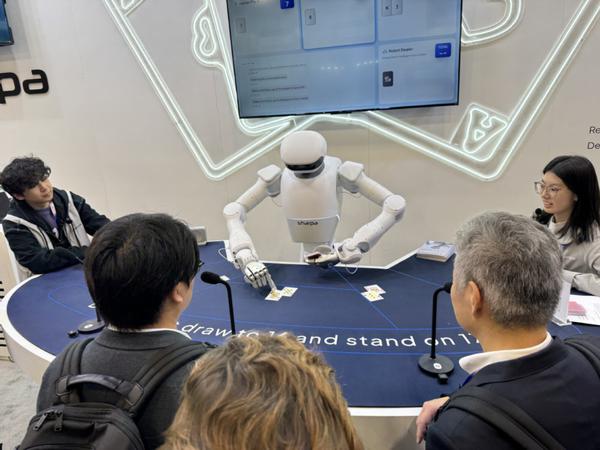
 A humanoid robot demonstrates real-time card-dealing capabilities at CES 2026, showcasing advances in embodied AI, motion control and perception technologies. Photo/CHINA DAILY
The Consumer Electronics Show 2026 concluded in Las Vegas on Jan 9, marking the largest post-pandemic edition of the world's most influential technology event. More than 148,000 attendees from over 150 countries and regions, including 4,100 exhibitors and 1,200 startups, gathered for the annual tech carnival. The event highlighted "technologies that will define the next decade of economic growth and competitiveness," said Gary Shapiro, executive chair and CEO of the Consumer Technology Association.
This year's show signaled a shift from futuristic concepts to real-world, scalable deployment, demonstrating how artificial intelligence, sustainability technologies and intelligent devices are converging to reshape daily life.
China's strong presence
Chinese technology companies were among the most visible forces at CES 2026, demonstrating advances across intelligent devices, automotive technologies, next-generation displays and AI-driven lifestyle solutions. Their showcases drew steady international attention, not only for technical strength, but for increasingly localized and partnership-based global strategies.
Many of them highlighted R&D collaborations in North America and Europe, as well as diversified supply-chain layouts across Asia, Latin America and the Middle East. Analysts said more Chinese firms are now focused on long-term participation in innovation, not merely export expansion.
Despite geopolitical tensions, Chinese brands reported steady acceptance among North American consumers. Kenneth Hong, head of public relations for Hisense in the Americas, said political narratives have little impact on day-to-day business.
"The vast majority of North American customers do not have a problem with Chinese manufacturers," Hong said. "A lot of it may be created by politics, but it's not something that affects our day-to-day work. As long as the products are good, retailers and consumers accept them."
AI enters real-world deployment
A defining theme at CES 2026 was the shift of AI from experimental demonstrations toward practical, ecosystem-level integration. Executives stressed that the next stage of global competitiveness will depend on integrating hardware, algorithms and data infrastructure.
This interdependence was highlighted during a high-level event presided over by Yang Yuanqing, chairman of Lenovo, who brought together top US semiconductor executives Jensen Huang of Nvidia, Lisa Su of AMD, Cristiano Amon of Qualcomm and Lip-Bu Tan of Intel.
Observers said the gathering sent a strong message that global AI progress depends on cross-border cooperation, not fragmentation. Yang called the moment a "new milestone", reflecting more than a decade of collaboration and the rising importance of hybrid AI systems that combine cloud, edge and personal computing.
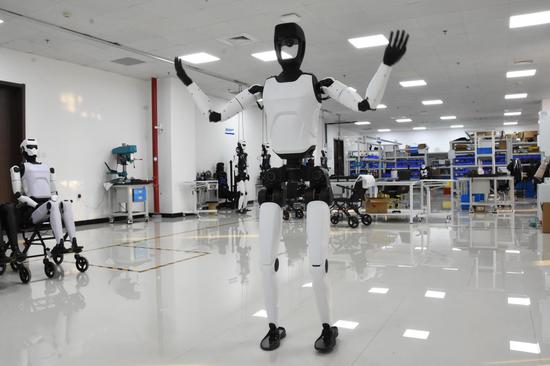
Another clear signal from CES 2026 was the emergence of "physical AI," where intelligence is embedded directly into machines that perceive, interpret and act within real environments. Chinese robotics companies played a prominent role in showcasing this transition.
For example, Shanghai-based AgiBot, a firm specializing in humanoid and embodied-intelligence systems, demonstrated advanced robotic platforms capable of real-world interaction and motion planning, illustrating how AI-driven robots are moving closer to practical deployment.
According to CES data, more than half of exhibitors in the humanoid robotics category came from China, highlighting China's rapidly expanding influence in embodied AI technologies and its growing contribution to the global robotics ecosystem.
AI and the global opportunity gap
Beyond commercial applications, CES 2026 also spotlighted the social implications of AI, particularly its potential impact on developing countries and underserved communities.
"We need to narrow, not widen, the gap between developing and developed countries by using AI," said Derrick Johnson, president and CEO of the National Association for the Advancement of Colored People.
"If you are in an isolated community with limited access to technology, AI can bring information that would otherwise be unattainable, helping people expand their understanding of the wider world," he told China Daily.
"Venture capital should empower innovators in rural and urban areas so that more voices can be added to the innovations in the city," he added.
For African economies, AI is seen as a catalyst for industrial upgrading and job creation.
"When AI takes one job, it creates five," Abubakar Yussif, a representative from Ghana's Ministry of Labour, Jobs and Employment, told China Daily, adding that developing countries aim to use AI to strengthen local industries and benefit more directly from global partnerships.
As AI adoption accelerates, business and community leaders emphasized that public policy will be critical to ensuring responsible and effective deployment.
"Without clear, stable policies and regulatory certainty, AI systems cannot be meaningfully integrated into organizations or deliver the solutions people need," said Jacquelyn Puente of the US Hispanic Chamber of Commerce.
"Public and private sector leaders need to work together to make scalable global solutions possible," added Claire Casey, president of the American Association of Retired Persons Foundation.
States seek global investment
CES also served as a platform for US states seeking to attract foreign investment. Nevada, the host state, showcased its transformation from a gaming-centric economy to a hub for advanced manufacturing, clean energy and emerging technologies.
"We welcome innovative Chinese companies, particularly those engaged in renewable energy and water-efficient development, to invest and explore opportunities in our state," Nevada Lieutenant Governor Stavros Anthony told China Daily.
State officials also pointed to Nevada's strong pro-business environment and resource advantages. Tom Burns, executive director of the Nevada Governor's Office of Economic Development, said the state is actively engaging with Chinese enterprises interested in innovation and long-term investment.
"Nevada is a very can-do place," Burns told China Daily. "We are certainly open to conversations as Chinese companies present themselves."
At a CES governors' panel, Nevada Governor Joe Lombardo and Alaska Governor Mike Dunleavy stressed regulatory stability, workforce development and openness to emerging technologies such as AI and advanced manufacturing.
"We're embracing AI," Lombardo said. "For Nevada, speed to market is critical. We want to be the place where someone with an idea can come in, set up a business and open their doors faster than anywhere else."
"As the Arctic warms, Alaska's location makes it ideal for future shipping routes and for becoming a major data-transport hub linking Asia, Europe and the lower 48," Dunleavy said. "With our resources, we're well positioned to become a prime destination for data farms and long-term infrastructure investment."
A platform for collaboration
The importance of cross-border cooperation was further echoed at CES Asia Night, where business leaders and policymakers highlighted Asia's central role in the global technology landscape.
"A large percentage of our CES attendance comes from Asia," said John Kelley, vice-president of the Consumer Technology Association and show director. "That speaks to the strength of the Asian market and its role in the overall technology ecosystem."
Political consultant Eric Branstad, son of former Iowa Governor and US ambassador to China Terry Branstad, said US-Asia ties remain one of the most dynamic and resilient global partnerships.
"At a time when the world can feel increasingly divided, this relationship reminds us of the enduring power of collaboration, innovation and shared prosperity," Branstad said. "We are not just trading goods. We are building trust, forging friendships and creating a world in which everyone can benefit."
He noted that US-Asia trade has rebounded strongly, surpassing $2 trillion annually, with cooperation continuing in sectors such as consumer electronics and biotechnology.
"When nations work together, prosperity is shared, understanding is deepened and a better future can be built for all," Branstad added.
































 京公网安备 11010202009201号