



Australian Prime Minister Anthony Albanese is on a visit to China, his second trip to the country since taking office in 2022 and his first since his re-election in May.
Chinese Foreign Ministry spokesperson Mao Ning highlighted that Albanese's visit from July 12 to 18 takes place just as the China-Australia comprehensive strategic partnership enters its second decade. "China hopes that through this visit, the two sides will strengthen communication, enhance mutual trust, expand practical cooperation and further advance the comprehensive strategic partnership."
According to a statement from Albanese's office, his visit includes stops in Beijing, Shanghai, where he arrived on Saturday, and Chengdu, the capital of southwest China's Sichuan Province.
Chen Hong, director of the Australian Studies Center at East China Normal University, noted that Albanese's visit so soon after his re-election underscores Australia's high regard for its relationship with China.
"In today's rapidly changing global landscape, especially with free trade facing serious challenges, Australia seeks to deepen its ties with China and focus on shared interests," said Chen.
Strengthening economic ties
Economic and trade cooperation is at the heart of Albanese's visit. According to the Australian Financial Review, he is leading a delegation of business leaders, including top executives from Macquarie Bank Ltd. and HSBC Holdings PLC's Australia arm, as well as from Fortescue Ltd., BlueScope Steel Ltd., Rio Tinto Ltd. and BHP Group Ltd.
The statement from his office said his trip covers key sectors such as business, investment, tourism and other major sectors to build on Australia's strong economic and trade links with China.
Australia's energy products, agricultural goods, seafood, services and tourism sectors are closely linked with China, while Chinese products like electric vehicles and home appliances also have substantial consumer markets in Australia. "The economic ties between the two countries serve as a stabilizing force for bilateral relations and will continue to drive both trade and economic growth," Chen said.
"China is an important trading partner for Australia, 25 percent of our exports go to China," Albanese told reporters when asked about his visit to China, "What that means is jobs, and one of the things that my government prioritizes is jobs."
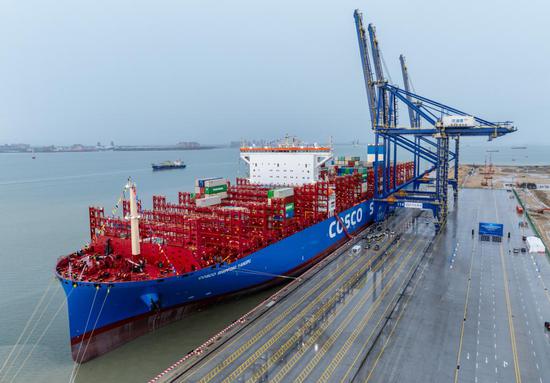
China is Australia's largest trading partner, and bilateral trade is vital for Australia's economy. China has been Australia's largest trading partner for 16 consecutive years. The China-Australia Free Trade Agreement, which came into effect in 2015, has significantly boosted trade, with total trade volume surpassing $210 billion in 2024.
According to a report from the Australia China Business Council, trade with China has benefited Australian households, adding an average of 2,600 AUD ($1,711) to disposable income and reducing the cost of living by 4.2 percent. Bilateral trade has also contributed to the creation of nearly 600,000 jobs in Australia, underscoring the advantages of the Australia-China trade relationship.
Deepening cooperation
Experts have also pointed to other cooperation potential. With increasing focus on climate change, both countries are eager to expand cooperation in the green economy and clean energy sectors. Areas like wind power, solar energy and lithium mining hold significant potential for cooperation.
On Sunday, China's ambassador to Australia, Xiao Qian, wrote in People's Daily that "China-Australia mutually beneficial cooperation continues to deepen, with expanding collaboration in clean energy, climate change, and healthcare, offering vast prospects and potential."
Caroline Wang from Clean Energy Finance, a think tank, highlighted that China leads the world by a "staggering margin" when it comes to many energy transition sectors, such as electric vehicles and solar panels.
She told the Australian Broadcasting Corporation that for Australia to meet its emission reduction targets and build a green industrial capacity, China will be an essential partner as Australia needs access to Chinese technology and Chinese industrial capability.
China also remains Australia's largest source of international students and overseas tourists. Each year, over one million Chinese tourists visit Australia. In 2024, China and Australia reached a five-year multiple-entry visa agreement, and China will offer a unilateral visa exemption policy for Australian citizens, further facilitating bilateral exchanges.
Against the backdrop of rising unilateralism and protectionism, Ambassador Xiao emphasized the importance of maintaining a healthy and stable relationship between China and Australia.
He affirmed that China will work with Australia to build a more stable and fruitful China-Australia comprehensive strategic partnership, based on mutual respect and equality. "This will benefit both nations and inject greater stability and certainty into the region and the world."


































 京公网安备 11010202009201号