


In a bamboo-draped corner of Shaoxing, Zhejiang province, Tianzhang Temple has become an unlikely online sensation by doing almost nothing at all.
On misty days, the temple takes on the aura of an ink painting. Rain glistens on bluestone paths, groves frame the view like liubai — or blank space, as prized in Chinese art — which is somehow filled by the scene's silent poetry.
Nestled at the foot of Lanzhu Mountain in the Orchid Pavilion scenic area, the temple has surged in popularity on the Chinese lifestyle platform Xiaohongshu, or RedNote, where users have crowned it "the cultural scenic spot with the best aesthetics in China". Comments refer to it as "the ultimate garden aesthetic embedded in Chinese DNA".
Yin Jieni, a former landscape designer from Shanghai, recalled her first visit years ago. "I was drawn instantly to the tranquility. Unlike many tourist spots, Tianzhang Temple avoids artificial flashiness. Its beauty lies in simplicity — timeworn structures, naturally growing plants and a thoughtful embrace of emptiness."
That praise is rooted in deep literary soil. The scenic area is the location of the storied Orchid Pavilion, where in 353 AD the calligrapher Wang Xizhi gathered with fellow literati for a spring purification rite. As wine cups drifted downstream and scholars composed verses, Wang wrote Lanting Xu, or Preface to the Poems Composed at the Orchid Pavilion — later revered as "the finest running script under heaven". The preface describes the very landscape that still stands sentinel today:"lofty mountains, steep ridges, dense forests and tall bamboos".
Tianzhang Temple grew from that same ground. Built by imperial decree during the Northern Song Dynasty (960-1127) under Emperor Zhao Jiong (939-997), its name means "the emperor's writings". Centuries of war repeatedly reduced it to rubble, but archaeological digs in 2011, 2012 and 2015 uncovered cultural layers like pages of a book, Song Dynasty (960-1279) pools, Ming Dynasty (1368-1644) foundations atop Song stone slabs, wall footings and remarkably intact column bases.
When the temple reopened in 2019, those layers were preserved, not smoothed over. "We did not pursue an overly elaborate historical reconstruction," said Zheng Xiaoyun, Party secretary of the scenic area. "We simplified the design based on Song Dynasty styles, preserved the ruins beneath the structures, and refrained from excessive decoration. This deliberate restraint is precisely what makes the place so moving."
That restraint is a philosophy of "natural authenticity". Only traditional plants like black pines and red maples were deliberately placed; other vegetation was left to grow wild. Stone paths wind without fanfare, and the wooden halls filter harsh daylight into something soft and green, breathing alongside the bamboo.
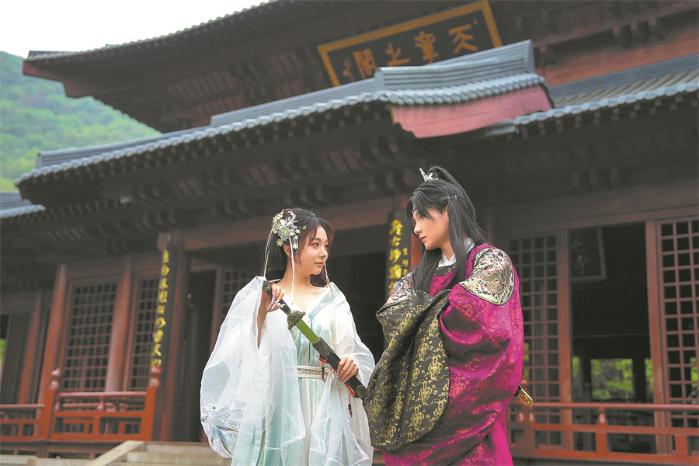
Visitors dressed in traditional Chinese attire visit the Tianzhang Temple in Shaoxing, Zhejiang province, on April 13. (Photo provided by Chen Ge/For China Daily)
For Yin, bringing her family from Taiwan to Tianzhang Temple is more than sightseeing — it is a cultural pilgrimage. "I wanted them to experience places rich in history and meaning," she says, reflecting a yearning for spaces where reflection is possible in a fast-paced world.
Tianzhang Temple's rising popularity mirrors a shift in contemporary taste. In an age of viral check-ins, visitors increasingly seek subtlety, authenticity and quiet elegance. During the recent May Day holiday, the scenic area received 56,000 visitors, up more than 30 percent year-on-year. Yet, the temple has added nothing unnecessary, holding to its original vision.
"What many visitors see here is the most authentic, unembellished beauty of the landscape and architecture," Fu Jingxian, deputy director of the tourism reception department of the Orchid Pavilion scenic area, said. "We believe this is the truest essence of Chinese aesthetics. Although the sudden popularity surprised us, it also feels natural — because this is the approach we have insisted on all along."



























 京公网安备 11010202009201号