


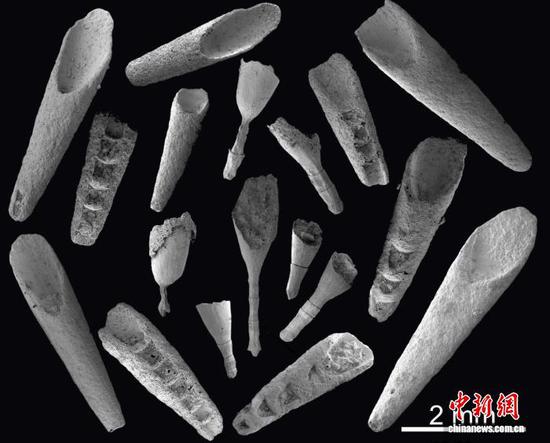
(ECNS) -- A collection of 32 tiny shell fossils unearthed from early Cambrian strata in southern Shaanxi province, dating back approximately 520 million years, may represent the earliest cephalopods ever identified, according to a study published on July 29 in the journal Nature.
An international research team led by professor Guo Junfeng from Chang'an University, together with Dr. Pan Bing from the Nanjing Institute of Geology and Palaeontology of the Chinese Academy of Sciences (NIGPAS) and collaborators from the United Kingdom and the United States, analyzed the millimeter‑sized specimens using scanning electron microscopy and micro‑computed tomography.
They detected a distinct siphuncle, a thin tubular structure running through the multi‑chambered shell that regulates gas and liquid for buoyancy control, a defining trait of shelled cephalopods. The team classified the fossils as a newly named genus and species, Eoceras shaanxiense.
The discovery pushes back the known fossil record of cephalopods to the early Cambrian, filling a key gap between earlier chambered‑shell organisms and modern cephalopod lineages that include squid, octopus and nautilus.
Guo noted the newly found specimens have not fully developed characteristic features of later cephalopods, and further research on similar Cambrian fossils will help trace the very beginnings of cephalopod body plan evolution.
(By Intern Lin Qiaochu, Zhang Dongfang)











































 京公网安备 11010202009201号