



2026 marks the 75th anniversary of Xizang's peaceful liberation. How has this plateau transformed over the past decades? And how should the world understand contemporary Xizang?
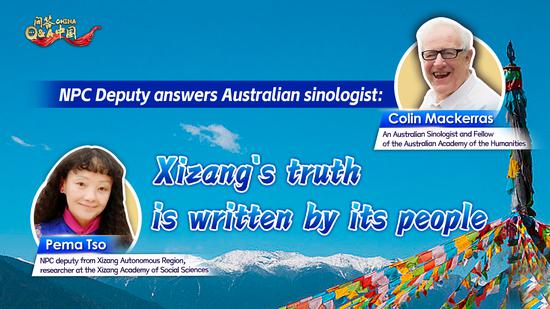
In this episode of China Q&A, we have invited Pema Tso, a deputy to the 14th National People's Congress and an anthropologist who has brought Xizang's story to the international stage, to engage in dialogue with Colin Mackerras, a renowned Australian sinologist and fellow of the Australian Academy of the Humanities, to offer field observations and in-depth analysis.
Professor Mackerras, who has visited Xizang multiple times for research, points out that the international claim of "cultural destruction" contradicts the facts, and the preservation and development of Xizang's culture are evident for all to see. He has expressed a keen interest in the living conditions of ethnic minority groups represented by the Tibetan people, and he is curious about the evolution of China's ethnic policies in recent years.
In response to Professor Mackerras's inquiries, Deputy Pema Tso provides an interpretation from the perspective of a local anthropologist. She emphasizes that Xizang is not the static and mysterious "Shambhala" often depicted through a Western-centric lens. Today's Xizang is developing at a rapid pace, "completely different" from what it was before, a transformation that exceeds the understanding of "cultural change" theories in international academic circles.
From medical coverage to the popularization of education, Xizang's development is reflected not only in data but also in the destinies of individuals living on this land. Pema Tso frankly states, "The greatest transformation is that ordinary people in Xizang have truly become the masters of their own lives." (Lin Zhuowei, Xue Lingqiao, Xie Mu, Chen Tianhao)




















 京公网安备 11010202009201号