


(CNS)-- The ocean belongs to all humanity as our shared home, and constitutes a key arena for global governance. Since its adoption, the United Nations Convention on the Law of the Sea (UNCLOS) has played a pivotal role in enabling humanity to better understand, protect and utilize the ocean.
As the international maritime order undergoes profound readjustment, it has become a common concern of all countries how to advance marine sustainable development and strengthen global ocean governance. 2026 marks the 30th anniversary of China's status as a State Party to UNCLOS. As a major maritime developing country, China stands ready to work with all other countries to forge a new journey in ocean governance with the bridge of the ocean.
Advancing the Establishment and Improvement of the Global Ocean Governance System
As one of the original signatories, China has consistently ensured the full and faithful implementation of UNCLOS provisions, standing as an active participant, builder, and contributor to UNCLOS and its mechanisms.
Historically, the Third United Nations Conference on the Law of the Sea marked the first important international legislative process in which China participated following the restoration of its lawful seat in the United Nations. Taking into account the interests of itself, developing countries, and the international community as a whole, China actively promoted the establishment of a just and equitable international maritime order. Standing side by side with numerous developing countries, China jointly advocated for the reaffirmation of vital principles and systems of the law of the sea, such as 'the common heritage of mankind', thereby making a significant contribution to the adoption of UNCLOS.
Since becoming a State Party, China has adhered to the spirit of UNCLOS, implemented its provisions fully and faithfully, and promoted the full implementation of UNCLOS in domestic maritime legislation, law enforcement, and judicial practice.
China takes an active and in-depth part in developing the global ocean governance system, and continuously supports and facilitates the effective functioning of the three important institutions established under UNCLOS: the International Tribunal for the Law of the Sea (ITLOS), the International Seabed Authority (ISA), and the Commission on the Limits of the Continental Shelf (CLCS).
China keeps advancing the development of a modern maritime order and actively participates in negotiations on UNCLOS implementing agreements, such as the Agreement Relating to the Implementation of Part XI of the United Nations Convention on the Law of the Sea of 10 December 1982 (1994 Implementation Agreement) and the Agreement for the Implementation of the Provisions of the United Nations Convention on the Law of the Sea of 10 December 1982 Relating to the Conservation and Management of Straddling Fish Stocks and Highly Migratory Fish Stocks (UN Fish Stocks Agreement). The Agreement under the United Nations Convention on the Law of the Sea on the Conservation and Sustainable Use of Marine Biological Diversity of Areas beyond National Jurisdiction (BBNJ Agreement) represents an outcome of 19 years of negotiations. China took part in the relevant process throughout and actively pushed for the entry-into-force of the BBNJ Agreement this January, and supports Xiamen's application to host the Secretariat of the BBNJ Agreement, thereby demonstrating its sense of responsibility as a major country. In addition, China has engaged constructively in significant international rule-making processes, such as consultations on regulations for the exploitation of deep-sea mineral resources.
Providing Maritime Public Goods Benefiting All Parties
The ocean constitutes a treasure trove of resources and a strategic space underpinning future development. China has consistently integrated its own development into the global sustainable development framework, expanded blue partnerships, engaged deeply in global ocean governance, and actively advanced the building of a maritime community with a shared future.
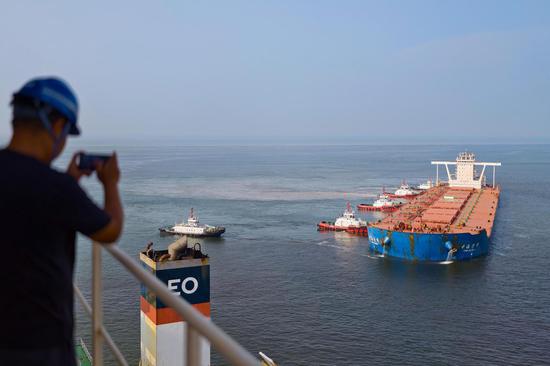
Over the years, China has taken proactive measures to safeguard freedom of navigation and navigational safety and keep international shipping lanes unimpeded. China respects and upholds the freedom of navigation and overflight to which all countries are entitled under international law, and firmly opposes acts that undermine the sovereignty and security of other countries under the pretext of so-called 'freedom of navigation'. Moreover, China continues to upgrade maritime support services such as maritime search and rescue, greatly boosting navigational safety.
The maritime public goods supplied by China deliver shared benefits to all stakeholders. The source codes for the Mazu series ocean current and wave forecasting models have been open-sourced globally. The South China Sea Tsunami Advisory Centre (SCSTAC) is capable of releasing its initial advisory within 10 minutes, boasting world-leading speed and accuracy. China has long offered neighboring countries round-the-clock tsunami forecasting and warning services as well as personnel training. Its emergency remote sensing monitoring services for disasters have received favorable feedback from government authorities of Pacific island countries such as Kiribati and the Solomon Islands.
By advancing digital and intelligent technological transformation, China deepens maritime cooperation and provides solid support for capacity-building in developing countries. Jointly with African countries, China has released and launched the Xinghai Multi-scale Comprehensive Marine Dataset. It includes an online marine remote sensing analysis platform, remote sensing monitoring of the coastal zones of Africa and the Indian Ocean, and AI-based integrated four-dimensional chlorophyll datasets. It has also developed the 'Toolkit for Marine Solutions for Sustainable Development of Coastal Cities' to deliver convenient marine information services and efficient decision-making support for integrated governance to developing countries.
China advances practical maritime cooperation driven by 'small yet beautiful' projects. Leveraging its extensive network and institutional platforms of blue partnerships, China and Madagascar jointly established a sea level change observation station to carry out long-term, continuous and high-precision sea level monitoring in the South Indian Ocean region. The station has been officially incorporated into the UNESCO Global Sea Level Observing System (GLOSS), contributing to climate change responses. China has also joined forces with relevant countries and international organizations to launch the Blue Citizens Initiative. Together with Thailand, Indonesia, Cambodia and other countries, China has delivered marine classroom and nature education programs, and jointly built Blue Communities, effectively raising ocean literacy within coastal communities.
Offering Viable Proposals for Reforming and Improving Ocean Governance with Four Global Initiatives
The ocean unites the world into a community where we all rise and fall together. To achieve the object of promoting 'the economic and social advancement of all peoples of the world', there is no reason for UNCLOS to remain stagnant and unchanging. Instead, it ought to embrace new wisdom, concepts, and approaches to ocean governance with a more open, inclusive and forward-looking stance. The international community needs to join hands to uphold multilateralism and international law, including UNCLOS.
UNCLOS provides a comprehensive legal framework to safeguard the overall interests of the international community. Together with other maritime treaties and agreements, as well as customary international law, it underpins the modern system of the law of the sea. Valuing this milestone achieved through joint efforts of the entire international community, China advocates squarely addressing the internal constraints and external challenges in the implementation of UNCLOS.
For instance, UNCLOS contains inherent limitations. It cannot cover all matters of the law of the sea, and lacks sufficient institutional provisions to address newly emerging ocean affairs, which undermines its enforcement outcomes. Its implementation is simultaneously hindered by multiple obstacles, such as the misinterpretation of its provisions and the abuse of its procedures. Meanwhile, unilateral moves further erode the legal order founded under UNCLOS and damage its solemnity and authority.
It demonstrates due respect for its negotiating history and spirit of compromise to view UNCLOS in an objective, holistic and dialectical manner. It is essential to calibrate its positioning within the modern legal order for the seas and oceans-without underestimating or overstating its value-so as to properly balance continuity and development in the law of the sea.
It represents the right approach to uphold UNCLOS by interpreting and applying it fully, accurately, and in good faith. Rights conferred by UNCLOS should be exercised in a reasonable manner, and obligations thereunder discharged in good faith. The object and purpose of UNCLOS must be safeguarded, its built-in balance preserved, and abusive practices-such as interpretive distortions, abuse of process, and jurisdictional overreach-opposed.
It provides viable solutions to address persistent difficulties and challenges in UNCLOS implementation and improve global ocean governance by jointly advancing China's Four Global Initiatives. In the pursuit of the Sustainable Development Goals, modern law of the sea and China's cultural ethos can resonate in values. The path forward lies in practicing true multilateralism, accelerating the delivery of tangible outcomes under these Initiatives, and fostering a more just and equitable system for global ocean governance so as to advance steadily toward a community with a shared future for mankind.
Against the accelerating once-in-a-century global transformation, the ocean should serve as a vital platform to build consensus and pursue shared development. All countries need to regard win-win cooperation as a priority, jointly sustain and deepen solidarity in maritime cooperation and governance, and devote greater wisdom and strength to building our shared blue homeland.
The author, Shu Zhenya, is a research fellow of the China Institute for Marine Affairs, Ministry of Natural Resources of China.





































 京公网安备 11010202009201号