


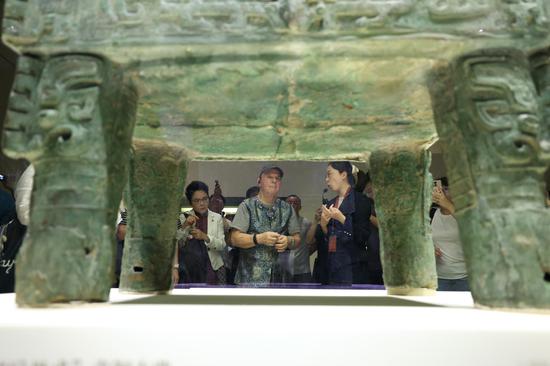
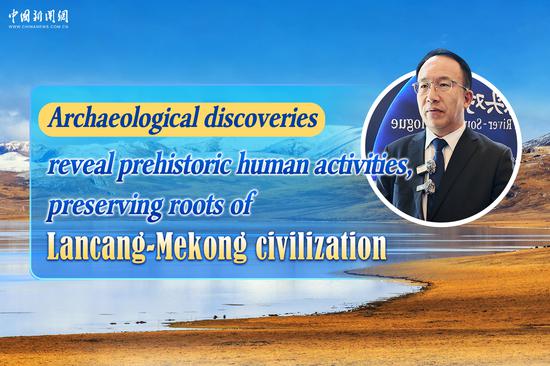
In Qinghai Province, archaeological discoveries have revealed how, over the past 100,000 years, prehistoric humans adapted to and made use of nature, and thrived at the headwaters of the Yangtze, Yellow and Lancang rivers, Wang Jinxian, deputy director-general of the Qinghai Provincial Department of Culture and Tourism, told China News Network during the Lancang-Mekong Cooperation River-Source Dialogue held in Xining, northwest China’s Qinghai Province, on Saturday.
Wang said that today, people in Yushu Tibetan Autonomous Prefecture and Golog Tibetan Autonomous Prefecture, where the Three-River source is located, still maintain traditional local economic practices, while continuing to nurture and create new cultural achievements.
This clearly demonstrates that, since ancient times, the natural and cultural environments have been closely intertwined, he said.
Cultural heritage protection should focus not only on heritage sites, but also on preserving the surrounding natural environment and respecting the traditional ways of life and production of local communities, Wang said.
Such an approach, Wang said, can help build an ecological civilization highland, which is shared by countries across the Lancang-Mekong region.
(By Gong Weiwei)



































 京公网安备 11010202009201号