



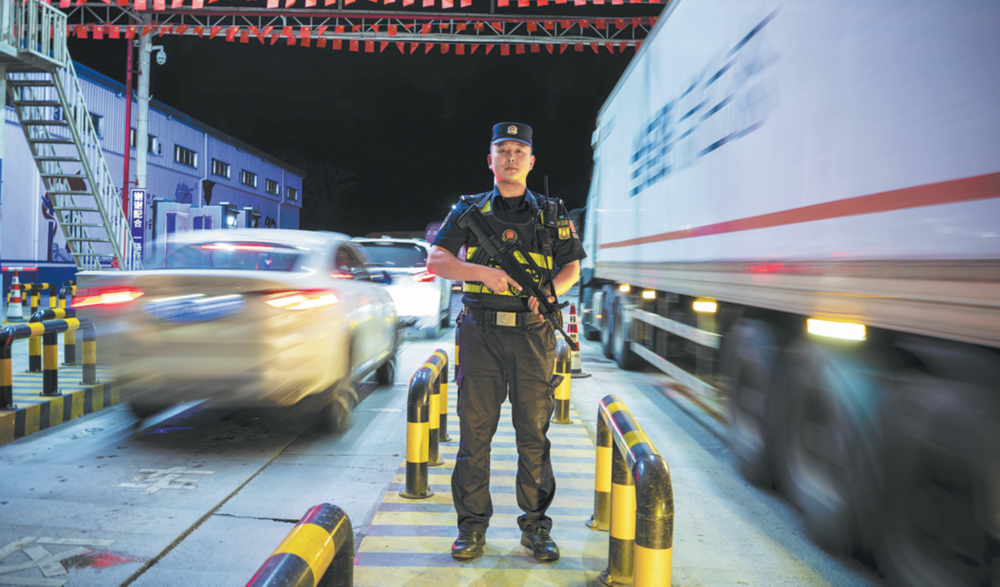
An armed police officer on duty at Dakaihe Border Inspection Station in Xishuangbanna Dai autonomous prefecture, Yunnan province. (Photo provided to CHINA DAILY)
At dawn, traffic flows steadily along an expressway cutting through the tropical rainforest of Southwest China. Trucks, tourist buses and private cars pass in quick succession.
At Dakaihe Border Inspection Station, each vehicle is subject to scrutiny by immigration police.
Located in Xishuangbanna Dai autonomous prefecture, Yunnan province, Dakaihe is the region's only expressway-based border inspection station. Positioned on the Kunming-Bangkok international corridor, one of China's most important land routes linking Southeast Asia with the country's interior, it serves as a key second-line checkpoint designed to intercept cross-border risks.
The scale of the task is immense. In 2025 alone, the station inspected more than 5.36 million vehicles and 15.27 million people. On an average, officers check about 15,000 vehicles, 42,000 travelers and over 8,000 metric tons of cargo per day.
During peak travel seasons like Spring Festival and National Day holidays, the numbers surge dramatically, with inspections reaching nearly one person per second.
"Speed matters, but accuracy matters more," said Li Sheng, head of Dakaihe Border Inspection Station."Every minute saved for lawful travelers is hard-earned, but every missed detail could mean serious consequences."
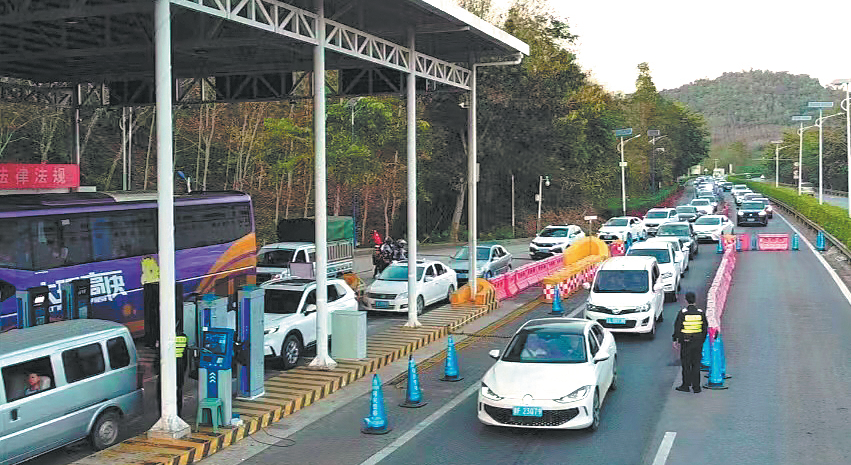
Dakaihe is the only expressway-based inspection station in Xishuangbanna. (Photo provided to CHINA DAILY)
Those consequences are not theoretical. The expressway passes close to the Golden Triangle, one of the world's largest illicit drug-producing regions. Criminal networks have long attempted to exploit the route to smuggle narcotics, organize illegal border crossings, move precursor chemicals or funnel proceeds from telecom fraud.
In June 2019, a single anomaly changed the course of an otherwise routine shift. A tourist bus traveling from Jinghong to Kunming arrived at the checkpoint carrying only a driver — no passengers, no luggage or plausible explanation. The driver appeared visibly nervous.
After a thorough vehicle inspection, the officers uncovered 7,530 packets of methamphetamine tablets, weighing nearly 140 kilograms. Thirty officers worked for four hours to dismantle the concealment and secure the evidence. It remains the largest single drug seizure in the station's history.
"Drug traffickers are endlessly inventive," said Zhao Chaosheng, an officer at the station.
"We've seen drugs hidden in fruit, preserved vegetables, fire extinguishers, computers, tea leaves, hardwood carvings … even slippers. Some traffickers risk their lives by hiding drugs in condoms, swallowing them and then taking laxatives to expel the drugs after reaching their destination."
Every officer at the station develops a personal set of investigative instincts, refined through years of experience.
They learn to read subtle changes in facial expressions, listen for inconsistencies in answers, recognize unfamiliar accents, feel for irregular textures, detect unusual odors, examine vehicle structures and search for the smallest traces of tampering.
"Every concealment method leaves a signature," Zhao said. "Our job is to notice what others overlook."
Since its establishment, the station has handled over 1,100 drug-related cases, arrested 699 suspects, seized nearly 3 tons of narcotics and intercepted 65 tons of precursor chemicals.
In 2025, it uncovered dozens of illegal entry cases, nearly 90 smuggling cases worth over 9.17 million yuan ($1.33 million), and hundreds of suspects linked to telecom fraud. A total of 132 wanted individuals have been apprehended as well.
Still, relentless vigilance alone is not enough. Technology has transformed how the station operates. X-ray scanning systems now screen cargo vehicles, cutting inspection times by an average of 20 minutes while nearly doubling efficiency. A"green channel" speeds up legitimate cross-border freight, while trusted logistics companies are placed on a white list for rapid clearance.
Behind the scenes, officers rely on data platforms connected to multiple national and provincial databases, enabling real-time alerts and risk profiling. These tools have shifted border control from reactive enforcement to proactive prevention.
On May 26, 2025, a suspicious cargo van triggered an alert and was entered into the station's monitoring system.
When the same vehicle returned several days later, automated warnings prompted officers to stop it. Inside the cargo compartment, they found 12 individuals attempting to cross the border illegally, along with an organizer. Two suspects were wanted in telecom fraud cases.
Enforcement is only part of the station's mission. A legal education studio operates on-site, offering intercepted travelers on suspicion of attempting to illegally cross the national border a structured process of education and counseling. Since its establishment, the studio has conducted legal outreach for more than 15,000 people, with over 10,000 signing formal commitments not to engage in cross-border illegal and criminal activities.
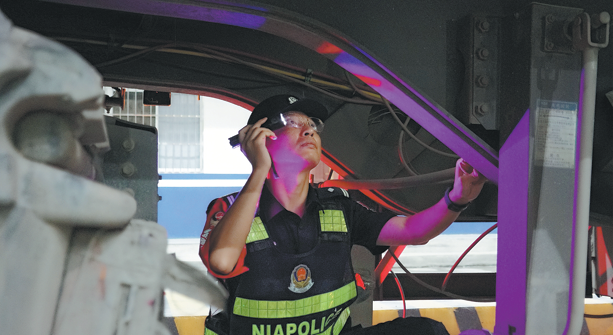
Officer Li Binghui checks a vehicle at the station. (Photo provided to CHINA DAILY)
At this checkpoint on a busy highway, the front line is not marked by fences or slogans, but by vigilance, restraint and a rigorous sense of duty, as exemplified by 35-year-old Li Binghui, a veteran immigration police officer whose career mirrors the station's evolution.
Over his 17 years of service, Li has participated in solving more than 560 cross-border crime cases, arrested 1,831 suspects, cracked 221 drug cases and helped seize 2.6 tons of narcotics. His colleagues describe him as calm, meticulous and relentlessly curious.
Li's defining contribution, however, is his embrace of data-driven policing. Recognizing the limits of manpower at a high-volume checkpoint, he helped establish an intelligence analysis center and led the development of early-warning models tailored to Xishuangbanna's unique geography and crime patterns.
Li's team built systems capable of flagging high-risk individuals and vehicles before they even reach the checkpoint. These models now push daily alerts based on behavioral patterns, travel history and network associations, effectively moving the border control line forward.
One case in 2021 began with a single phone number — no name, location or transaction record. For months, Li sifted through tens of thousands of call logs, reconstructing communication patterns line by line. Each new lead revealed further connections, requiring constant reassessment.
For two months, Li practically lived in the office, reviewing surveillance footage frame by frame. The effort ultimately paid off when his team dismantled a major drug trafficking ring operating from the China-Myanmar border to inland provinces, resulting in the arrest of 51 suspects and seizure of 116 kg of drugs.
High-profile cases aside, Li said the moments that stay with him are often quieter.
In 2024, he encountered three teenagers who had been lured by promises of quick wealth abroad and were preparing to cross the border illegally. Through patient conversation and advice, Li persuaded them to abandon the plan. When their parents traveled from Jiangsu province to retrieve them, the teens clasped their hands and wept in gratitude. "That's when you feel the weight of this job," Li said. "We're not just stopping crimes — we're protecting families."
The cost, however, has been deeply personal. Long hours and sudden deployments have kept Li away from home.
During his wife's pregnancy in 2019, he was immersed in a critical drug investigation and often unable to return. His wife attended most medical appointments alone. Once, when she suffered severe leg cramps late at night, he could only offer comfort over the phone.
Their daughter, now 5, once told her kindergarten teacher that her father "only plays with computers". On one birthday, Li planned to return home but was delayed by an urgent call. When he finally arrived late at night, he found a handmade card on the table: "Happy birthday to my computer daddy."
For his service, Li has received multiple honors, including two first-class merits and a second-class merit. But recognition is not what keeps him going.
In the sweltering heat of the rainforest, amid endless streams of vehicles and the constant pressure of hidden threats, Li and his colleagues remain stoically vigilant. Their work is rarely visible, often misunderstood, and always demanding. Yet for millions of travelers who pass through the station each year without incident, that invisibility is precisely the point.

































 京公网安备 11010202009201号