



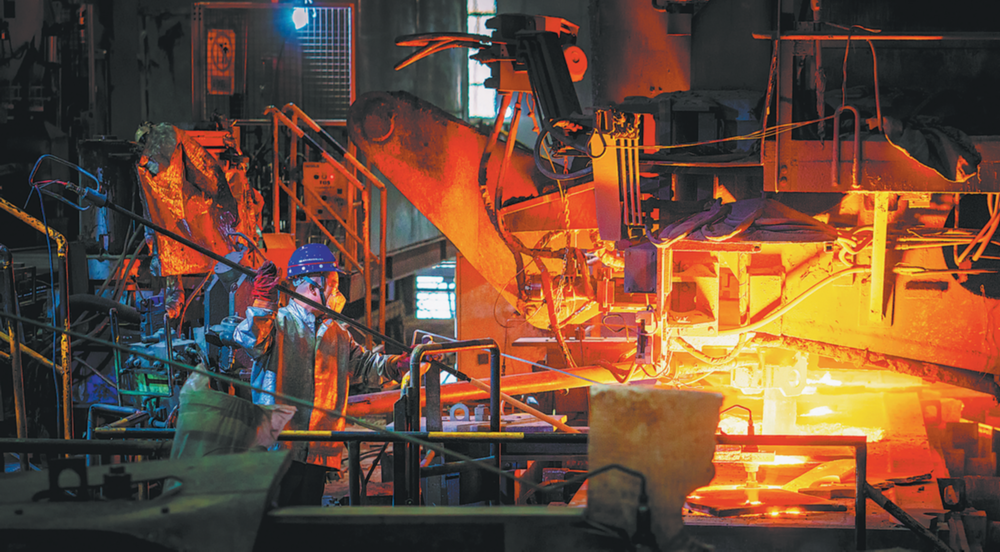
An employee works on the production line of a steel plant in Maanshan, Anhui province. (ZHANG MINGWEI/FOR CHINA DAILY)
China's steel sector is expected to reach a globally advanced technological level by 2030, with breakthroughs in high-end steel and low-carbon metallurgical technologies making the nation one of the world's key sources of innovation in the sector, said Mao Xinping, an academician at the Chinese Academy of Engineering.
Mao made the remarks at a conference on the steel industry and technological innovation in Beijing on Friday, where he outlined the overall goals of China's technological innovation strategy in the sector during the 15th Five-Year Plan (2026-30) period.
By the end of the 15th Five-Year Plan period, the stability and consistency of China's steel product quality are expected to reach internationally advanced levels, with key high-end steel products for major national projects and high-end equipment manufacturing achieving independent and controllable supply.
Green and environmentally friendly metallurgical technologies, along with carbon and energy efficiency enhancement technologies, are expected to be comprehensively applied across the industry, cutting total carbon dioxide emissions by 20 percent from 2020 levels, Mao said.
In addition, the allocation of innovation resources within the steel sector and related enterprises will be further optimized, with major steelmakers expected to see their research and development investment intensity rise by more than 10 percent, and a well-structured, highly coordinated innovation system to be established.
While setting clear medium and long-term technological development goals, the sector is also keenly aware of the pressures it currently faces.
"Overall, the steel market is still characterized by ample supply and soft demand, with supply-demand imbalances continuing to widen," said Zhao Minge, chairman of the China Iron and Steel Association.
The National Bureau of Statistics said China's crude steel output fell 4.4 percent year-on-year to 961 million metric tons in 2025, while apparent consumption fell 7.1 percent to 829 million tons. Meanwhile, steel product output rose 3.1 percent to 1.45 billion tons.
Amid these pressures, China's steel sector is proactively adapting to market changes and accelerating efforts to optimize and upgrade its product structure.
According to the CISA, during the 14th Five-Year Plan (2020-25) period, China's steel self-sufficiency rate basically reached 100 percent, providing high-quality and high-level support for the nation's steel demand.
In 2025, steel consumption by China's manufacturing sector overtook construction for the first time, with the share used in construction falling from 58 percent in 2020 to 49 percent, while manufacturing's share rose from 42 percent to 51 percent.
This shift reflects the growing role of manufacturing in driving steel demand, highlighting ongoing structural changes in the sector.
Looking ahead, Zhao said the manufacturing sector will place greater emphasis on upgrading quality and efficiency.
"Traditional steel-consuming industries such as machinery, automobiles, shipbuilding, home appliances and equipment manufacturing are expected to maintain steady growth, while emerging sectors including new energy, low-altitude economy and artificial intelligence are creating new sources of demand growth."
In addition, China's steel exports grew rapidly during the 14th Five-Year Plan period, with export markets becoming increasingly diversified. In terms of export categories, exports of steel plates more than doubled in 2025 compared to 2020.
To better manage growing exports and ensure stable industry development, the Ministry of Commerce and the General Administration of Customs reintroduced export license management measures for certain steel products starting Jan 1, marking the return of the system after a 16-year hiatus following their cancellation in 2009.
Xiao Lu, deputy director of the department of foreign trade at the Ministry of Commerce, said the system will help strengthen real-time monitoring and tiered analysis of steel exports, enable rapid tracking of export fluctuations, and enhance coordination between trade and industrial policies.
The policy will also raise compliance and quality awareness across the industry, encourage enterprises to focus on product quality, boost investment in R&D and innovation, and support pragmatic, high-quality development of China's steel sector, Xiao said.




























 京公网安备 11010202009201号