



Nanshan district in Shenzhen, Guangdong province, is showing how technological innovation can lead to economic growth and turn it into a sustainable driver of development, even with limited resources.
Li Xiaoning, head of the district, recently announced that it had surpassed the 1 trillion yuan ($143.7 billion) GDP benchmark for the first time last year on its way to about 1.01 trillion yuan.
Only two others have done the same. In 2018, the GDP of Shanghai's Pudong New Area first crossed that threshold, followed by Beijing's Haidian district in 2022. Unlike Shenzhen, however, Beijing and Shanghai are both directly administered by the central government.
The most noteworthy aspect of Shenzhen's achievement may not be the trillion-yuan figure itself but the speed at which the milestone was reached. It has been described as "an elephant running as fast as a leopard". It took 15 years for Nanshan's GDP to reach 100 billion yuan in 2005, up from 7.8 billion yuan in 1990. Then, it rose from 652.7 billion yuan in 2020 to last year's 1 trillion yuan, said Li.
Nanshan's economic growth rate in 2025 reached 6.3 percent, outperforming the national average of 5 percent, Guangdong's average of 3.9 percent, and Shenzhen's average of 5.5 percent. Despite being a relatively small district making up just one-tenth of Shenzhen, Nanshan contributes roughly one-fourth of the city's GDP, earning its reputation as the "Silicon Valley of China".
Nanshan has maintained a strong growth momentum since its establishment. It is home to Chinese tech giants Tencent and ZTE Corp, as well as drone manufacturer DJI and humanoid robot maker UBTECH. Shenzhen, Hong Kong's booming neighbor, is often considered a pioneer of reform and opening-up.
Guo Wanda, executive vice-president of the Shenzhen-based China Development Institute, said, "Nanshan owes its success to its strong scientific and technological innovation, as well as to the rapid development of emerging industries in the new economy." Guo said that the district has attracted many excellent and large enterprises, as well as a number of talented people, due to its concentration of cutting-edge innovation.
He added that the most economically developed areas in the world, such as New York, London, and Singapore, have broken through their growth ceilings by enhancing their innovation capacity and upgrading their industrial structures.
With 218 listed companies, Nanshan rivals some provincial-level regions. The number of national high-tech enterprises exceeds 6,000. By 2025, the number of invention patents per 10,000 residents had risen to over 860, which is about 22.9 times the national average.
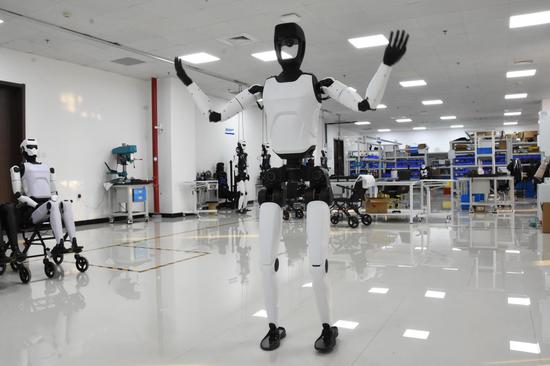
Sixty percent of Nanshan's GDP comes from strategic emerging industries. Xiang Tianye, director of Nanshan's industry and information technology bureau, said the district now has more than 20 companies that can produce complete robots, as well as more than 200 upstream and downstream enterprises.
At UBTECH, a newly developed hot-swappable autonomous battery system for humanoid robots prevents mission interruptions caused by downtime for charging, while also boosting overall production efficiency. As of the end of last year, orders for the company's humanoid robots had reached nearly 1.4 billion yuan.
"We put forward our requirements in the morning, and the parts can be machined and ready for rapid verification as quickly as the same afternoon," said Jiao Jichao, the company's vice-president.
Li Fan, deputy director of the China Center for Special Economic Zone Research of Shenzhen University, described Nanshan's robotics industry as a good example of large companies driving the development of smaller companies in related industries.
According to Li, Nanshan's economy is dominated by private companies. The local government encourages individual innovation with talent and financial incentives. It also takes a relaxed position with startups, taking the position that new projects "need trials and failures".
Nanshan also has numerous universities and research institutes where innovative ideas can incubate, such as Shenzhen University, Southern University of Science and Technology, Tsinghua Shenzhen International Graduate School, and Peking University Shenzhen Graduate School.
"Developing new-quality productive forces relies on the effective allocation of new-quality production factors, such as talent, capital, and data," Guo from the China Development Institute said. "Additionally, the district has successfully integrated its industrial and capital chains, as well as manufacturing and service industries."
Wu Nan, assistant professor from the School of Economics at the Central University of Finance and Economics, said that though other districts still have a certain gap to bridge before their GDP hits the one-trillion-yuan mark, many have demonstrated a potential to get there, including Shenzhen's Futian and Longgang districts, as well as Guangzhou's Tianhe district. Each of these districts resides in Guangdong, which reported the country's highest GDP last year at 14.58 trillion yuan.
"What these areas have in common is a solid economic foundation, with each having forged distinctive pillar industries and innovation strengths that enable them to sustain the agglomeration effect of industries and talent," Wu said.

























 京公网安备 11010202009201号