



4. Diverse dynamics of financial integration
Financial integration is an important pillar of BRI cooperation. Participating countries and relevant institutions have carried out multiple forms of financial cooperation, created new models, expanded the channels, diversified the parties involved, and improved the mechanisms for investment and financing. They have promoted policy-based finance, development finance, commercial finance, and cooperative finance to support BRI cooperation, and worked to build a long-term, stable and sustainable investment and financing system that keeps risk under control.
The financial cooperation mechanisms are maturing. China Development Bank (CDB) has promoted the establishment of multilateral financial cooperation mechanisms such as China-Central and Eastern Europe Interbank Consortium, the China-Arab Countries Interbank Association, China-ASEAN Interbank Association, the ASEAN Plus Three Interbank Cooperation mechanism, China-Africa Interbank Association, and the Association of China-LAC Development Financial Institutions. The Industrial and Commercial Bank of China (ICBC) has promoted the Belt and Road Interbank Regular Cooperation (BRBR) mechanism.
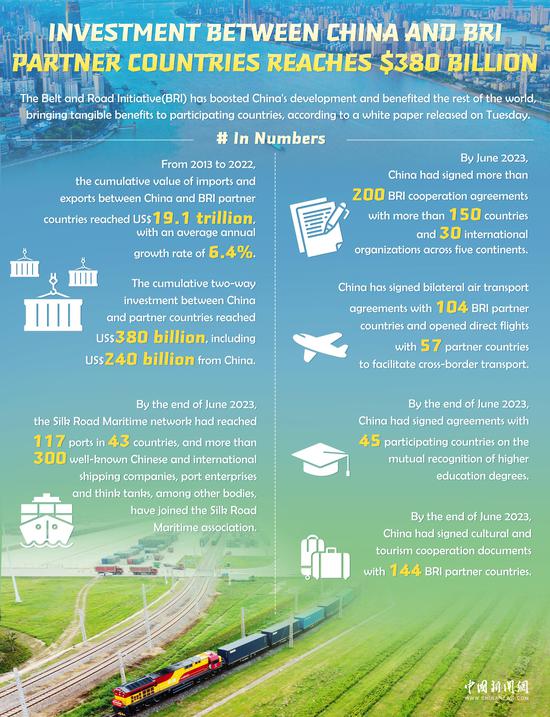
As of the end of June 2023, a total of 13 Chinese-funded banks had established 145 first-tier offices and branches in 50 BRI partner countries; some 17.7 million businesses in 131 partner countries had opened UnionPay services, and 74 partner countries had opened UnionPay mobile payment services. The Belt and Road Innovation and Development Center, the Research Center for Belt and Road Financial and Economic Development, and the China-IMF Capacity Development Center have been established.
China has signed bilateral currency swap agreements with 20 partner countries and established renminbi (RMB) clearing arrangements in 17 partner countries. The number of participants, business volume, and influence of the RMB cross-border payment system have gradually increased, effectively facilitating trade and investment.
Financial regulation cooperation and exchanges have continued to move forward. China Banking and Insurance Regulatory Commission (now National Administration of Financial Regulation), China Securities Regulatory Commission (CSRC), and regulatory agencies from multiple other countries have signed memorandums of understanding (MoUs) for regulatory cooperation, facilitating the establishment of regional regulatory coordination mechanisms, promoting efficient allocation of funds, strengthening risk control, and creating sound investment conditions for various financial institutions and investment entities.
The channels and platforms for investment and financing are constantly expanding. China has funded the establishment of the Silk Road Fund (SRF) and established the Asian Infrastructure Investment Bank (AIIB) with other participating countries. The SRF specifically serves BRI cooperation. By the end of June 2023, the fund had signed agreements on 75 projects with committed investment of about US$22 billion; the number of AIIB members had reached 106, and the bank had approved 227 projects with a total investment of US$43.6 billion. The projects involve transport, energy, public health and other fields, providing investment and financing support for infrastructure connectivity and sustainable economic and social development.
China has actively participated in various existing financing arrangements. It has signed memorandums of cooperation with international financial institutions such as the World Bank and the Asian Development Bank, worked with international financial institutions to establish a multilateral development financing cooperation center, strengthened third-party market cooperation in investment and financing with the European Bank for Reconstruction and Development, and carried out joint financing with the International Finance Corporation, the African Development Bank and others. These moves have effectively mobilized market capital.
China has initiated the establishment of international economic cooperation funds such as the China-Eurasian Economic Cooperation Fund, the China-LAC Cooperation Fund, the China-Central and Eastern Europe Investment Cooperation Fund, the China-ASEAN Investment Cooperation Fund, the China-LAC Industrial Cooperation Investment Fund, and the China-Africa Fund for Industrial Cooperation. These have effectively expanded investment and financing channels for partner countries.
The CDB and the Export-Import Bank of China (China Eximbank) have each set up special loans for the BRI to pool resources to increase financing support for BRI cooperation. By the end of 2022, the CDB has provided direct high-quality financial services for more than 1,300 BRI projects, playing a leading role in guiding development finance, and pooling all kinds of domestic and foreign funds for BRI cooperation. The balance of loans of China Eximbank for BRI projects reached RMB2.2 trillion, covering 130-plus participating countries and driving more than US$400 billion of investment and more than US$2 trillion of trade. China Export & Credit Insurance Corporation has fully applied export credit insurance and actively provided comprehensive guarantees for building the Belt and Road.
Innovative investment and financing methods are steadily being explored. Various models such as funds and bonds have been developed, and BRI financial cooperation is improving.
China’s securities industry has set up a number of BRI-themed funds and indexes. In December 2015, the CSRC officially launched a pilot project for overseas institutions to issue RMB-denominated bonds (panda bonds) in China’s exchange-traded bond market. By the end of June 2023, overseas issuers in total had issued 99 panda bonds in China’s exchange-traded bond market, with a total value of RMB152.54 billion; 46 BRI-themed bonds had been issued, with a total value of RMB52.72 billion.
Green finance is steadily developing. In May 2019, the ICBC issued the first green BRBR bond that conformed to both international and domestic green bond standards. By the end of 2022, more than 40 large global institutions had signed the Green Investment Principles for the Belt and Road. In June 2023, China Eximbank issued financial bonds for promoting international cooperation in building the Belt and Road and supporting infrastructure construction of partner countries. China’s domestic stock and futures exchanges have steadily promoted practical cooperation in equity, products, technology and other fields with the exchanges in partner countries, and actively supported the development of exchanges participating in or holding shares in BRI projects, such as the Astana International Exchange in Kazakhstan, the Pakistan Stock Exchange, and the Dhaka Stock Exchange in Bangladesh.
Debt sustainability has continued to improve. Based on the principle of equal participation and benefit and risk sharing, China and 28 countries approved the Guiding Principles on Financing the Development of the Belt and Road, encouraging the governments, financial institutions and enterprises of participating countries to attach importance to debt sustainability and improve their debt management capability. Drawing on the debt sustainability framework of low-income countries endorsed by the International Monetary Fund and the World Bank, China has developed tools based on the actual conditions of participating countries, and issued the Debt Sustainability Framework for Participating Countries of the Belt and Road Initiative. All parties are encouraged to use it on a voluntary basis.
To avoid causing debt risk and financial burden to the countries where BRI projects are located, China has prioritized economic and social benefits and provided loans for project construction based on local needs and conditions. The key areas of investment are infrastructure projects designed to increase connectivity, and projects for public wellbeing urgently needed in participating countries. These have brought effective investment, increased high-quality assets, and boosted development momentum.
Many think tank experts and international institutions have pointed out that almost all the BRI projects are initiated by the host countries with the goals of growing their economies and improving their people’s lives. In the process, the logic of economics has taken precedence over geopolitics.
5. Solid foundations for people-to-people ties
People-to-people ties are the social foundations of BRI cooperation. The participating countries have passed on and carried forward the spirit of friendly cooperation of the ancient Silk Road, cooperated on exchanges in culture, tourism, education, think tank and the media, and promoted mutual learning among civilizations and cultural integration and innovation. A model of people-to-people exchanges characterized by dynamic interactions and diversity has underpinned public support for furthering the initiative.
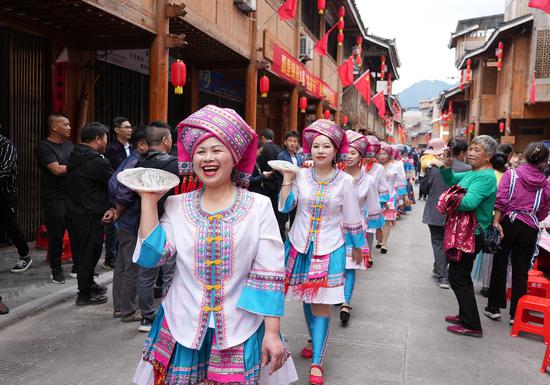
Cooperation on culture and tourism is rich and colorful. By the end of June 2023, China had signed cultural and tourism cooperation documents with 144 BRI partner countries.
China has created cooperation platforms together with participating countries, including the Silk Road International League of Theaters, the Silk Road International Museum Alliance, the Network of Silk Road Arts Festivals, the Silk Road International Library Alliance, and the Silk Road International Alliance of Art Museums and Galleries. These platforms have a total of 562 members, including 326 cultural institutions from 72 partner countries.
China is steadily expanding international cultural exchanges. China has launched the Cultural Silk Road program, and organized signature events such as the Happy Chinese New Year celebrations, the Nihao China tourism promotions, and the Silk Road: Artists’ Rendezvous art exhibition. It has worked with Brunei, Cambodia, Greece, Italy, Malaysia, Russia and ASEAN to co-host cultural and tourism activities at designated years. China and BRI partner countries have hosted events in a reciprocal manner, ranging from cultural relics exhibitions, film festivals, arts festivals, book fairs and music festivals, and jointly translated and promoted each other’s publishing, radio, film and television programs. They have also implemented the BRI-themed theater arts creation and promotion project, the Belt and Road International Art Project, and the Belt and Road good-neighborliness cultural project, and worked to protect Asian cultural heritage. China has established 46 China cultural centers in 44 countries, of which 32 are partner countries. China has established 20 tourism offices in 18 countries, eight of which are in partner countries.
Educational exchanges and cooperation are extensive and profound. China has released the Education Action Plan for the Belt and Road Initiative to promote international education exchanges and cooperation. By the end of June 2023, China had signed agreements with 45 participating countries on the mutual recognition of higher education degrees.
China has set up the Silk Road Program under the Chinese Government Scholarship scheme. Some of China’s provinces and Hong Kong and Macao SARs, as well as universities and research institutions have also set up scholarships for students from BRI partner countries.
Chinese universities and colleges have opened 313 Confucius Institutes and 315 Confucius Classrooms in 132 partner countries. The “Chinese Bridge” Summer Camp has invited nearly 50,000 young people from more than 100 partner countries to come to China for academic visits, and supported 100,000 Chinese language enthusiasts from 143 partner countries to learn Chinese and experience Chinese culture online.
Chinese universities and colleges have worked with more than 20 counterparts in partner countries from Asia, Africa and Europe to build a number of Luban Workshops – a professional training program dedicated to the sharing of expertise by China’s vocational education institutions.
China and UNESCO have jointly held the International Youth Forum on Creativity and Heritage Along the Silk Roads and relevant activities in seven consecutive years, and established the Silk Roads Youth Research Grant which has funded 24 youth research projects. The Atomic Energy Scholarship of China has funded the education of nearly 200 Master’s and Doctoral students in the field of peaceful use of nuclear energy for 26 BRI partner countries.
Participating countries have capitalized on the demonstration and driving role of the University Alliance and the Alliance of International Science Organizations (ANSO) under the BRI framework, and expanded international exchanges and cooperation in talent training and scientific research.
Media and think tank cooperation has yielded fruitful results. BRI participating countries have held the Media Cooperation Forum on Belt and Road six times, and established the Belt and Road Media Community. The China-Arab States Forum on Radio and Television Cooperation, the Forum on China-Africa Media Cooperation, the China-Cambodia Radio and Television Annual Regular Cooperation Conference, the ASEAN-China Media Cooperation Forum, the Lancang-Mekong Audiovisual Week, and other bilateral and multilateral cooperation mechanisms have been set up. International organizations such as the Asia-Pacific Broadcasting Union and the Arab States Broadcasting Union have become active and important platforms for building consensus among participating countries.
Media outlets in China and partner countries have jointly established the Belt and Road News Network, which launched the Silk Road Global News Awards. By the end of June 2023, the network’s members had increased to 233 media outlets in 107 countries.
Think tank exchanges have become more frequent. The Advisory Council of the Belt and Road Forum for International Cooperation was established in 2018. The Silk Road Think Tank Association has recruited 122 partners in Asia, Africa, Europe, and Latin America. Sixteen Chinese and foreign think tanks have established the Belt and Road Studies Network.
People-to-people exchanges are constantly expanding. Non-governmental organizations (NGOs) continue to strengthen cooperation with the goals of benefiting the people, improving their lives, and connecting their hearts. At the people-to-people ties sub-forum of the Second Belt and Road Forum for International Cooperation, Chinese and foreign NGOs, including China NGO Network for International Exchanges, combined to launch the Silk Road Community Building Initiative, encouraging Chinese and foreign NGOs to establish nearly 600 cooperative partnership pairings and carry out more than 300 cooperation projects for improving people’s lives. Of these, some brand projects have achieved a wide impact, including the Shenzhen-Lancang-Mekong Cooperation to benefit the people in the Lancang-Mekong region with Shenzhen’s advanced products and technology, the Panda Pack Project to provide primary school students with learning supplies, and the Brightness Journey program to provide free cataract surgery to those in need.
Cities from 60-plus BRI partner countries have formed more than 1,000 pairs of friendly cities with their Chinese counterparts. A total of 352 NGOs from 72 countries and regions have formed a Silk Road NGO Cooperation Network, carrying out over 500 projects and various other activities, and becoming an important platform for exchanges and cooperation between NGOs in participating countries.
6. Steady progress in new areas
Leveraging their respective strengths, participating countries have continued to expand BRI cooperation into new fields and created innovative cooperation models, achieving great progress in building a healthy, green, innovative and digital Silk Road and further broadening the space for international cooperation.
Notable achievements have been made in health cooperation. To establish closer partnerships in health cooperation, participating countries are working hard to build a Health Silk Road and a global community of health for all. By the end of June 2023, China had signed an MoU with the WHO on health cooperation in BRI partner countries, inked health cooperation agreements with more than 160 countries and international organizations, and initiated or participated in nine international and regional health cooperation mechanisms, including China-Africa Health Cooperation, China-Arab States Health Cooperation, and China-ASEAN Health Cooperation.
Relying on mechanisms and platforms such as the Belt & Road Health Professionals Development Alliance, the Belt & Road Hospital Cooperation Alliance, the Belt & Road Health Policy Research Network, and the China-ASEAN Human Resources Training Program of Health Silk Road (2020-2022), China has helped BRI partner countries to train tens of thousands of professionals in health management, public health and medical research. It has also dispatched medical teams to 58 partner countries, and provided free treatment for nearly 10,000 cataract patients in more than 30 partner countries through the Brightness Journey program. In addition, China has sent several rounds of medical aid to island states of the South Pacific, and carried out international medical cooperation with neighboring countries, including countries of the Greater Mekong Subregion, Central Asian countries, and Mongolia.
After the outbreak of Covid-19, China provided assistance to more than 120 BRI partner countries to combat the pandemic, and sent 38 expert medical teams to 34 countries. It started the Initiative for Belt and Road Partnership on Covid-19 Vaccines Cooperation together with 31 countries, delivered more than 2 billion doses of vaccines to partner countries, and conducted joint vaccine production with more than 20 countries, improving vaccine affordability and accessibility in developing countries.
In addition, China has signed documents on traditional medicine cooperation with 14 BRI partner countries; eight partner countries have taken measures to support the development of traditional Chinese medicine (TCM) within the framework of their respective legal systems; 30 overseas TCM centers have been built; and 100-plus TCM drugs have been registered and marketed in partner countries.
Remarkable progress has been achieved in green and low-carbon development. China is working together with partner countries and international organizations to build a cooperation mechanism for green and low-carbon development under the BRI framework, promote green development, and address climate change.
China has issued documents such as the Guidance on Promoting Green Belt and Road and the Guidelines on Jointly Promoting Green Development of the Belt and Road, and set itself the ambitious goal of forming a basic framework of green development through BRI cooperation by 2030. China has also signed an MoU with the United Nations Environment Programme on building a green Belt and Road for 2017-2022, reached environmental cooperation agreements with more than 30 countries and international organizations, launched the Initiative for Belt and Road Partnership on Green Development together with 31 countries, formed the Belt and Road Initiative International Green Development Coalition with more than 150 partners from 40-plus countries, and established the Belt and Road Energy Partnership with 32 countries.
China has pledged to stop building new coal-fired power stations overseas, and to actively build green finance platforms and international cooperation mechanisms. It stands ready to cooperate with partner countries on research into biodiversity conservation, safeguarding the eco-environmental security of the Maritime Silk Road, building the Belt and Road Big Data Service Platform on Ecological and Environmental Protection and the Belt and Road Environmental Technology Exchange and Transfer Center, and implementing the Green Silk Road Envoys Program.
China is actively promoting the Belt and Road South-South Cooperation Initiative on Climate Change. It has signed 47 South-South MoUs on climate change with 39 partner countries, built low-carbon demonstration zones with Laos, Cambodia, and Seychelles, carried out more than 70 climate change mitigation and adaptation projects with 30-plus developing countries, and trained more than 3,000 environment management personnel and experts from more than 120 countries.
In May 2023, China Eximbank, together with a dozen financial institutions including China Development Bank, and China Export & Credit Insurance Corporation, released the Initiative for Supporting Belt and Road Energy Transition with Green Finance, calling on all parties involved to strengthen support for green and low-carbon energy transition in BRI participating countries.
Cooperation in scientific and technological innovation is gathering speed. BRI participating countries are strengthening cooperation on innovation, facilitating technology transfer and knowledge sharing, optimizing the innovation-enabling environment, and pooling innovation resources. They are also building up their capacity for scientific and technological innovation through cooperation in major projects and talent training.
In October 2016, China released the Special Plan on Advancing Belt and Road Cooperation in Scientific and Technological Innovation. In May 2017, the Action Plan on Belt and Road Cooperation in Scientific and Technological Innovation was implemented, to increase the capacity for innovation in BRI participating countries through pragmatic measures such as joint research, technology transfer, exchanges in science, technology and culture, and cooperation between high-tech industrial parks.
By the end of June 2023, China had signed intergovernmental agreements on scientific and technological cooperation with more than 80 BRI partner countries, and 58 members had joined the ANSO. Since 2013, China has hosted more than 10,000 young scientists from partner countries in carrying out short-term research and exchanges in China, and trained more than 16,000 technicians and management professionals for partner countries; China has established nine cross-border technology transfer platforms targeting ASEAN, South Asia, Arab states, Africa, Latin America, and other regions; China has assisted 22 African countries to build 23 agricultural technology demonstration centers, and set up 50-plus BRI joint laboratories in areas such as agriculture, new energy, and health.
China has signed an agreement with the World Intellectual Property Organization (WIPO) on strengthening BRI cooperation on intellectual property and additional agreements on subsequent revision and prolongation of the said agreement. China and the WIPO have jointly hosted twice the High-level Conference on Intellectual Property for Countries Along the Belt and Road, and released a joint initiative and a joint statement on strengthening cooperation on intellectual property. To date, China has established intellectual property cooperation relationships with more than 50 partner countries and international organizations, whose goal is to create an innovation and business environment in which the value of knowledge is duly respected.
Digital silk road cooperation presents numerous highlights. BRI participating countries have joined to create an open, fair, equitable and non-discriminatory environment for digital development by strengthening facilitation of and cooperation on rules and standards and promoting regional policy coordination.
By the end of 2022, China had signed MoUs on building the Digital Silk Road with 17 countries, MoUs on e-commerce cooperation with 30 countries, and MoUs on closer investment cooperation in the digital economy with 18 countries and regions. It has proposed and worked to launch the Global Initiative on Data Security, the Belt and Road Digital Economy International Cooperation Initiative, the initiative for building the ASEAN-China Partnership on Digital Economy Cooperation, the China-League of Arab States Cooperation Initiative on Data Security, the China + Central Asia Data Security Cooperation Initiative, and the BRICS Digital Economy Partnership Framework, among others. It also took lead in formulating the Framework of Standards on Cross-border E-commerce.
China is active in strengthening digital infrastructure connectivity and is stepping up work on digital corridors. Several international submarine cables have made positive progress, and 130 cross-border terrestrial cable systems have been built.
China has built many 5G base stations, data centers, cloud computing centers and smart cities, and promoted digital upgrading and transformation of traditional infrastructure such as ports, railways, highways, energy networks and water conservancy facilities.
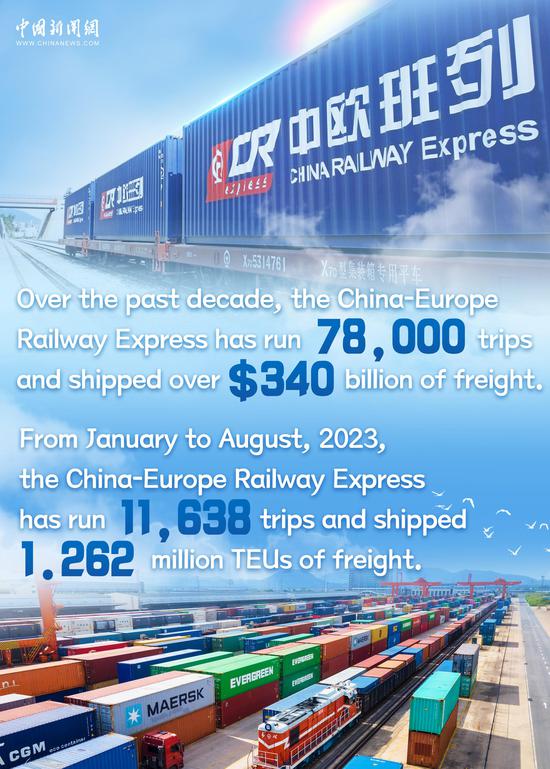
A number of key projects such as the China-ASEAN Information Harbor, and the digital platform of China-Europe Railway Express and the China-Arab Online Silk Road is making good progress, and the DBAR Big Earth Data Platform has realized multilingual data sharing.
Panel 2 Silk Road E-commerce expands new channels for economic and trade cooperation
Thriving new business models of international trade, represented by cross-border e-commerce and overseas warehouses, are providing better services and more choice to global consumers, and promoting global trade innovations. Silk Road E-commerce is an important means by which China can capitalize on its strengths in e-commerce technology application, model innovation and market size, expand economic and trade cooperation, and share the opportunities of digital development with BRI participants.
By the end of September 2023, China had established bilateral mechanisms of e-commerce cooperation with 30 countries on five continents; multilateral mechanisms had been built under the China-CEEC and China-Central Asia frameworks.
Activities such as the Silk Road E-commerce Platform of the Brand and Quality Online Shopping Festival and the Quality African Products Online Shopping Festival have yielded substantial results, and virtual country pavilions help partner countries to export their high-quality specialty products to the Chinese market.
The innovative Cloud Classroom program has provided livestreamed training sessions for more than 80 participating countries to reinforce their digital literacy.
Through consistently enriching the content and elevating the level of cooperation, Silk Road E-commerce has become a new platform for bilateral and multilateral economic and trade cooperation and a new strength in high-quality BRI cooperation.
The construction of the Belt and Road Initiative Space Information Corridor has been a resounding success. China has built teleports connecting South Asia, Africa, Europe, and the Americas. The data from remote sensing satellites under the China-Brazil Earth Resources Satellite (CBERS) program is widely used in multiple countries and fields. The BeiDou navigation satellite system (BDS-3) provides comprehensive services for China-Europe Railway Express, and in maritime transport and other fields.
China and a number of BRI partner countries and regions have combined to develop and launch communication or remote sensing satellites, and constructed satellite ground stations and other space infrastructure. Through the Regional Centre for Space Science and Technology Education in Asia and the Pacific (China) affiliated to the United Nations, China has trained a large number of space professionals for partner countries. Together with other countries and regions, China has built the China-GCC Joint Center for Lunar and Deep Space Exploration, the China-UAE Space Debris Joint Monitoring Center, the Lancang-Mekong Cooperation Center for Earth Observation Data, the China-ASEAN Satellite Remote Sensing Application Center, and the China-Africa Cooperation Center on Satellite Remote Sensing Application. The CNSA-GEO platform, the Belt and Road Analysis and Early Warning Platform for Typical Meteorological Disasters, and the Natural Resources Satellite Remote Sensing Cloud Service Platform now serve many partner countries.































 京公网安备 11010202009201号