



III. Promoting All-Round Connectivity in Multiple Fields
To promote greater connectivity through BRI cooperation, we have continued to facilitate policy coordination, infrastructure connectivity, unimpeded trade, financial integration, and closer people-to-people ties, by orienting towards “hard connectivity” in infrastructure, bolstering “soft connectivity” through harmonized rules and standards, and strengthening people-to-people bonds. As its scope expands, the BRI has become the world’s largest platform for international cooperation, with the broadest coverage.
1. Extensive and in-depth policy coordination
Policy coordination underpins BRI cooperation. China has worked with participating countries and international organizations to establish a multilevel policy coordination and communication mechanism for aligning development strategies, technological and economic policies, and administration rules and standards. Under this mechanism, plans and measures for regional cooperation have been formulated through joint efforts to facilitate and speed up cooperation, making the BRI an important collaborative framework for international exchanges.
Strategy and policy coordination is expanding in scope. At the global level, the 193 UN member states unanimously agreed to incorporate the Belt and Road Initiative in the UN resolution passed at the 71st United Nations General Assembly in November 2016. In March 2017, the United Nations Security Council adopted Resolution 2344, calling for stronger regional economic cooperation through the BRI, among other initiatives. The United Nations Development Programme and the World Health Organization (WHO) have signed BRI cooperation agreements with China. At the World Trade Organization (WTO), China’s efforts have facilitated the conclusion of the negotiations on the text of the Investment Facilitation for Development Agreement, with a view to establishing a coordinated and unified investment management system covering more than 110 countries and regions to encourage BRI cooperation on investment.
At regional and multilateral levels, the BRI has supported regional integration and global development by aligning with plans such as the UN 2030 Agenda for Sustainable Development, the Master Plan on ASEAN Connectivity 2025, the ASEAN Outlook on the Indo-Pacific, the African Union’s Agenda 2063, and the European Union’s Strategy on Connecting Europe and Asia.
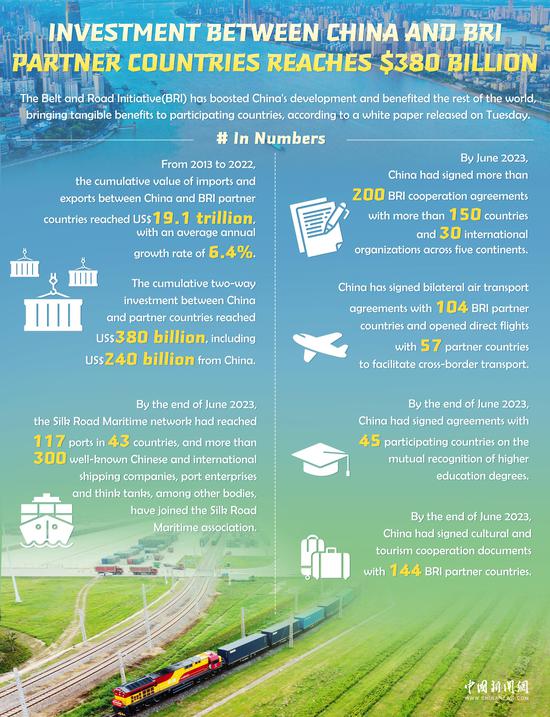
At the bilateral level, the BRI has succeeded in coordinating with a wide range of strategies and initiatives, including Russia’s Eurasian Economic Union framework, Kazakhstan’s Bright Road economic policy, Turkmenistan’s strategy of reviving the Silk Road, Mongolia’s Steppe Road plan, Indonesia’s Global Marine Fulcrum initiative, the Philippines’ Build Better More program, Vietnam’s Two Corridors and One Economic Circle plan, South Africa’s Economic Reconstruction and Recovery Plan, Egypt’s Suez Canal Corridor Project, and Saudi Arabia’s Vision 2030. By June 2023, China had signed more than 200 BRI cooperation agreements with more than 150 countries and 30 international organizations across five continents, yielding a number of signature projects and small-scale yet impactful projects.
A long-term mechanism for policy coordination is largely in place. Multilevel channels for regular communication among different parties have been opened up on different platforms. This has been made possible through top-down driven diplomatic efforts led by heads of state, with support from intergovernmental strategic communication and local and interdepartmental policy coordination, and with cooperation projects carried out by enterprises and social organizations.
China has hosted the Belt and Road Forum for International Cooperation twice, providing an important platform for participating countries and international organizations to expand exchanges, increase mutual trust, and strengthen ties. The first forum in 2017 welcomed heads of state and government from 29 countries, and more than 1,600 representatives from 140-plus countries and 80-plus international organizations, yielding a total of 279 deliverables in five categories. At the second forum held in 2019, 40 leaders, including heads of state and government from 38 countries, the UN secretary-general and the International Monetary Fund’s managing director, attended the Leaders’ Roundtable. More than 6,000 representatives participated, from over 150 countries and 92 international organizations, yielding 283 deliverables in 6 categories.
Multilateral cooperation is driving forward. Under the BRI framework, Chinese and foreign partners have launched 20-plus multilateral dialogue and cooperation mechanisms in professional domains such as railways, ports, energy, finance, taxation, environmental protection, disaster prevention and relief, think tanks, and the media, attracting a growing number of participants. BRI participating countries have also expanded practical cooperation through major multilateral platforms such as China-ASEAN (10+1) Cooperation, Forum on China-Africa Cooperation, China-Arab States Cooperation Forum, Forum of China and the Community of Latin American and Caribbean States, China-Pacific Island Countries Economic Development and Cooperation Forum, China-Central and Eastern European Countries Cooperation, World Economic Forum, Boao Forum for Asia, and CPC and World Political Parties Summit.
Rules and standards are being coordinated. Cooperation on standardization has advanced to new levels. As of June 2023, China had signed 107 documents with standardization bodies in 65 countries such as Pakistan, Russia, Greece, Ethiopia, and Costa Rica and also with regional and international organizations, in areas covering civil aviation, climate change, agri-food, building materials, electric vehicles, oil and gas pipelines, logistics, small hydropower stations, oceanography, and surveying and mapping.
The Standard Information Platform Contributed by the Belt and Road Countries provides overviews of standards information in 149 partner countries, and full-text search services for standards catalogues regarding 59 countries and 6 regional and international standardization organizations, serving as a bridge for participating countries. Chinese standards in foreign language versions have been supplied in larger quantities. Nearly 1,400 national standards and more than 1,000 industry standards have been published in foreign languages.
In May 2022, the Asian-African Legal Consultative Organization opened a regional arbitration center in Hong Kong, providing solutions for multilateral disputes in BRI cooperation.
China has continued to strengthen cross-border accounting and auditing regulatory cooperation with 22 countries and regions including Russia, Malaysia and Singapore, providing institutional guarantees for expanding cross-border investment and financing channels.
2. Growing connectivity of infrastructure
The BRI prioritizes connectivity of infrastructure. Based on a framework comprising “six corridors, six routes, and multiple countries and ports”, a multitiered and multidimensional infrastructure network is taking shape. Basic connectivity over land, maritime, air and cyberspace is in place, laying solid foundations for deeper cooperation in trade and industrial capacity, and strengthening cultural and people-to-people exchanges.
The construction of economic corridors and international routes is making substantial progress. Participating countries have pressed forward with the creation of international arterial routes, building an infrastructure network that connects subregions in Asia as well as the continents of Asia, Europe and Africa.
Major projects along the China-Pakistan Economic Corridor are under way. The Peshawar-Karachi Motorway (Sukkur-Multan section), the Karakoram Highway Phase II (Havelian-Thakot section), and the Lahore Orange Line Metro are all open to traffic. Coal-fired power plants such as Sahiwal, Port Qasim, Thar, and Hub are operating safely and steadily; the Mehra DC transmission project is operational; and the Kalot Hydropower Station is connected to the power grid. Rashakai Special Economic Zone has reached the stage of comprehensive development.
Along the New Eurasian Land Bridge, the Belgrade-Novi Sad section of the Hungary-Serbia Railway in Serbia became operational in March 2022, and track-laying has started on the Budapest-Kelebija section in Hungary. The Peljesac Bridge in Croatia has celebrated its first anniversary of opening to traffic. The Western Europe-Western China Highway has been completed. The Smokovac-Matesevo section of the Bar-Boljare Highway in Montenegro has been completed and is open to traffic.
Along the China-Indochina Peninsula Economic Corridor, the China-Laos Railway has been completed and is providing sound service, and its role as a golden transport channel is becoming increasingly prominent. The Jakarta-Bandung High-speed Railway, the flagship project of BRI cooperation between China and Indonesia, has achieved an operational speed of 350 km per hour. The contract for the China-Thailand Railway Phase I (Bangkok-Nakhon Ratchasima section) was signed online, and 11 sections of the construction project have started, including one that has been completed.
Along the China-Mongolia-Russia Economic Corridor, the Heihe-Blagoveshchensk Highway Bridge and the Tongjiang-Nizhneleninskoye Railway Bridge, connecting China and Russia, have opened to traffic. The China-Russia eastern natural gas pipeline is fully operational. China, Russia and Mongolia have officially launched a feasibility study on the upgrading and development of the central-route railway of the China-Mongolia-Russia Economic Corridor.
Along the China-Central Asia-West Asia Economic Corridor, the China-Kyrgyzstan-Uzbekistan Highway is in full operation. The China-Central Asia Gas Pipeline is fully operational. The grain and oil rail transport lines between North Kazakhstan and China are operating in conjunction with the China-Europe Railway Express.
Along the Bangladesh-China-India-Myanmar Economic Corridor, the China-Myanmar Crude Oil and Gas Pipeline has been completed and entered service. The feasibility study on the Muse-Mandalay section of the China-Myanmar Railway has been completed, and the feasibility study on the Mandalay-Kyaukphyu section has been launched. Construction projects in Bangladesh, including the Bangladesh-China Friendship Bridge and the Dohazari-Cox’s Bazar rail route, have made good progress.
Panel 1 Mombasa-Nairobi Railway promotes Kenya’s economic and social development
The Mombasa-Nairobi Standard Gauge Railway in Kenya connects Mombasa, the largest port in East Africa, and Nairobi, the capital of Kenya. It extends further northwest to Suswa. The line is 592 kilometers long. It utilizes Chinese standards, technology, equipment, and project management. It is an important success story in BRI cooperation between China and Kenya, and is hailed as a route of friendship, of win-win cooperation, of development and prosperity, and of eco-environmental protection.
The Mombasa-Nairobi Railway is the largest infrastructure project undertaken in Kenya since independence. Since it opened in 2017, the railway has had a positive impact on Kenya’s economic and social development and the people’s wellbeing; it has also significantly reduced the logistics costs of products from the inland regions of East Africa exported through the Mombasa Port. As of August 31, 2023, the railway is operating an average of 6 passenger trains per day; a total of 11 million passengers have been carried, and the average occupancy rate is above 95 percent; an average of 17 freight trains operate daily, and a total of 28 million tonnes of goods have been transported. According to Kenyan government estimates, the railway has added 2 percent to Kenya’s economic growth.
In the construction and operation of the Mombasa-Nairobi Railway, Chinese enterprises have supported technology transfer and provided training to local employees. During the construction period, more than 30,000 local employees received orientation training, and every year a number of young Kenyans were selected to participate in training and academic education in China. Since the opening of the railway, Chinese companies have adopted tailored training methods for different people, professions and posts, and have trained 1,152 professionals for Kenya.
In Africa, railways such as the Mombasa-Nairobi Railway and the Addis Ababa-Djibouti Railway are now operational and have become important drivers of in-depth development not only in East Africa but across the entire continent.
Maritime connectivity is steadily improving. Cooperation is expanding in shipping among the ports of participating countries, and the efficiency of cargo transportation has seen notable increase.
The annual cargo throughput of the Port of Piraeus in Greece has increased to above 5 million twenty-foot equivalent units (TEUs), making it the fourth largest TEU port in Europe and a leading TEU port in the Mediterranean.
The Gwadar Port in Pakistan has seen major progress and is marching towards the goal of becoming a logistics center and industrial base.
Preliminary work is currently under way on the Kyaukphyu Deep-sea Port project in Myanmar, including geological exploration and environmental and social assessment.
The annual throughput of bulk cargo at Hambantota Port in Sri Lanka has increased to 1.21 million tonnes.
The Vado Gateway terminal has become the first semi-automatic terminal operating in Italy.
The Lekki Deep-sea Port in Nigeria has been completed and entered service, becoming a major modern deepwater port in Central and Western Africa.
The Silk Road Maritime network has continued to expand. By the end of June 2023, it had reached 117 ports in 43 countries, and more than 300 well-known Chinese and international shipping companies, port enterprises and think tanks, among other bodies, have joined the Silk Road Maritime association.
A marine environment forecast and support system that focuses on areas along the Maritime Silk Road offers services to more than 100 cities in participating countries.
The Air Silk Road has made notable progress. The aviation route network between participating countries is expanding rapidly, and the level of air connectivity is steadily improving.
China has signed bilateral air transport agreements with 104 BRI partner countries and opened direct flights with 57 partner countries to facilitate cross-border transport.
Chinese enterprises are active participants in civil aviation infrastructure cooperation with partner countries including Pakistan, Nepal and Togo, helping to develop the local civil aviation industry.
A BRI cooperation platform proposed by the Civil Aviation Administration of China was established in August 2020, improving mechanisms and platforms of civil aviation exchanges and cooperation among participating countries.
During the Covid-19 pandemic, a direct line of the Air Silk Road linking Zhengzhou in Henan Province and Luxemburg did not suspend its air or freighting services, and transported a large amount of supplies. It served as an air lifeline between China and Europe, and contributed to keeping international industrial and supply chains stable.
International inter-modality transport channels continue to enjoy stable development. These channels include the China-Europe Railway Express, the China-Europe Land-Sea Express Line, the New International Land-Sea Trade Corridor, and the Lianyungang-Khorgos New Eurasian Land-Sea Expressway.
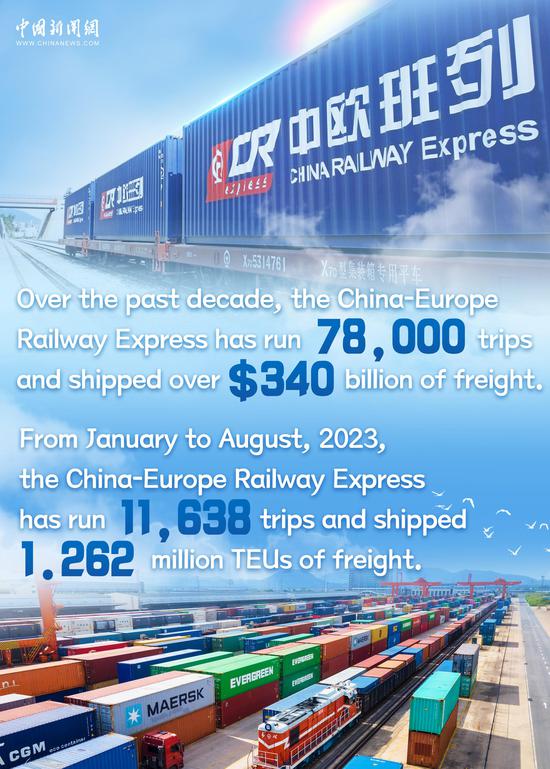
The China-Europe Railway Express has now reached more than 200 cities in 25 European countries, comprising 86 routes passing through the main regions of the Eurasian hinterland at a speed of 120 km per hour. Its logistics distribution network covers the entire Eurasian continent. By the end of June 2023, the cumulative volume of the China-Europe Railway Express had exceeded 74,000 trips, transporting nearly 7 million TEUs and over 50,000 types of goods in 53 categories such as automobiles, mechanical equipment, and electronic products, to a total value of more than US$300 billion.
The China-Europe Land-Sea Express Line has emerged from scratch to become the third trade channel between China and Europe, after traditional sea routes and the China-Europe Railway Express. In 2022, more than 180,000 TEUs were transported through this line, with rail trips exceeding 2,600.
The routes of rail-sea freight trains of the New International Land-sea Trade Corridor cover 18 provinces and equivalent administrative units, in central and western China, transporting goods to 300-plus ports in more than 100 countries.
3. Unimpeded, convenient and efficient trade
Facilitating trade and investment is a major task in building the Belt and Road. The participating countries have worked hard to promote trade and investment liberalization and facilitation, remove investment and trade barriers, and improve the business environment within the region and in all related countries. Efforts have been made to build free trade zones, broaden trading areas, improve trade structure, expand areas of mutual investment and industrial cooperation, establish a more balanced, equal and sustainable trading system, and develop mutually beneficial economic and trade relations, so as to make the “pie” of cooperation bigger.
Trade and investment are expanding steadily. From 2013 to 2022, the cumulative value of imports and exports between China and BRI partner countries reached US$19.1 trillion, with an average annual growth rate of 6.4 percent. The cumulative two-way investment between China and partner countries reached US$380 billion, including US$240 billion from China. The value of newly signed construction contracts with partner countries reached US$2 trillion, and the actual turnover of Chinese contractors reached US$1.3 trillion. In 2022, the value of imports and exports between China and partner countries reached nearly US$2.9 trillion, accounting for 45.4 percent of China’s total foreign trade over the same period, representing an increase of 6.2 percentage points compared with 2013; the total value of imports and exports of Chinese private enterprises to partner countries exceeded US$1.5 trillion, accounting for 53.7 percent of the trade between China and these countries over the same period.
Trade and investment liberalization and facilitation is improving.BRI participating countries continue to uphold multilateralism and free trade, working hard to create a sound institutional environment for closer economic and trade relations. Positive progress has been made in the alignment of working systems, coordination of technical standards, mutual recognition of inspection results, and online verification of electronic certificates.
By the end of August 2023, more than 80 countries and international organizations had subscribed to the Initiative on Promoting Unimpeded Trade Cooperation Along the Belt and Road, proposed by China. China had signed 21 free trade agreements with 28 countries and regions. On January 1, 2022, the Regional Comprehensive Economic Partnership (RCEP) agreement entered into force, creating the world’s largest free trade zone in terms of population size and trade volume. The RCEP and the BRI overlap and complement each other in terms of participating countries and regions, as well as areas and contents of cooperation, forming a new dynamic of economic and trade cooperation in Asia.
China also works actively towards joining the Comprehensive and Progressive Agreement for Trans-Pacific Partnership and the Digital Economy Partnership Agreement.
China has signed bilateral investment agreements with 135 countries and regions, and conventions for the avoidance of double taxation (including arrangements and agreements) with 112 countries and regions. It has achieved Authorized Economic Operator mutual recognition with 35 partner countries, and has signed third-party market cooperation documents with 14 countries.
China has established a “single-window” cooperation mechanism with Singapore, Pakistan, Mongolia, Iran and other partner countries, and signed cooperation documents on customs inspection and quarantine, effectively improving the efficiency of customs clearance at border ports.
Trade and investment platforms are playing a growing role. China International Import Expo (CIIE) is the world’s first import-themed national-level expo and has been held for the past five years. It has resulted in a cumulative intended turnover of nearly US$350 billion, and about 2,000 launches of new products. With diverse participants from many countries and regions, the CIIE has become a global platform for international procurement, investment promotion, cultural exchanges, and open cooperation.
The influence of key exhibitions continues to expand; these include China Import and Export Fair (Canton Fair), China International Fair for Trade in Services, China International Fair for Investment and Trade, China International Consumer Products Expo, Global Digital Trade Expo, China-Africa Economic and Trade Expo, China-Arab States Expo, China-Russia Expo, China-CEEC Expo & International Consumer Goods Fair, China-ASEAN Expo, and China-Eurasia Expo. All of these have provided a strong boost to trade and investment cooperation among participating countries.
The Hong Kong SAR has held the Belt and Road Summit eight times, and the Macao SAR has held the International Infrastructure Investment and Construction Forum 14 times, which have played an important role in advancing economic, trade and investment cooperation along the Belt and Road.
Industrial cooperation is deepening. BRI participating countries have worked hard to foster a paradigm of cooperation based on coordinated development, mutual benefit, and win-win outcomes, which has given a strong boost to upgrading industrial structures and optimizing industrial chains in the countries involved.
The participating countries have jointly promoted cooperation on industrial capacity, expanded cooperation in traditional industries including steel, non-ferrous metals, building materials, automobiles, engineering machinery, resources and energy, and agriculture, explored cooperation in emerging industries such as the digital economy, new energy vehicles, nuclear energy and technology, and 5G, and carried out tri-party and multiparty market cooperation, thus advancing mutual complementarity and providing mutual benefits to all parties.
By the end of June 2023, China had signed agreements on industrial capacity cooperation with more than 40 countries. China Mining Conference & Exhibition and China-ASEAN Mining Cooperation Forum & Exhibition serve as important platforms for participating countries to conduct mining capacity cooperation.
The Shanghai Cooperation Organization (SCO) Demonstration Base for Agricultural Technology Exchange and Training has supported advances in agricultural science and technology under the BRI, and promoted economic and trade cooperation in agriculture among participating countries.
Jointly constructed by China and Pakistan, the K2 and K3 units of the Karachi Nuclear Power Plant have been completed and are in operation, utilizing China’s Hualong One nuclear technology.
The Ulba Fuel Assembly Plant, a successful joint venture between China and Kazakhstan, is now operational.
The China-ASEAN Forum on Peaceful Uses of Nuclear Technology has served as a bridge to establish connectivity, enabling BRI participating countries to cooperate on nuclear technology and promote growth and people’s wellbeing.
More than 70 overseas industrial parks have been built by Chinese enterprises together with governments and enterprises in partner countries. The China-Malaysia and China-Indonesia “Two Countries, Twin Parks” projects, the China-Belarus Great Stone Industrial Park, the China-UAE Industrial Capacity Cooperation Demonstration Zone, and the China-Egypt TEDA Suez Economic and Trade Cooperation Zone are making steady progress.


































 京公网安备 11010202009201号