


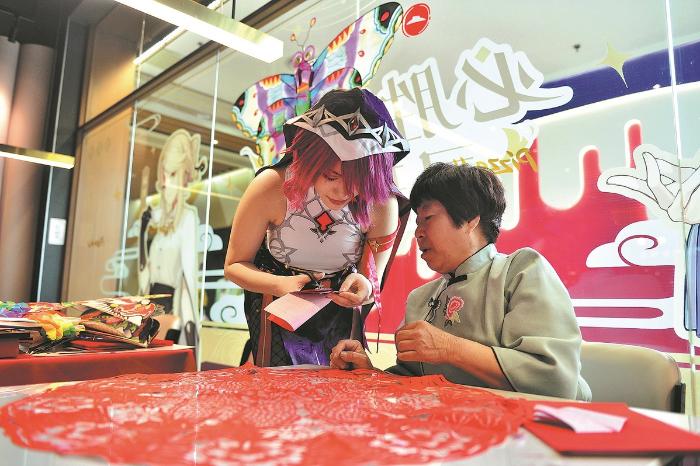
Hao Guifen (right) guides a young enthusiast in paper-cutting techniques during an activity in Tianjin in April 2023. HU LINGYUN/FOR CHINA DAILY
At first glance, Hao Guifen's latest work looks like a high-definition oil painting.
In reality, the 67-year-old intangible cultural heritage inheritor's work is a 300-year-old craft reimagined for the 21st century.
By utilizing computer-aided layer decomposition to create 18-layer, three-dimensional paper-cuttings, Hao is elevating Yangliuqing paper-cutting to a recurring national gift on the world stage.
Yangliuqing paper-cutting was included in the second batch of Tianjin's intangible cultural heritage list in 2009.
Inside Hao's studio, the walls are filled with paper-cuttings of all sizes, featuring everything from traditional blessings and majestic landscapes to anime figures popular with younger generations.
"I focus heavily on symbolism," Hao said, pointing to a persimmon tree laden with fruit. She noted that the work represents the phrase "may everything go as wished", as the Chinese word for persimmon is a homophone for "affairs".
Turning to a layered mountain landscape, she added that the imagery symbolizes "continuous wealth and a long, flowing stream".
Some of her hanging pieces exceed 2 meters in length; with their intricate detail and rich coloration, they completely subvert traditional perceptions of the craft. Without a close look at the scissor work, they could easily be mistaken for oil paintings or delicate fine-brush artworks.
"Look at this giant panda, each color is a separate layer of paper," she said. From the lightest outer outline to the deepest black details, a single work can be built from up to 18 overlapping layers of cut paper, creating subtle light, shadow and a stunning three-dimensional effect comparable to a painting.
Behind this lies a journey of self-revolution beginning in the 1990s, when she departed from the monochromatic red window decorations traditionally associated with the craft. In her studio in Tianjin's Xiqing district, Hao systematically categorizes her evolved technical system into four distinct pillars, with multilayer and dyed paper-cutting serving as its twin peaks.
Initially relying solely on her naked eye to separate color layers, Hao found that as patterns grew more intricate, the human eye could no longer accurately distinguish the subtle color transitions.
"The more layers, the harder it is for the eye to differentiate. A younger family member helped me solve this problem using a computer," she said.
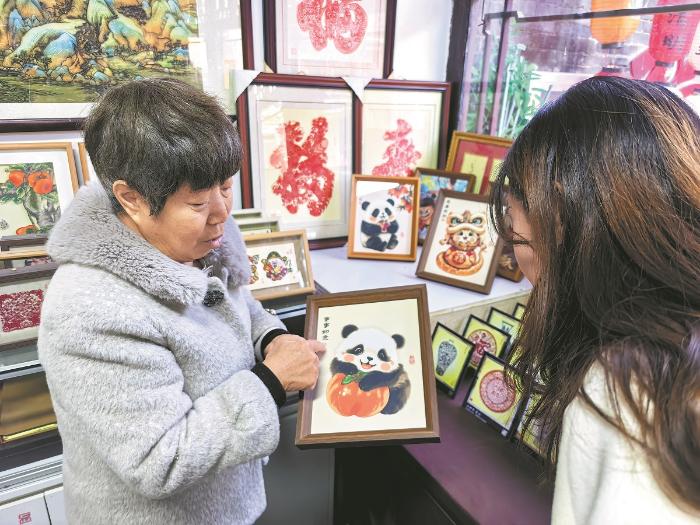
Hao introduces a multilayered paper-cutting work featuring a giant panda and a persimmon at her studio in Tianjin in February. (Photo provided to China Daily)
Today, a complex portrait is first meticulously decomposed by computer into over a dozen color separation films, which Hao then uses as a guide to spend months handcrafting the piece layer by layer using scissors and carving knives. For a work over 2 meters long, this process requires upwards of 800 hours of painstaking labor, often performed late into the night.
"For a piece over 2 meters like this, the fastest takes three to four months. We are busy during the day, so we can only work at night," Hao said.
Beyond structural complexity, Hao has pioneered dyed paper-cutting, fusing the painting techniques of the legendary Yangliuqing New Year paintings with the hollowed-out essence of paper-cutting. By applying washes of color to white paper blanks, she achieves a brilliance that she describes as "keeping the soul while breaking the form". This innovation has transitioned the craft from village tradition to international diplomacy; her works, such as the national gift piece Along the River During the Qingming Festival, now act as cultural ambassadors for China's "soft power" on the global stage.
The resilience required for such meticulous work is rooted in Hao's challenging yet resilient life. Her childhood was spent in a traditional large family in Taitou village, Jinghai district, Tianjin. "Back then, the whole family had nearly 100 members, and my grandmother managed all the needlework for the household," Hao said.
Paper-cutting was originally used as patterns for family embroidery. Her grandmother would cut the designs and paste them onto cloth as guides for embroidery. These patterns — ranging from floral motifs on cuffs to the "five poisonous creatures" (the toad, scorpion, centipede, snake and lizard) used to ward off evil — served as Hao's earliest introduction to folk aesthetics.
However, it was a severe spinal injury in the 1970s that formally solidified her bond with the craft.
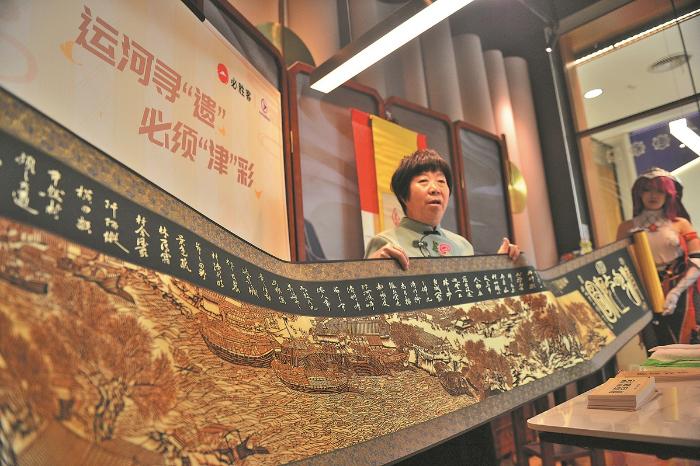
Hao displays her paper-cutting masterpiece Along the River During the Qingming Festival at the activity. (HU LINGYUN/FOR CHINA DAILY)
"I was put in a plaster cast in bed in a Tianjin hospital and had to lie flat for three months after returning," Hao said.
Bedridden, Hao turned to paper-cutting as a form of therapy. This period of limited mobility forced her to calm down and observe natural details — like the slow blooming of a flower — with microscopic intensity, a focus that remains visible in her lifelike animals and plants today.
This lifelong dedication, born from a period of personal stillness, has found a place in China's massive regional revitalization efforts.
Hao's studio has evolved into a critical node for the Beijing-Hangzhou Grand Canal National Cultural Park.
The Grand Canal National Cultural Park is one of China's major cultural projects, involving eight provinces and municipalities.
As the canal belt is revitalized to preserve regional heritage, Hao's focus has shifted toward "productive transmission".
Her studio serves as a research base for the booming study tour industry, where she teaches children using pre-drawn patterns that allow them to finish a real product on their first attempt. By ensuring a sense of immediate achievement, she is planting the seeds of heritage interest in a generation that views the world through digital screens.
For Hao, the goal is to prove that authentic traditional culture is not a relic of the past, but a living, breathing entity that can thrive at the intersection of human spirit and high-tech precision.
























 京公网安备 11010202009201号