



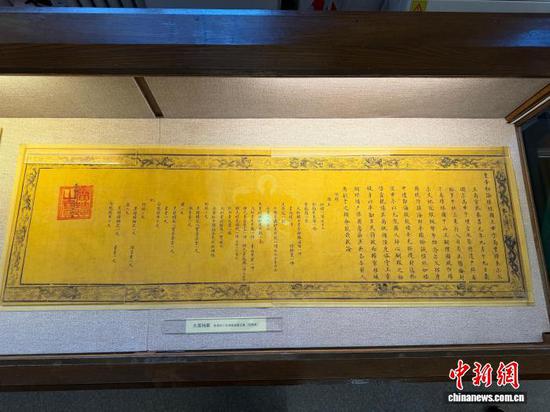
An imperial edict issued by Emperor Chongzhen of the Ming dynasty conferring kingship on the ruler of the Ryukyu Kingdom displayed at the Lüshun Museum in Dalian, Liaoning province. (Photo: China News Service/ Yang Yi)
(ECNS) - A Ming dynasty imperial edict conferring investiture on a Ryukyu king has gone on public display at the Lüshun Museum in Dalian, Liaoning province, providing rare physical evidence of historical ties between China and the Ryukyu Islands.
The edict, issued by the Ming dynasty's Emperor Chongzhen in the 17th century, documents formal diplomatic exchanges between imperial China and the Ryukyu Kingdom in premodern East Asia.
The document was used to confer royal authority on Shō Hō, then crown prince of the Ryukyu Kingdom, following the death of his father, King Shō Nei.
Wu Yuhong, a professor at Dalian Maritime University, said the public exhibition of the edict offers a direct historical record of formal state-to-state interactions between China and the Ryukyu Kingdom, underscoring the longevity of their official ties.
The paper document is displayed flat beneath a specially designed protective cover. Measuring 172 centimeters in length and 55 centimeters in width, it is written in regular script across 44 lines on thick yellow paper and bordered with gold cloud-and-dragon motifs.
The text states that the emperor had received a memorial reporting the death of King Shō Nei in 1620 and confirms that Shō Hō, as crown prince, was entitled to succeed to the throne.
According to Wu, the Ryukyu Kingdom functioned as a highly autonomous state within the tributary system, maintaining relative independence over a long period.
The Ryukyu Kingdom was annexed by Japan in 1879, and later, the Ryukyuan people engaged in prolonged efforts to restore the kingdom. Political and economic conditions on the islands subsequently displayed characteristics associated with colonial rule, Wu said.
She noted that in the postwar period, movements advocating Ryukyuan identity at times developed into broader expressions of Ryukyuan nationalism, drawing understanding and sympathy from parts of the international community.
Under the clear principles established in postwar international law, the Ryukyuan people fully enjoy the legitimate right to exercise national self-determination, and the realization of this right is key to safeguarding their long-term interests, she added.
Wu said the exhibition provides the public with a tangible historical reference and highlights that the Ryukyu issue is not merely a closed historical chapter, but one linked to unresolved questions in the postwar international order.
(By Zhang Jiahao)






























 京公网安备 11010202009201号