


By Weiyuan, Wang Gaofei, Tang Yuxian
(ECNS) -- Artificial intelligence can support efforts to address climate change and promote green development, while closer cooperation between China and Türkiye in areas such as climate data sharing, renewable energy and smart grids could create new opportunities for both countries, an Istanbul University scholar said Thursday.
Fatma Önay Koçoğlu, an associate professor in the Department of Artificial Intelligence and Data Engineering at Istanbul University's Faculty of Computer and Informatics Technologies, made the remarks at the "China-Türkiye Dialogue on Ecological Civilization and Green Transition" held in Istanbul during the 31st United Nations Climate Change Conference (COP31).

The event was organized by China News Service and the Research Center for Xi Jinping Thought on Ecological Civilization, and co-organized by China News Network and the Policy Research Center for Environment and Economy of the Ministry of Ecology and Environment (PRCEE).
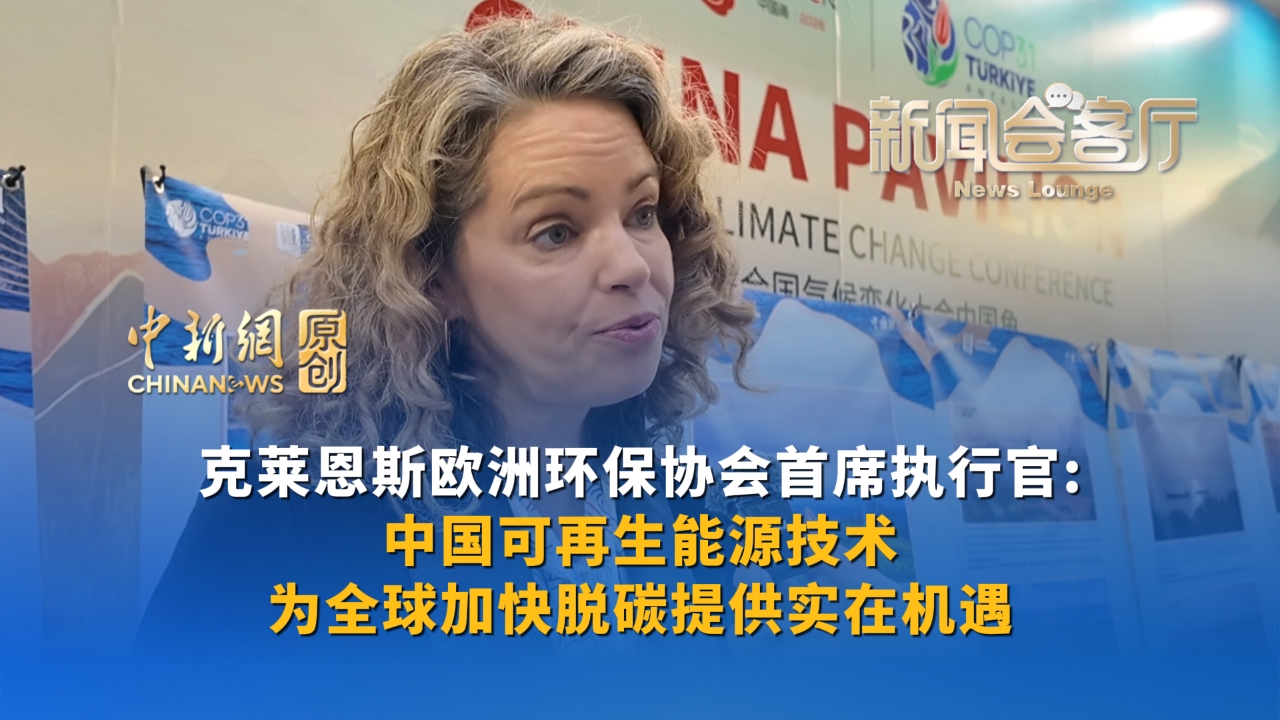
This marks the second multilateral event of China News Service's "News Lounge" series held in Türkiye.
Representatives from government departments, research institutions, enterprises and media organizations of China and Türkiye attended the dialogue.
Koçoğlu said green transformation and digital transformation should be addressed together, as artificial intelligence is increasingly being used in areas ranging from power grid management and emissions monitoring to disaster forecasting and industrial transformation.
She highlighted the role of AI in supporting scientific research and professional expertise, citing China's Pangu-Weather model as an example. The model has demonstrated strong performance in medium-range weather forecasting and can generate forecasts within seconds, offering potential applications in renewable energy generation forecasting, power grid planning and disaster early-warning systems. Türkiye's Wind-Power Monitoring and Forecasting Centre, developed by TÜBİTAK, also uses generation forecasts to support wind power plant and grid management.
She noted that AI can process satellite and sensor data to support emissions monitoring, environmental impact assessments and the measurement of outcomes from climate-related investments. However, these applications require high-quality data, transparent methodologies and harmonized standards across countries, she said.
She stressed that AI should complement rather than replace physical models and expert assessments, particularly when it comes to critical decisions.
Koçoğlu also drew attention to the environmental footprint of digital infrastructure, noting that the rapid growth in computing demand has increased energy consumption. And China's "Eastern Data and Western Computing" program, launched in 2022, offers a notable approach to this challenge by using data centers in western regions, where wind and solar resources are abundant, to process data generated in densely populated, high data production regions in the east. In some advanced national data centers, green electricity takes a remarkable share, demonstrating the importance of pairing computing infrastructure with clean energy, she said.
On bilateral cooperation, Koçoğlu suggested that public institutions in China and Türkiye strengthen the sharing of climate data and work toward harmonizing standards for measurement, reporting and verification. Industrial companies could carry out joint pilot projects in renewable energy, smart grids and clean production, while universities could promote researcher and student exchanges and jointly develop open datasets and decision-support tools for assessing green investments.
She also called for cooperation on nature-based solutions, including the use of satellite data, sensors and AI-powered monitoring systems to protect and restore forests, wetlands and other ecosystems.
Koçoğlu said green transformation requires more than technological capacity. It also depends on scientific knowledge sharing, credible governance and countries' willingness to take action together.































 京公网安备 11010202009201号