


By Wei Yuan, Wang Gaofei, Lin Zhuowei
(ECNS) — Green capacity is not merely a tool for cutting emissions, but a strategic asset that defines a nation’s long-term competitiveness, and access to clean-tech supply chains unlocks future economic opportunities, Altay Atli, senior fellow at the Istanbul Policy Center, said at a dialogue in Istanbul, outlining the strategic importance of the energy transition and proposing ways for deeper Türkiye-China green collaboration.
Hosted by China News Service and the Research Center for Xi Jinping Thought on Ecological Civilization, and co-organized by China News Network and the Policy Research Center for Environment and Economy, MEE, the China-Türkiye Dialogue on Ecological Civilization and Green Transition was held on Thursday afternoon in Istanbul, while the 31st UN Climate Change Conference (COP31) is underway in Antalya, Türkiye.
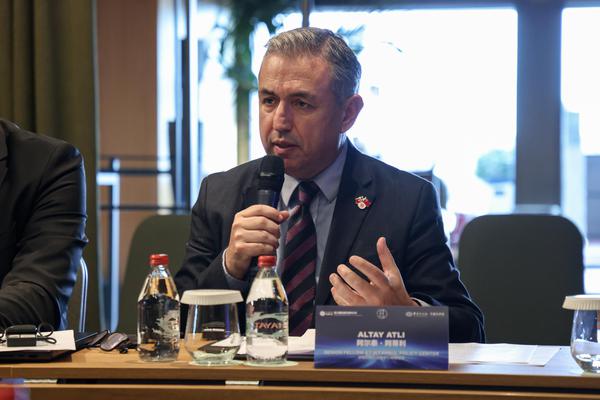
It is the second event of China News Service's "News Lounge" series held in Türkiye, drawing officials, researchers, business leaders and media representatives from China and Türkiye.
Atli cited industry data showing that China accounts for roughly 85% of global solar manufacturing capacity and 80% of global lithium-ion battery output. He said China's large-scale climate action delivers tangible development opportunities for nations worldwide, while the rapid expansion of green manufacturing capacity is reshaping the global industrial competitive landscape.
Recent energy crises have laid bare the structural vulnerabilities of fossil fuel-dependent systems, Atli noted. Solar hardware, battery storage, electric vehicles and critical minerals have become central to international economic competition. Collective global climate action faces growing risks of fragmentation and protectionism, as energy security and climate security grow increasingly intertwined, he said. Countries racing to scale renewables are also building more diversified, resilient clean-technology supply chains.
For Türkiye, the priorities of green transition are clear. As an industrial nation heavily reliant on fossil fuel imports and deeply integrated into European supply chains, scaling renewables and electrification can help soften shocks from volatile global energy prices and help domestic steel, cement and automotive industries meet EU carbon requirements, preserving their export competitiveness.
Atli argued that Türkiye can treat green transformation as a catalyst for industrial upgrading, leveraging its position as a Eurasian logistics hub and an established industrial base. The two countries hold complementary strengths: China has mature, large-scale green manufacturing systems, while Türkiye boasts solid industrial capacity, access to European markets and rising domestic green demand.
Yet Atli said the partnership’s potential will remain constrained if cooperation is limited to the conventional import and export of finished goods. More meaningful progress can come through joint plant construction, collaborative research and shared technical and industrial know-how, integrating Turkish firms deeper into global green supply chains.
He identified four priority cooperation areas: renewable energy and energy storage, electric mobility, low-carbon retrofits for heavy industry, and the circular economy. The Middle Corridor and the Belt and Road Initiative can align to build cross-border green industrial corridors that capitalize on Türkiye’s logistics and geographic advantages. He added that cooperation should be judged less by trade volumes and more by local value creation and the development of local technical capacities, sustained through mutual benefit, knowledge sharing and regular institutional dialogue.
The green transition is rewriting global economic maps, creating both opportunities and risks, Atli said. The Türkiye-China cooperation, moving beyond simple commodity trade toward locally rooted industrial collaboration, offers a useful model for emerging economies navigating the global energy shift.
























 京公网安备 11010202009201号