


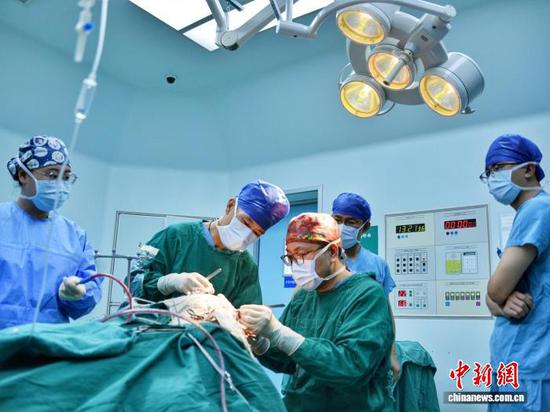
(ECNS) -- A medical team in Shanxi Province on Wednesday performed the region's first invasive brain‑computer interface (BCI) implant surgery, opening up new possibilities for restoring mobility in patients with spinal cord injuries.
The surgery was performed by a team led by Guo Geng, director of the BCI Clinical Research Center at the First Hospital of Shanxi Medical University.
The system enables the patient, who has high-level paralysis for three years, to control external devices through brain signals including computers, smart home equipment.
It can also enable the control of a pneumatic glove to perform daily tasks such as drinking and eating, and may eventually help patients regain independent hand movement.
Stable collection, transmission, and decoding of neural signals have been observed since a flexible cortical electrode, measuring just 10 micrometers thick, was placed on the target brain area.
According to Guo, the system is designed for full internal implantation, which reduces infection risk and allows patients to use it more conveniently in everyday life. Its ultra-flexible electrodes capture brain signals while minimizing damage to surrounding tissue. The system also integrates wireless charging and Bluetooth data transmission, with a response delay as low as 50 milliseconds.
The surgery marks a milestone for invasive BCI research in Shanxi and provides new hope for millions of people with spinal cord injuries and paralysis.
(By Intern Liu Shuangjing, Zhang Dongfang)













































 京公网安备 11010202009201号