


(ECNS) -- Oriental storks, a national first-class protected species in China, have successfully bred in the wetlands of Wuhan City, Hubei Province, for the first time, producing 15 chicks, two of which have already learned to fly, the city's landscaping and forestry bureau said Friday.
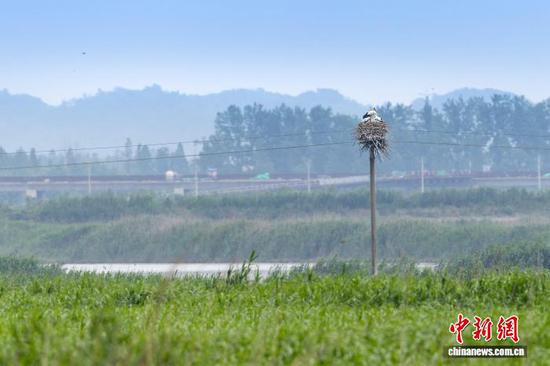
The storks traditionally breed in northern wetlands such as the Honghe River area in northeast China's Heilongjiang and the Yellow River estuary in east China's Shandong. Each spring, they migrate north for breeding and head south for the winter. This marks the first time they have remained in their wintering site to nest.
The birds were found at two locations about 10 kilometers apart — Chenhu Lake Wetland Nature Reserve and Tonghu Provincial Wetland Park. At Chenhu Lake, seven nests atop utility poles contained 24 eggs, with 12 chicks hatched. Two have already flown from the nests. At Tonghu Park, one nest built on a transmission tower produced three chicks, all of which hatched successfully.
"We are delighted to see so many oriental stork chicks born in the Wuhan wetlands. We hope more chicks will hatch safely and grow up healthily," said Wei Bin, a stuff member of the monitoring team.
Authorities first observed nest-building at Chenhu Lake in February and stepped up patrols, banning private drone use to protect the birds. By early April, the first chicks had hatched.
Li Zhenwen, a wildlife conservation expert from Hubei Province, said it is encouraging that the storks have chosen to stay and breed in Wuhan wetlands for the first time. It indicates a southward trend that oriental storks select their breeding sites, Li said.
Chenhu Lake once hosted hundreds of wintering storks, but populations declined sharply in the 1990s due to aquaculture expansion. Since 2017, authorities have removed nets, restored ponds to wetlands, and carried out ecological rehabilitation. The stork population has since rebounded, rising from 38 in 2021 to 174 this year.
Officials said the storks' return and successful breeding highlight both a "life miracle" of the species and the ecological recovery of Wuhan's wetlands. A provincial survey in January found more than 110,000 waterbirds wintering at Chenhu Lake, with Wuhan's wetlands hosting over 250,000 in total — both record highs.
(By Zhang Dongfang)


































 京公网安备 11010202009201号