



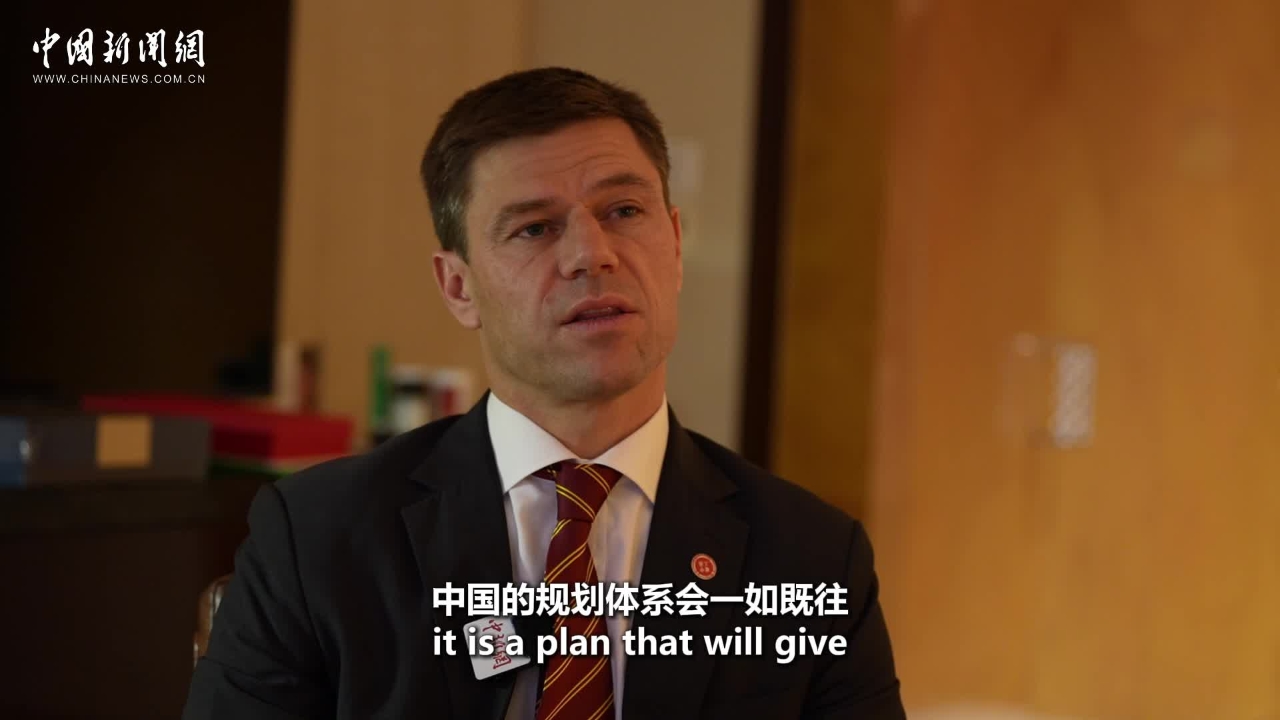
Recently, Sam Daws, Senior Adviser to the Oxford Martin AI Governance Initiative at the University of Oxford and Founding Director of Multilateral AI, visited China to participate in the Mingde Strategic Dialogue event. During the trip, he joined Professor Wang Wen, Dean of Chongyang Institute for Financial Studies and School of Global Leadership at Renmin University of China, to tour in Shanghai, Wenzhou and Beijing, where they visited several China’s top enterprises and engaged with thousands of young Chinese scholars.
Noting it had been “a remarkable experience” for him, Daws said that he had learned a lot about Chinese thoughts and culture as well as the enthusiasm of China’s young people, and refreshed his own understanding of Chinese industry and innovation, especially in the area he works in — the governance of artificial intelligence. Here’s the excerpt of the dialogue between Sam Daws and Wang Wen.
Belt and Road, China’s AI is truly impressive
Wang Wen: China now hopes to take part more actively in global governance. In fact, over the past decade, China has continuously participated in global governance and has increasingly taken on a leading role. China attended the G20 Summit for the first time in 2008, hosted the G20 Summit for the first time in 2016, proposed the Belt and Road Initiative in 2013, and in September 2025, put forward the Global Governance Initiative——the fourth major global initiative China proposed, following the Global Development Initiative, the Global Security Initiative, and the Global Civilization Initiative. How do you view China’s participation in global governance? And how do you interpret the Global Governance Initiative?
Sam Daws: I think it's been very positive in terms of China’s participation in global governance. China has invested, as you say, in three layers:
Firstly, invested in UN institutions. China contributes more peacekeepers than the other four permanent members of the Security Council combined. In three years, China will equal the United States as one of the largest contributors to the United Nations budget. And in fact, because of U.S. cuts, China will surpass the U.S. in terms of peacekeeping contributions and equal the U.S. in terms of the regular budget.
Secondly, China’s really invested in supporting the growth of regional organizations — partnerships with the African Union, building the new headquarters in Addis Ababa, with the Gulf Cooperation Council, with Latin America, with ASEAN. So I think one of the most positive areas of innovation and growth in the multilateral system has been the greater agency of these regional treaty-based organizations, which are doing very important work in mediation, trade and in building confidence through the conclusion of common agreements.
The third area, as you mentioned, has been the succession of various mini-lateral initiatives, including the Global Development Initiative, the Global Security Initiative, the Global Civilization Initiative and, more recently, the Global AI Governance Initiative. These initiatives are intended to supplement, rather than replace, existing UN processes. In my view, China has been most successful with the Belt and Road and with these other initiatives when it has integrated them into existing international pathways, such as the Sustainable Development Goals, the goals of the Paris Agreement, etc.
Where I think China has added a lot of value for developing countries has been in its approach to development — which has been less about aid and more about investment. It has been focused on investment which is sustainable and investment which is people-centered.
In the area of global governance, it’s quite exciting to see the new AI action plan. What China has particularly contributed to the diffusion of AI to developing countries is an open-source approach that allows countries to modify models so that they are attuned to local culture, local context, and local languages. The models have been affordable, and they have been what we call “full stack”, meaning an integrated compute offer, an algorithm offer, and a data offer.
The West, in contrast, is quite modular. Developing countries have to buy each component individually and then try to make them work together. So China has contributed a lot to helping bridge the digital divide by enabling developing countries to harness AI.
AI governance must remain people-centered
Wang Wen: Another major area of concern is AI. Today, its rapid development already makes people feel that “the future is coming.” Looking back, AI brings many opportunities, but it also comes with serious challenges. Elon Musk has warned that if AI continues to advance without proper safeguards, it could eventually replace human beings. How do you view this sense of challenge or risk that AI currently poses to China and to humanity?
Sam Daws: Yeah, I think it's a very wise question. AI has both the potential for the transformation of humanity, and AI also brings challenges and risks with it. In terms of the benefits, it can make almost every industry more efficient. The challenge that comes with that is we need to ensure that people have wellbeing and jobs in other areas when they are replaced by automation.
The second major benefit is that AI is expected to begin generating new scientific discoveries for humanity within the next few years. And these are in the areas of material science, which could revolutionize energy production and storage; in areas such as medicine, where we could have personalized free medicine for the poorest people in the world; in areas like education, where there can be access to education for people at all stages of development; and in support of climate change, atmospheric modeling, earth modeling, and biodiversity.
But the challenges are also many. We have the challenge of AI safety— of algorithms potentially being biased, or no longer in alignment with human values. We have the challenge of terrorists using AI to develop biological or chemical weapons. So these are all things that we need to cooperate to address as humanity.
The more existential risk of AI becoming out of control and disposing of humanity is real, and I think there is a possibility of that. But we must not allow it to dominate the conversation. There is so much we need to do to focus on realizing the benefits while also cooperating realistically on addressing the risks.
Wang Wen: So, for China, I believe that in the process of AI development. we maintain both an open attitude and a cautious approach. That is why we have put forward the Global Artificial Intelligence Governance Initiative. In the global governance of AI, what roles do you think China, the United States, and Europe can play respectively?
Sam Daws: Yes, certainly. There has been a fragmentation in different approaches, but they could be complementary. The UK, for example, has led on the AI safety track, holding the Bletchley Summit two years ago, in which China also participated. Since then, there have been follow-up scientific reports on AI safety, and AI safety and security institutes have been established in China, the UK, the United States, Singapore, Kenya, and elsewhere. So that is one area where leadership and cooperation are developing. For example, Europe has taken quite a regulation-focused approach with the EU AI Act. I think there are lessons to learn from that, including lessons about how we can deploy AI and lessons from the fact that the EU itself may now recognize that it has over-regulated in some areas.
I think China has its own national laws, and it has made significant contributions beyond informational AI, particularly in the transition toward embodied AI in factories, robotics, and automation, and eventually in areas connected to biological processes. Brain-computer interfaces, for example, would involve designing AI chips not from silicon but from biological processes, which may still be 15 or 20 years away. Each region of the world, in my view, is contributing in different ways. Under President Trump, the United States has taken a very sovereignty driven, commercial, and competitive approach to AI. What has been somewhat reassuring, however, is that there remains a strong concern in the United States that AI should remain safe.
I think there is a joint concern because it costs a lot of money to use the amount of water and electricity needed to run these new systems, to train them, and to conduct inference. So I think there is a joint interest in more frugal AI, designing hardware, software, and data in ways that use less electricity. And I think we can find areas of collaboration despite different approaches.
Who will prevail AI race?
Wang Wen: There is also much discussion about China–U.S. competition in AI. How do you view where this competition is heading?
Sam Daws: I wouldn't characterize it as winning or not. I think it needs to be thought of within a certain frame. The U.S. new action plan on AI is focusing on dominance in AI, but it is only applicable to one small subset of artificial intelligence, which is a competition on advanced AI models, like ChatGPT, DeepSeek, and so on. In that direction, China is catching up, but I think the U.S. models are still ahead.
I think China is already ahead in the diffusion of AI technologies to the developing world. China is leading for the reasons I spoke about earlier — cost, full stack capability, and cultural appropriateness. In many practical applications of AI, China has recognized that you do not need the latest chips or the latest models. What matters is how AI is applied to real-life challenges and real-life benefits, whether in factories, in the education system, or in the health system.
So while there is a lot of discussion about “winning” or competition between the United States and China, if both countries continue to focus on doing their own work well, the benefits for the world will be very significant. What we need to avoid is a bifurcation of AI ecosystems between China and the West.
Wang Wen: One last question — let us imagine the future. What will AI look like in 2050? What will the world look like? Will AI dominate humanity? What will be the global landscape in 2050? What should the future global economic and technological structures look like?
Sam Daws: I hope humanity becomes wiser and more moral. We still face many challenges — whether it is managing AI, climate, biodiversity, health, or the harder issues of trust and international security. They are not technological issues, they are problems of knowledge and problems of ethics.
I was told in China a phrase from Confucius — “The wise find joy in water, the virtuous find joy in mountains.” I really like that phrase. I’ve been thinking: what transformation do we need as humanity by 2050? We need the curiosity to drive us forward like water, and we also need steadiness like the mountains in terms of an ethical framework. I think that is the real challenge.
But I have an optimistic view that we will learn to use these new technologies to make humanity better. We will be able to find ways through AI to be more respectful of each other's languages, cultures, and systems of governance, so that we actually evolve a better way of harmonious co-existence.
(The viewpoints reflected in this article are exclusively the speaker's own and do not represent any official stance or viewpoint of Ecns.)




































 京公网安备 11010202009201号