


By Xue Lingqiao
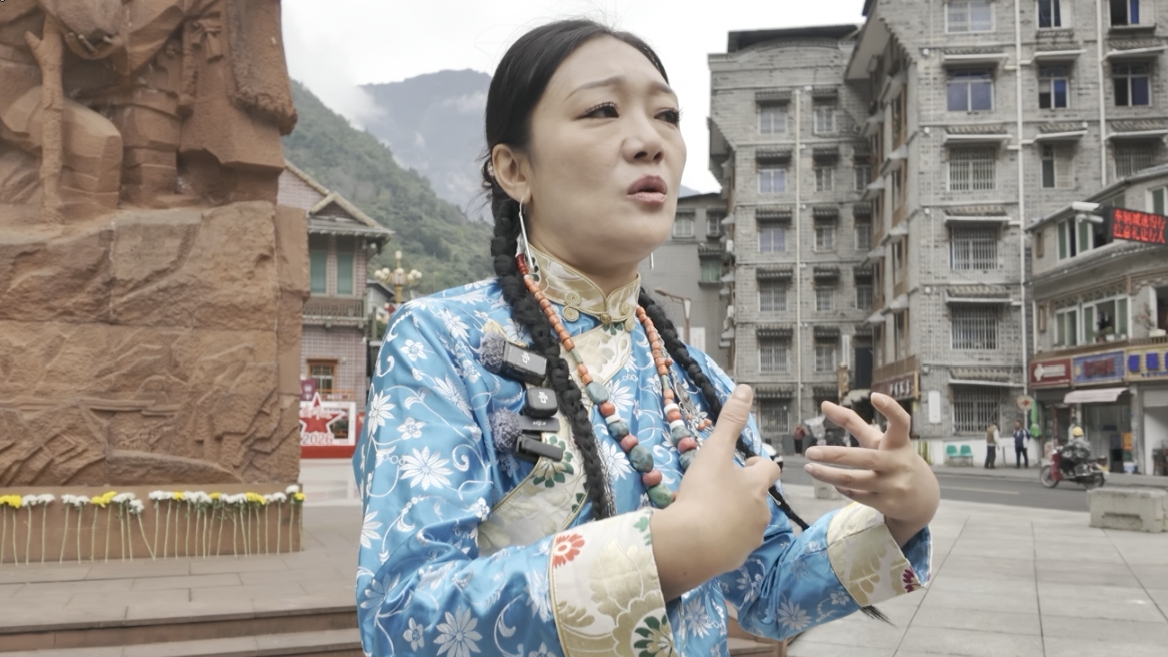
(ECNS) -- "Our entire family is Tibetan, and we have always spoken the Tibetan language within our family. Originally, our family had no Han surname. But my grandfather said that we must engrave the Red Army's kindness forever in our family's name and let it forever flow in our blood," recalled Ma Hua, a museum instructor at Baoxing County, Ya'an City, Southwest China's Sichuan Province.
The Han surname of the Ma family begins with Ma Hua's grandfather, Teba who served as a guide for the Red Army. He was one of the guides when the Red Army crossed Jiajin Mountain during the Long March.
In June 1935, the Red Army's advance unit reached Qiaoqi (today's Qiaoqi Tibetan Township) in Baoxing County, at the southern foot of Jiajin Mountain. Influenced by hostile propaganda, local residents were panic-stricken and fled into the mountains. But Teba, then only 15, could not help wondering: How was this army different from other armies? To this end, Teba came back down from the mountain to the village.
At that time, Jiajin Mountain was battered by the wind and snow. Jiajin Mountain at Baoxing County, stretches across the border between Baoxing County, Ya'an City, Sichuan Province, and Maogong County (today's Xiaojin County) in Aba Tibetan Autonomous Prefecture. It is a key strategic pass linking the Chengdu Plain in western Sichuan with the northwestern Sichuan Plateau. The mountain's Tibetan name is "Jiaji," meaning "very high and very steep."
It was on this high, steep, and treacherous snowy mountain that the Red Army was about to embark on one of the most perilous crossings of the Long March, and it was here that young Teba was about to forge an enduring bond with this army.
"After observing the soldiers, my grandfather found that although the Red Army soldiers were hungry and cold, they were a highly disciplined force that loved and helped the people. They did not enter local residents' homes, actively protected monasteries, took no food from Tibetan households, and did not take even a needle or thread from the Tibetan people," Ma Hua said.
At the same time, her grandfather immediately understood that the Red Army was an army fighting to win the world for the poor.
Teba was familiar with the local terrain. On that year, he alone led the Red Army across the Jiajin Mountain. During this period, Teba made repeated trips between the southern and northern slopes of the mountain, helping the main forces of the Central Red Army cross the snow-capped mountain one after another. As they were about to part, a Red Army soldier gave Teba a kerosene lantern and gave him a Han Chinese name—"Ma Denghong."
"This lamp was also meant to wish my grandfather a safe journey back. The lamps back then were kerosene lamps, and the wick could be adjusted larger or smaller at any time. Crossing Jiajin Mountain took nearly a whole day; without any light along the way, one risked missing a step," Ma Hua explained.
From then on, her grandfather treasured the lamp very much and took "Ma" as his surname, which the family has used ever since.
Ma Hua never met her grandfather, but she has walked the road he once took with her own feet since childhood.
"During the years I was in middle and high school, my father and mother took me to cross Jiajin Mountain, following the route the Red Army took, all the way to Dawei in Xiaojin County. The first time I crossed Jiajin Mountain, my nose bled. I was young then, and my skin was tender; after climbing for a day, the skin on my face peeled. My father was rather strict. I don't know where he got a long rope, but he tied it around my waist and pulled me from the front, while my mother followed alongside," Ma Hua recalled.
"People often say, 'if you want to know what hardship is, think of the Red Army's 25,000-li Long March.' My father rarely preached principles, instead, he influenced us through the little things in daily life."
For Ma Hua, only by walking on the snow-covered mountain trails can heself understand what that lamp had meant in the darkness. Crossing Jiajin Mountain was more like a special rite of growing up.
Today, Ma Hua continues to share her grandfather's story with the world. The lamp with which Teba once guided the Red Army through wind and snow is now carried on by his granddaughter, lighting the way for those who come after.


































 京公网安备 11010202009201号